


Steven Sahiounie, journalist and political commentator
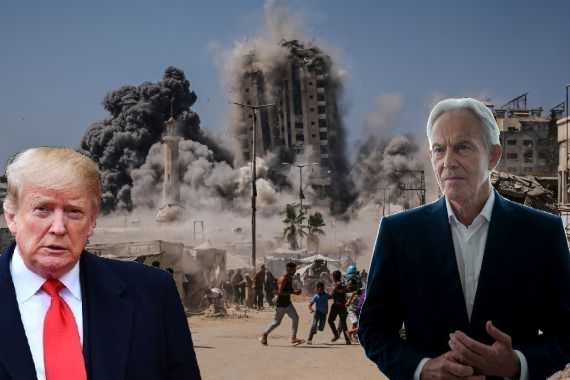
Former UK Prime Minister Tony Blair has been excluded from the list for the “Peace Council” proposed by US President Donald Trump to oversee Gaza’s post-war transition. The decision follows strong Arab and Islamic opposition to Blair’s inclusion due to his leading role in the US-UK attack, invasion, destruction and occupation of Iraq in 2003, which killed thousands of unarmed civilians.
Blair, who was initially the sole publicly known candidate for a senior position in the council, had been discussed as part of Trump’s 20-point plan announced in late September to end the war between Israel and Hamas. But, according to media sources, the backlash against his potential appointment ultimately led Washington to cancel his role.
Reports indicate that multiple Arab and Muslim governments formally objected to Blair’s involvement, a source close to Blair confirmed he “will not be a member of the Peace Council,” explaining that the council will include current heads of state and sitting officials.
The Executive Committee and Emerging Governance Framework for Gaza
British media revealed that the proposed executive committee—expected to be chaired by former Bulgarian Foreign Minister and UN Middle East Envoy Nickolay Mladenov—will serve as the interface between the US-led Peace Council and a Palestinian technical committee responsible for local administration.
The restructuring effort comes as President Trump prepares to announce the second phase of the Gaza peace initiative, including the new governance architecture for the strip ahead of Christmas.
US officials and Western diplomats told Israel’s Channel 12 that the formation of the international security force and the new administrative structure is in its “final stages,” with an announcement expected within two to three weeks.
Since the October 13 ceasefire between Israel and Hamas, the movement has handed over all living Israeli captives and several bodies, while Israel has released nearly 2,000 Palestinian detainees.
Confusion and Contradictions: Trump’s Gaza Plan Faces Early Turbulence
The Financial Times reported that Blair’s removal reflects growing disarray surrounding Trump’s Gaza plan. The proposal—co-authored in part by the Tony Blair Institute in coordination with Jared Kushner—has been criticized for lacking a clear timeline for establishing a Palestinian state, proposing a separate legal framework for Gaza and the West Bank, and risking further division between the two territories.
Palestinian Analysts: No Solution in Gaza Without the Palestinian Authority
According to Palestinian political and military experts, the stalled transition to phase two of the ceasefire agreement is rooted in three critical challenges: disarming Hamas, Israeli military withdrawal, and forming an international stabilization force.
Defense expert Maj. Gen. Samir Al-Abbara argued that the Palestinian Authority (PA) must be integrated into Gaza’s future governance, stating it is “the only body capable of assuming a sustainable administrative role” in the strip.
But, both Israel and Hamas reject enhanced PA involvement—Israel due to political considerations, and Hamas due to fears of losing control over the strip.
Who Might Replace Blair?
Political analyst Dr. Ayman Al-Raqab told Al-Mashhad that Washington may now favor Jared Kushner or presidential envoy Steve Witkoff to oversee the Gaza transition committee.
At the same time, Western reports suggest the US is considering launching Gaza reconstruction in the “yellow zone”—an area fully controlled by Israel—due to ongoing disputes over Hamas’ disarmament.
Israel currently maintains control of 53% of Gaza’s territory under phase one of Trump’s plan.
Egypt, however, has explicitly rejected any arrangements that appear to divide the Gaza Strip. Egyptian Foreign Minister Badr Abdel Aaty affirmed Cairo’s opposition to “any proposal that seeks to carve up Gaza,” adding that Egypt has already begun training Palestinian police forces to assume security duties in the strip.
Netanyahu: Phase Two Is Near, but Major Disputes Remain
Israeli Prime Minister Benjamin Netanyahu said that the transition to phase two of the US plan Is “very close,” yet major disagreements remain unresolved—especially concerning the deployment of a multinational security force.
Netanyahu plans to meet President Trump at the end of the month to discuss ending Hamas’ rule in Gaza, ensuring Israeli security requirements, and moving forward with the next phase of the ceasefire plan.
The ceasefire—now in its second month—continues to be marred by mutual accusations of violations from both sides.
Disarmament of Hamas: The Central Sticking Point
Dr. Al-Raqab noted that disarming Hamas remains the most contentious issue. He added that Qatar and Turkey have proposed freezing Hamas’ weapons rather than dismantling them, Israel insists on complete disarmament, and Hamas rejects both options.
Regarding PA participation, he noted that the Authority has roughly 5,000 employees in Gaza who could assume administrative roles, but internal political obstacles—particularly President Mahmoud Abbas’s reluctance to initiate reforms or elections—complicate this pathway.
Hamas officials stressed that the proposal for an international force to forcibly disarm the resistance had never been discussed with the movement.
Political analyst Wissam Afifa argued that Blair’s removal represents the first significant crack in the U.S. plan for Gaza’s transitional phase.
Israeli Military Escalates Tensions: The “Yellow Line” Declared a New Permanent Border
During a controversial visit inside Gaza, Israeli Army Chief Lt. Gen. Eyal Zamir declared the “yellow line” —a boundary drawn under Trump’s plan to mark temporary Israeli deployment—as a new long-term border and an advanced defensive line for Israel.
Under phase one of the plan Israel was to gradually withdraw from areas west of the yellow line, the line was to remain temporary, and it was intended solely to separate civilians from military forces.
However, Israel has since built over 20 permanent military outposts along the line, installed concrete barriers and surveillance towers, constructed paved military roads, and effectively transformed the temporary boundary into a de facto border.
This development suggests a strategic shift toward long-term occupation of roughly 210 square kilometers—more than half of Gaza’s territory.
Zamir’s comments contradict Netanyahu’s assurances about progress toward phase two, raising concerns about internal contradictions between Israel’s military and political leadership.
A Direct Violation of Trump’s Peace Plan
Transforming the yellow line into a permanent border constitutes a serious breach of the Trump plan, which stipulates that Israel must gradually withdraw, civilians must regain access to their homes and farmland, and the buffer zone must not become a tool for demographic or territorial engineering.
Instead, the new reality threatens permanent displacement of thousands of Palestinians, fragmentation of Gaza into separate zones, and undermining humanitarian access and reconstruction efforts.
A Peace Plan in Crisis
Israel’s entrenchment along the “yellow line” threatens to derail the entire framework before phase two even begins.
With Trump expected to unveil the next stage of his plan soon, Gaza’s political landscape remains unstable, contested, and hostage to competing regional and international agendas.
Steven Sahiounie is a two-time award-winning journalist

