


Steven Sahiounie, journalist and political commentator
The regional security architecture of the Middle East and Eastern Mediterranean appears to be entering a new phase of realignment, as multiple overlapping defense initiatives take shape amid intensifying geopolitical competition. According to reports by Bloomberg, Turkey is engaged in advanced negotiations to join a strategic defense framework with Saudi Arabia and Pakistan, potentially giving rise to a new trilateral security bloc with far-reaching implications.
Discussions between Ankara, Riyadh, and Islamabad have reached an “advanced stage,” with a strong likelihood of a formal agreement. If finalized, the pact would bring together three states with distinct yet complementary strategic assets.
Saudi Arabia would anchor the alliance economically and politically as the only Arab member of the G20 and a central actor in the Islamic world. Pakistan would contribute its status as the only Muslim-majority nuclear-armed state, along with its growing defense-industrial base. Turkey, meanwhile, would add operational experience as the second-largest military in NATO and a country deeply involved in multiple regional theaters.
In September 2025, Saudi Arabia and Pakistan signed a Strategic Mutual Defense Agreement (SMDA), committing both sides to treat an attack on one as an attack on the other—an arrangement conceptually similar to NATO’s Article 5, though without NATO’s institutional depth. Turkey’s potential accession would significantly elevate the agreement’s strategic profile.
Pakistan is close to finalizing a $1.5 billion arms deal with the Sudanese Armed Forces, which are backed by Saudi Arabia and Turkey in their confrontation with the UAE-supported Rapid Support Forces. The package includes Karakorum-8 (K-8) light attack aircraft, more than 200 reconnaissance and strike drones, and advanced air-defense systems. A retired Pakistani air marshal described the deal as “essentially finalized,” adding that JF-17 fighter jets—jointly produced by Pakistan and China—may also be included.
Turkey and Pakistan have increasingly emerged as major arms exporters. Ankara’s combat drones have played a decisive role in Ukraine’s war against Russia and in multiple regional conflicts, while Pakistan has steadily expanded its aircraft, drone, and missile exports across Africa and the Middle East.
I interviewed Pakistan-based political analyst Sabtain Ahmed Dar, an academic and policy strategist, specialized in international relations, global political economy and strategy. He gave me the following personal analysis on the situation.
“In September 2025, Pakistan and Saudi Arabia signed a Strategic Mutual Defense Agreement (SMDA), committing to treat an attack on one as an attack on both, similar in principle to NATO’s Article 5 collective security concept. With Turkey likely to become part of it next. As it brings NATO experience.
Keep an eye on Somaliland. Israel recognizes it, but both Pakistan and Saudi Arabia rejected it. Because Israel has a puppet regime in Somaliland and they aim to establish future military bases on it.
Israel Greek alliance is mainly focused on security, energy routes (Eastern Mediterranean gas), and balancing Turkey’s assertiveness in the region. It has also drawn in EU/NATO support and reflects Western bloc dynamics.
But this new Muslim security cooperation is not simply a “response to” the Israeli-Greek alliance; it’s driven by broader security uncertainties, shifting US influence, and intra-regional rivalries (especially with Iran’s role and tensions involving Israel).
Pakistan is the main player behind everything concerning new securing dynamics. It aimed at entering Libya. Look what happened with its Western backed military command in Turkey.
Also, Saudi Arabia’s pivot toward Asian partners (Pakistan, and potentially Turkey) reflects concerns about over-reliance on the US and aims to share defense burdens with like-minded regional actors.”
Despite deep historical ties, Turkey and Saudi Arabia have not always seen eye to eye. Ankara’s support for the Arab Spring movements was perceived by Riyadh as a direct threat to regional stability, and the two countries clashed in Libya, Egypt, and broader ideological alignments.
However, since 2021, relations have improved markedly. A normalization process has coincided with converging interests in key theaters such as Syria and Sudan. The Israeli war on Gaza and its regional repercussions have further narrowed differences among several Muslim-majority states, reinforcing the sense that existing security arrangements may no longer be sufficient.
At the same time, Saudi–Emirati relations have shown visible strain, particularly in Yemen, where Riyadh has backed forces opposing the UAE-supported Southern Transitional Council. These divergences have encouraged Riyadh to explore broader and more diversified security partnerships.
Former Qatari Prime Minister Sheikh Hamad bin Jassim bin Jaber Al Thani has publicly supported the emergence of a broader regional defense arrangement. He described the Saudi–Pakistani defense agreement as a significant step toward safeguarding regional security and argued that Turkey’s inclusion would give the pact greater strategic depth.
Bin Jassim emphasized that any such alliance should not be framed as being directed against Iran, stressing that Tehran remains a major Muslim country and that regional security must not be built on sectarian or confrontational logic. He called for Gulf states to join the framework without delay, arguing that smaller states stand to benefit the most from collective security mechanisms.
While a Muslim-majority security framework is taking shape, Israel has simultaneously deepened its military cooperation with Greece and Cyprus. The three countries signed a 2026 joint military action plan in Nicosia, covering joint exercises, specialized working groups, and structured strategic dialogue.
Reports indicate discussions on forming a rapid-response force of approximately 2,500 troops—around 1,000 each from Israel and Greece, and 500 from Cyprus—designed for swift deployment during crises rather than permanent stationing. Air and naval components would support the force, with potential deployment zones including Rhodes, Karpathos, Cyprus, and Israeli bases.
This cooperation is widely viewed as part of a broader strategy to deter Turkish activity in the Eastern Mediterranean, particularly regarding maritime boundaries, energy exploration, and infrastructure security. The framework is also closely aligned with European Union and NATO strategic interests and Western-backed energy corridors, including Eastern Mediterranean gas projects and regional interconnector initiatives.
Despite the momentum, some analysts urge caution.
I interviewed former Turkish diplomat Aydın Sezer, who feels reports about a NATO-style defense alliance should be viewed skeptically. He suggests that Ankara’s engagement may resemble earlier initiatives such as Turkey’s outreach to the Shanghai Cooperation Organization or BRICS—useful for signaling strategic autonomy but constrained by NATO obligations.
Sezer notes that while Saudi Arabia and Pakistan can engage in meaningful defense cooperation with Turkey, the pact is unlikely to evolve into a fully institutionalized collective security system. He also argues that it is unrealistic to frame the arrangement as a counter-bloc to Israel, particularly as Saudi Arabia is widely expected to join the Abraham Accords in the foreseeable future.
Instead, he believes the most plausible outcome is enhanced defense-industrial collaboration, arms development, and joint military exercises rather than a binding mutual defense organization.
From Islamabad’s perspective, Pakistan has quietly positioned itself as a pivotal actor in emerging security dynamics, leveraging its military capabilities and defense exports to expand influence from the Gulf to North Africa. Saudi Arabia’s growing outreach to Asian partners reflects concerns about overdependence on the United States and a desire to diversify security guarantees.
Meanwhile, concerns persist over Israel’s activities in Somaliland, which it recognizes as an independent entity. Both Saudi Arabia and Pakistan have rejected this recognition, viewing it as part of a broader Israeli strategy to establish future military footholds near the Red Sea and Gulf of Aden.
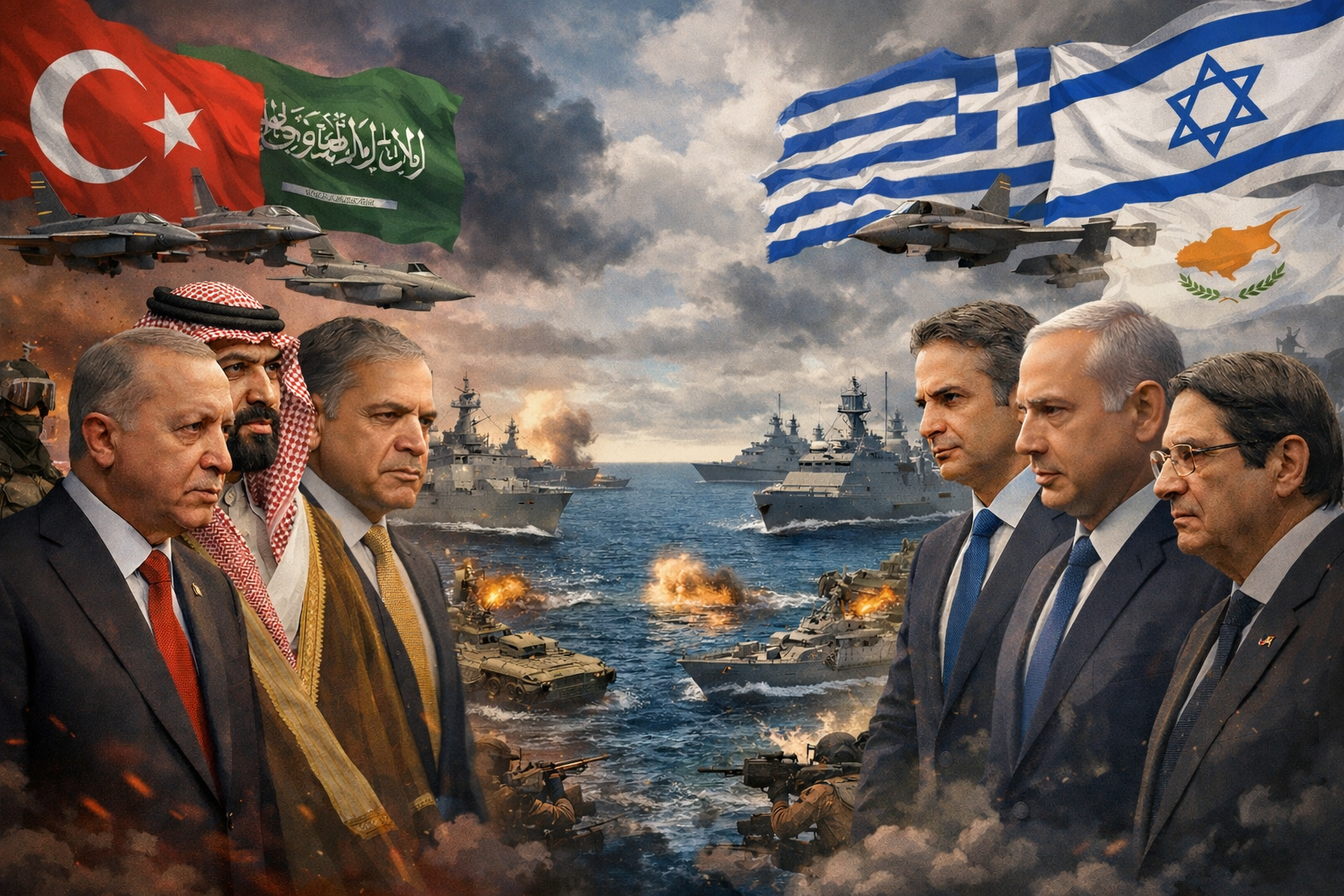
Rather than a single, coherent bloc, the region appears to be witnessing the emergence of parallel security architectures: a Muslim-majority defense cooperation framework centered on Saudi Arabia, Pakistan, and potentially Turkey, and a Western-aligned Israel–Greece–Cyprus axis focused on Eastern Mediterranean security and energy routes.
These developments reflect declining confidence in traditional security umbrellas, shifting U.S. regional engagement, and intensifying competition over influence, resources, and strategic geography. While none of these initiatives may fully replicate NATO-style collective defense, together they signal a profound transformation in how regional actors perceive and pursue security in an increasingly fragmented international order.
Steven Sahiounie is a two-time award-winning journalist.

