


By: Dragana Trifković، Journalist and political commentator
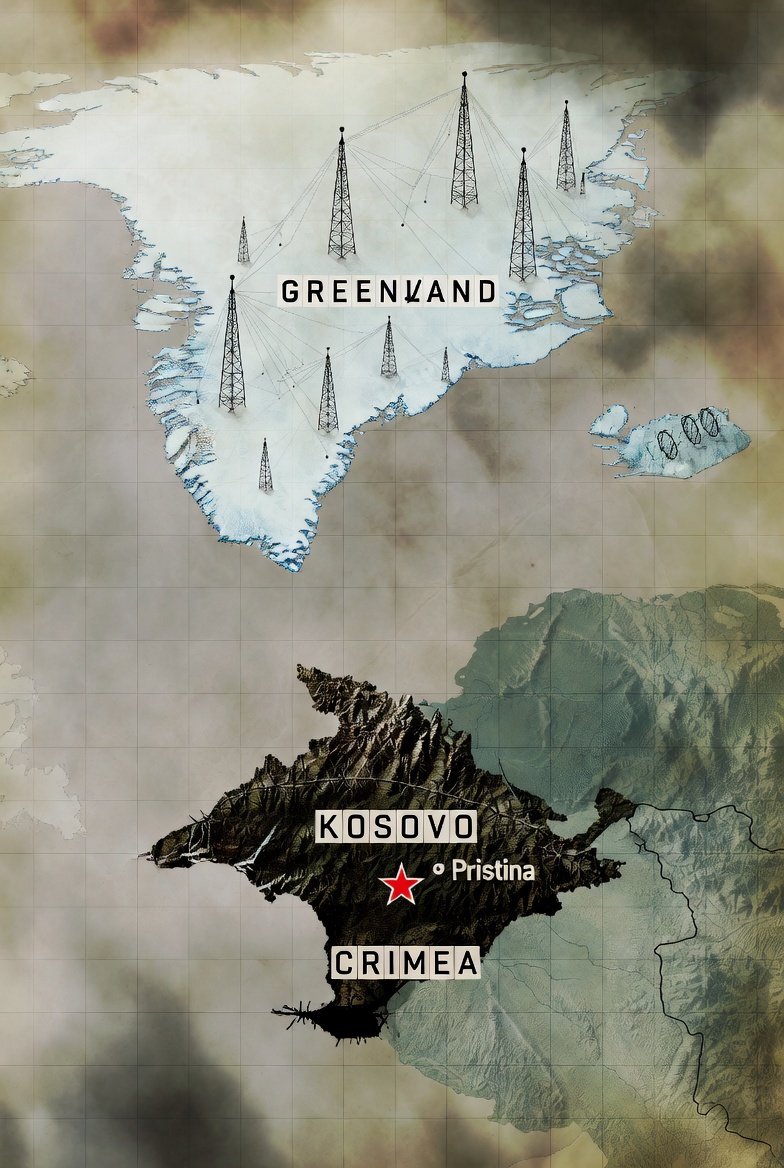
In George Orwell’s novel Animal Farm, one slogan stands out in particular: “All animals are equal, but some animals are more equal than others.” The farm satirically depicts a society in which “all are equal,” yet some (the pigs) enjoy privileges, while the same actions are punished when committed by others. Principles change whenever convenient, representing a classic example of hypocrisy and double standards. The policy of the European Union can rightly be described as the policy of an “animal farm.” The cases of Kosovo, Crimea and Greenland reveal a deep contradiction in the EU’s foreign policy. The Union consistently defends territorial integrity and sovereignty when the states in question are its members or allies, while at the same time supporting or recognizing the secession of Kosovo and strongly condemning the reunification of Crimea with Russia. This shows that, just like on Orwell’s farm, rules apply only when they suit the interests of the “elite,” while others bear the consequences. Hypocrisy and double standards in this context clearly indicate that the values of law, democracy and sovereignty are applied selectively, in line with geopolitical interests.
Guaranteeing Sovereignty: Greenland in the Context of European Foreign Policy
“The European Union will continue to uphold the principles of national sovereignty, territorial integrity and the inviolability of borders. These are universal principles, and we will not stop defending them — especially when the territorial integrity of an EU member state is called into question,” said European Commission spokesperson Anitta Hipper at a press conference in Brussels, responding to Trump’s statements about Greenland.
It was further stated that the EU expects all partners to respect sovereignty and international obligations, and that Greenland, as an autonomous territory within the Kingdom of Denmark, should determine its future together with Denmark.
Greenland is part of the Kingdom of Denmark, which is a full member of the EU, so any attempt by the United States to annex the island would represent direct pressure on the territorial integrity of a member state — something the EU cannot ignore without risking its own credibility. Although Greenland itself is not a member of the Union, it holds the status of an Overseas Country and Territory (OCT) associated with the EU, and the European Union has significant financial, economic and regulatory interests on the island, particularly in the sectors of fisheries, energy and critical minerals. Moreover, Greenland is a geostrategic key to the Arctic. Control over it provides oversight of new maritime routes, military infrastructure and access to rich natural resources. The EU is therefore concerned that a unilateral American takeover would not only endanger the interests of a member state, but also further marginalize Europe in shaping the Arctic security architecture.
Kosovo, Crimea and Greenland: Selective Application of International Law in the European Union
The position of European officials regarding Greenland is entirely opposite to their stance on Kosovo and Metohija. Most EU member states, including France, Germany and Italy, recognized the self‑proclaimed independence of Kosovo in 2008. This political act directly contradicts the principle of firm support for territorial integrity and calls into question the territorial wholeness of Serbia. Under international law, state borders cannot be changed without the consent of the state concerned — a rule that applies both to Serbia in the case of Kosovo and to Denmark in the context of Greenland. The EU treats the Kosovo issue as a “special case,” but in essence it is a political move inconsistent with the principle of territorial integrity that the Union officially emphasizes in other situations.
Although most EU institutions and member states recognized Kosovo without an agreement with Belgrade, several countries (Spain, Slovakia, Romania, Cyprus and Greece) still have not done so, mainly due to internal separatist or national sensitivities. Nevertheless, the EU continues to provide financial and institutional support to Kosovo as a separate economic and political entity, thereby effectively confirming its self‑declared statehood.
The case of Greenland clearly shows that Europe does not act on the basis of universal principles, but applies selective rules according to current political interests. While in the case of Kosovo the violation of international law is justified by “higher values” — democracy, human rights and freedom — these same values are not mentioned in relation to Greenland. This reveals that European rhetoric about law and democracy functions as a political instrument rather than a consistent practice. Such a gap between words and actions undermines the Union’s credibility and makes the Greenland case a symbol of a deeper crisis in Europe’s policy of principles.
A similar imbalance in the application of international law can be seen in the example of Crimea. In 2014, a referendum on reunification with Russia was held on the peninsula, after which Crimea became part of the Russian Federation. The democratic decision of the Crimean population provoked a sharp reaction from the EU, which condemned it as a “violation of Ukraine’s territorial integrity,” imposed sanctions on Russia and supported Kyiv. Unlike Crimea, no referendum was held in Kosovo in 2008; instead, an informal group unilaterally declared independence from Serbia.
This is why Brussels’ reaction to Trump’s statements appears not as a defense of international law, but as a defense of its own sphere of influence. It is precisely here that the European Union loses its moral argument and enters the position it created for itself in 2008 — where “exceptions” cease to be exceptions and become the rule.
Putin’s Critique and the Orwellian Metaphor: A Lesson in Political Hypocrisy
The European Union formally rejects accusations of double standards, claiming that every case in international relations represents a sui generis situation. This same argument was used to justify the recognition of Kosovo’s unilaterally declared independence in order to avoid creating a precedent. In practice, however, the EU acts selectively: the principle of territorial integrity is defended when EU member states or allies are concerned, while the right to self‑determination is emphasized when it serves the geopolitical interests of Brussels and Washington.
The gap between rhetoric and actual policy is clear to outside observers, yet within the Union there is a reluctance to address it openly. Acknowledging double standards would amount to political and legal self‑disqualification for the EU: it would undermine its credibility as a “normative power,” weaken its position in international institutions, and open the door for the same arguments to be used against it. For this reason, Brussels does not admit the problem directly but instead relativizes it through exceptions, special circumstances and legal constructs. However, this strategy gradually erodes trust in the EU and diminishes its credibility on the global stage.
The Union’s reaction is also symbolic: if it were to accept that the United States openly questions the territory associated with an EU member state, the EU would be acknowledging its own political weakness and dependence on Washington. The internal logic of Euro‑Atlantic relations further indicates that Europe increasingly acts asymmetrically in relation to the United States, where European interests are not a priority.
In conclusion, the cases of Kosovo, Crimea and Greenland clearly demonstrate that a lack of principled policy always carries consequences. When principles are applied selectively, and the values of law, democracy and territorial integrity are used as instruments of geopolitical interests, credibility is lost, and an environment is created in which political leaders become targets of ridicule, criticism and loss of authority.
In this context, Vladimir Putin recently referred to European leaders as “piglets,” criticizing their policies toward Ukraine and their relations with the former U.S. administration. This metaphor functions as an illustration of Orwell’s satire: leaders guided by personal or short‑term interests rather than consistent principles eventually become objects of mockery and lose their moral and political weight. Anyone in politics who disregards universal principles must understand that such hypocrisy is never without consequences — it leads to a loss of trust, a weakening of position and, ultimately, public disgrace.

