


Steven Sahiounie, journalist and political commentator
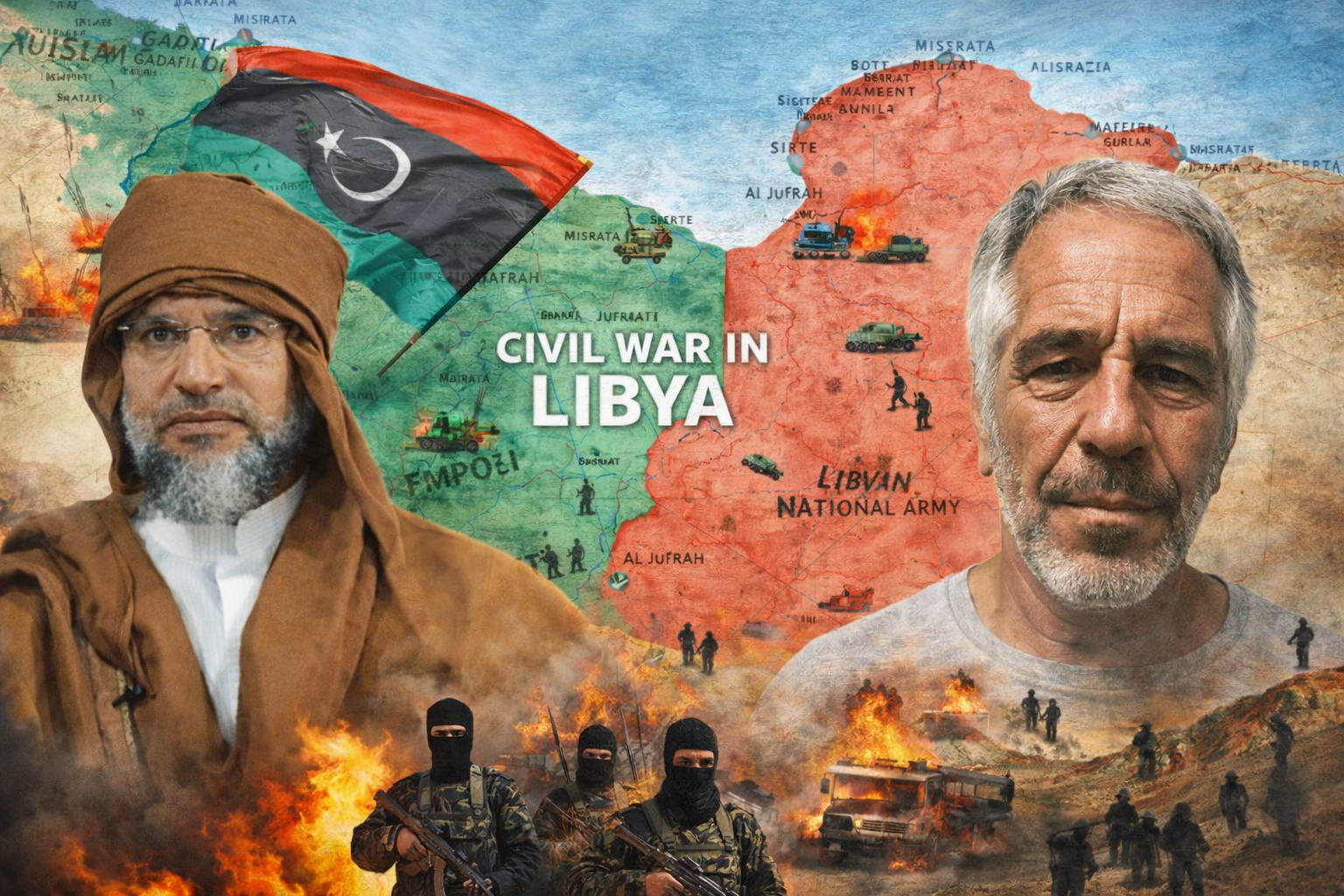
Saif al-Islam, 53, Muamar Gaddafi’s son, was killed in Zintan where he had been based since 2011.
The 2008 PhD holder from the London School of Economics had in June 2011 announced that his father was willing to hold elections and to step down if he did not win; however, NATO rejected the offer, and the bombardment of Libya continued.
Saif al-Islam’s father and brother, Mutassim, were killed in Sirte on October 20, 2011.
On January 30, documents released by the US government included an email to Jeffrey Epstein dated July 2011 describing the huge amount of money to be made off the US-NATO attack on Libya. About $80bn in frozen Libyan funds, including roughly $32.4bn in the US, were available for the taking, with UK’s MI6 and Israel’s Mossad both willing to assist Epstein and his associate.
The Rise and Fall of the “Reformist”
Saif al-Islam was long viewed as the modernizing face of his father’s regime. Educated in Austria and the UK, he spearheaded Libya’s diplomatic reintegration with the West in the early 2000s, negotiating the resolution of the Lockerbie bombing compensation and the dismantling of Libya’s nuclear weapons program.
During the 2011 ‘Arab Spring’ he warned of “rivers of blood” and a civil war that would consume Libya’s oil wealth. Following his father’s ouster and death, Saif was captured in the desert and held in Zintan for nearly a decade. Despite being sentenced to death in absentia by a Tripoli court in 2015 and sought by the International Criminal Court (ICC) for crimes against humanity, he was eventually released under a general amnesty law in 2017.
In 2014, Seymour M. Hersh published “The Red Line and the Rat Line” exposing the US-NATO war against Libya and Syria, both cloaked in the disguise of ‘freedom and democracy’ building.
In 2012, President Obama gave his famous “Red Line” speech, promising US military action against the Assad regime in Syria. Washington’s intelligence sources knew the armed opposition in Syria had chemical weapon capabilities, but ignored the facts on the ground. Obama chose to not act on his “Red-Line” promise in the end.
The “Rat Line” beginning in 2012 was a CIA operation (Timber Sycamore) in which arms captured by the US in Libya were shipped to the armed opposition in Syria, via a port in Turkey.
Mahdi al-Harati is an Irish-Libyan who commanded the Tripoli Brigade in the US-NATO war on Libya. Later, he followed the CIA weapons transfers to Syria and commanded the Liwaa Al-Umma, an armed opposition group.
In the US and its allies, the Syrian and Libyan armed opposition groups were called ‘freedom fighters’, but to the unarmed civilians who they targeted they were ‘terrorists’ and affiliated by Al Qaeda, and later ISIS.
The US-NATO war on Libya was “to protect civilians”, and was air support for armed groups fighting Muammar Gaddafi, which included extremists, and led to a post-conflict rise in terrorism.
The anti-Gaddafi coalition was diverse, and included members of extremist Islamic groups and fighters previously associated with al-Qaeda-linked groups.
Following the fall of the Qaddafi regime, the country became a hotbed for terrorist groups and the NATO-backed uprising allowed groups like Al Qaeda and ISIS to establish a foothold in the region.
The Impact on National Reconciliation
Saif al-Islam’s death marks a radical shift in the “National Reconciliation” process led by the Presidential Council. As a candidate for the aborted 2021 presidential elections, he represented a significant constituency—those nostalgic for the stability of the former regime and those disillusioned by the decade of chaos that followed.
Political Fallout
The 444 Combat Brigade is a powerful unit, affiliated with the Tripoli-based Government of National Unity (GNU). They issued a categorical denial of involvement in the Zintan clashes. The brigade emphasized it has no military presence in Zintan and had no orders to pursue Gaddafi.
A vacuum of leadership is created after Saif al-Islam’s passing. The “Green” movement (loyalists to the former regime) has lost its most prominent figurehead, potentially fracturing the group or driving it toward new alliances.
Regional tensions will follow the news of his death. Pro-Gaddafi strongholds like Beni Walid and parts of Zintan saw popular and armed mobilizations, raising fears of a renewed cycle of internal violence.
A Nation Divided
The death of Saif al-Islam occurs against the backdrop of a country still split between two rival administrations: the UN-recognized Government of National Unity (GNU) in Tripoli, led by Abdulhamid Dbeibeh, and the Government of National Stability (GNS) in the east, supported by the House of Representatives and Field Marshal Khalifa Haftar.
Critics of the Western intervention in 2011 argue that the U.S.-NATO campaign destroyed Libya’s institutional fabric without providing a viable alternative. Today, Libya remains what UN former envoy Stephanie Williams described as a “redistributive kleptocracy,” where a transactional ruling class utilizes state resources for personal gain while basic social services for the population continue to deteriorate.
While Libya and Syria both underwent a US-NATO attack beginning in 2011, Syria has begun a recovery after the December 2024 ouster of Assad. But, Libya continues to be divided into two main parts with competing ideology and interests.
The Syrian leadership under President Ahmed al-Sharaa has denounced Al Qaeda, ISIS and other banned terrorist groups. Both Syria and Libya have not held elections yet, but Damascus is attempting to keep the country secure. Libya is not yet secure, with competing ideologies and energy resources interests hampering reconciliation between the various players.
A Closed Chapter
For some, the death of Saif al-Islam Gaddafi closes the final chapter of the 2011 revolution. For others, it represents the loss of a potential, albeit controversial, bridge to the past that might have stabilized the future. As Libya navigates this sudden vacuum, the international community watches closely to see if this event will catalyze a genuine move toward elections or if it will serve as a spark for the “rivers of blood” Saif al-Islam himself once predicted.
Steven Sahiounie is a two-time award-winning journalist.

