


Steven Sahiounie, journalist and political commentator
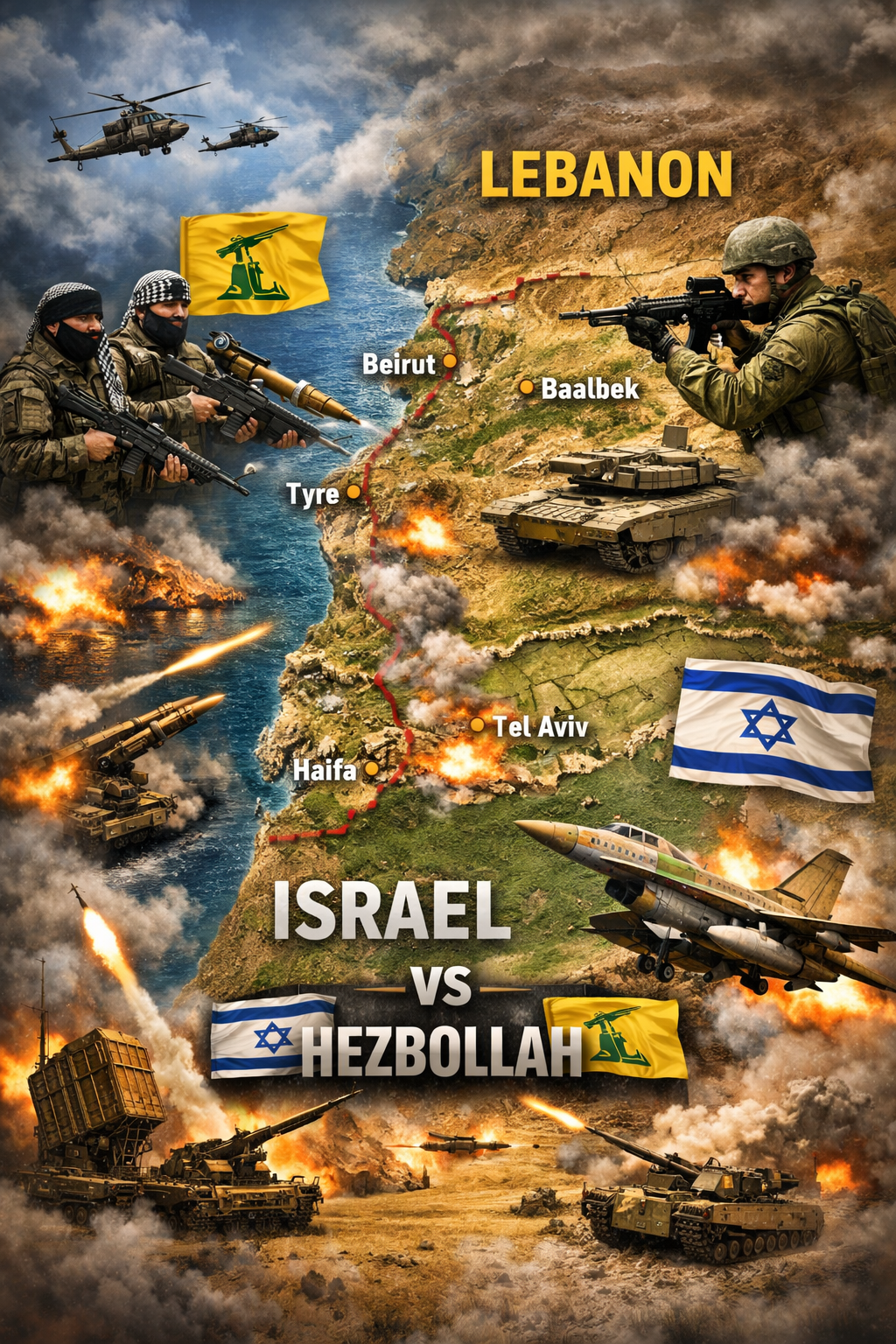
Lebanon has been thrust into the epicenter of a widening regional war begun by the unprovoked attack on Iran carried out by Israel and Iran resulting in the death of Iran’s Supreme Leader, Ali Khamenei, on February 28.
Hezbollah, a Lebanese resistance group supported by Iran, began a series of cross-border exchanges, which quickly transformed into a high-stakes military confrontation, marked by Israeli ground incursions, intensive aerial bombardments, and a landmark—yet controversial—decision by the Lebanese government to ban Hezbollah’s military activities.
The current wave of Israeli attacks surged after Hezbollah launched a high-profile missile attack on an Israeli military installation, citing “retaliation” for the killing of Khamenei. While Hezbollah’s domestic critics accuse the group of dragging Lebanon into a “war that is not its own,” some military analysts suggest the group’s recent maneuvers, including a strike on the Haifa Naval Base with “qualitative missiles,” represent a preemptive attempt to secure political leverage before an eventual regional settlement.
Hezbollah claimed responsibility for 13 separate attacks on Tuesday, asserting it destroyed at least five Israeli tanks and targeted key strategic sites, including the Ramat David Airbase and the Meron Air Surveillance Center using suicide drones.
Israel’s “Northern Arrows” Expansion
Israel has responded with overwhelming force through “Operation Northern Arrows.” Defense Minister Yoav Gallant (and successor Israel Katz) signaled a shift from containment to territorial control, instructing the IDF to seize strategic positions in southern Lebanon to prevent attacks on northern Israeli communities.
The IDF reported conducting “simultaneous strikes” on 60 targets across Beirut and as far as Tehran. In Southern Lebanon, Israeli forces have reportedly crossed the border in at least four sectors, establishing “advanced defensive” positions. Reports indicate that Israeli troops have entered the town of Al-Qouzah, occupying former Lebanese Army outposts, and are advancing toward the strategic town of Khiam.
Humanitarian Toll and Mass Displacement
The human cost of the escalation is mounting rapidly. The Lebanese Ministry of Health reported that recent strikes on Mount Lebanon, Baalbek, and the Southern Suburbs (Dahiyeh) killed at least 11 people on Wednesday morning alone, following a devastating Tuesday that saw 50 fatalities and hundreds of injuries.
The violence has triggered a massive displacement crisis with over 58,000 Lebanese citizens having fled their homes.
In a reversal of a decade-long trend, approximately 20,000 Syrians previously seeking refuge in Lebanon have fled back home across the border into Syria through the Masnaa-Judeideh Yabous and Jousieh crossings.
The IDF issued urgent evacuation warnings for 30 towns and villages in southern Lebanon, ordering residents to move at least one kilometer away from suspected Hezbollah infrastructure.
Steven Sahiounie of MidEastDiscourse has interviewed Professor Jamal Wakim, Lebanese college professor, writer, and political commentator for his opinion on the current crisis.
#1. Steven Sahiounie (SS): In your opinion, what will be Hezbollah’s response to the Lebanese government’s decisions and statements regarding the party?
Jamal Wakim (JW): In my assessment, the decisions taken by the Lebanese government do not have the capacity to be implemented. We are accustomed to differences in positions between official Lebanon, which is subject to American influence, and resistance Lebanon. Therefore, I do not believe these decisions will have any real effect. The fate of the resistance and the fate of Lebanon are ultimately decided on the battlefield. I believe the resistance is capable of enduring. The axis of conflict is linked to developments across the region; if Iran withstands the pressure, the Lebanese resistance will also endure alongside it and will be able to thwart all planned schemes.
#2. SS: Will Lebanon and Hezbollah have a share in the upcoming regional settlement?
JW: I believe Hezbollah chose to be part of this confrontation so that Lebanon and Hezbollah would have a share in the broader regional settlement. If it had marginalized itself from what is happening in the region, Lebanon would have become vulnerable to unfolding events. The resilience of the resistance, in my view, is what will prevent Lebanon from being subjected to a geopolitical map imposed by Israel, thereby allowing Lebanon to survive.
Steven Sahiounie of MidEastDiscourse turned next to Khalil Harb—the Beirut-based veteran journalist and former editor-in-chief of Al-Safir— as he offered his insights into the current escalation.
Harb noted that the current trajectory suggests a conflict that is no longer bound by previous “rules of engagement,” pointing toward a protracted struggle where the psychological and physical resilience of the Israeli interior will be the ultimate testing ground.
As history appears to repeat itself on the hills of Southern Lebanon, the military landscape is shifting from border skirmishes to a high-stakes war of attrition. Reports and footage of Lebanese Army units repositioning away from the border have coincided with Israel’s stated intent to occupy additional strategic points within Lebanese territory. In response, the Resistance has intensified its operations, launching a significant attack on the Samaqa site, with Israeli reports confirming damage to at least one tank, according to Harb.
The Iranian Doctrine: Targeting the “Internal Front”
For Tehran, the priority has shifted toward destabilizing the Israeli home front. Strategic analysts suggest a stark disparity in the capacity for national endurance: while Iran, facing what it perceives as an existential struggle, might be prepared to sustain immense casualties, there is significant doubt regarding Israel’s ability to endure weeks of consistent bombardment and thousands of civilian casualties, wrote Harb.
According to Harb, the conflict remains in its opening stages, with initial Iranian responses targeting “civilian-nature” areas across various regions. Lessons from the 12-day war in June revealed a critical strategic divide:
Strategic Protection: Israel achieved a “reasonable” level of success in shielding sensitive sites, including military command centers, airbases, and nuclear facilities.
The Civilian Achilles’ Heel: When Iranian strikes pivoted toward “open cities” and densely populated residential zones, the impact was profound and painful.
By focusing on these vulnerabilities, Iran aims to achieve a three-fold objective:
Internal Distraction: Forcing the Israeli government to prioritize domestic chaos over external military gains.
Economic and Human Parity: Inflicting losses that mirror the scale of Iranian and Lebanese casualties.
Deterrence: Thwarting any long-term plans for a sustained aerial campaign against Iran itself.
A Fractured Political Landscape
Domestically, the Lebanese government has taken the unprecedented step of announcing an immediate ban on Hezbollah’s military and security activities. This decision has polarized the nation. Supporters see it as a vital move to reassert state sovereignty and halt Israeli aggression, while skeptics fear the decree may remain “ink on paper” given Hezbollah’s entrenched power.
Simultaneously, the political process remains paralyzed. Lebanese leaders recently reached a consensus to postpone parliamentary elections, citing the prevailing instability and the need for a clearer electoral framework—a move that critics argue further highlights the erosion of democratic institutions during wartime.
Regional Reinforcements
As the conflict intensifies, Syria has reportedly moved to fortify its Western borders. Sources indicate that the Syrian Army has deployed thousands of troops and rocket launchers—including Grad and Katyusha units—to the Homs and Tartus countryside. While Damascus claims these moves are intended to curb smuggling and prevent the infiltration of armed groups, the buildup has heightened international concerns regarding a broader regional conflagration.
Steven Sahiounie is a two-time award-winning journalist.

