


Steven Sahiounie, journalist and political commentator
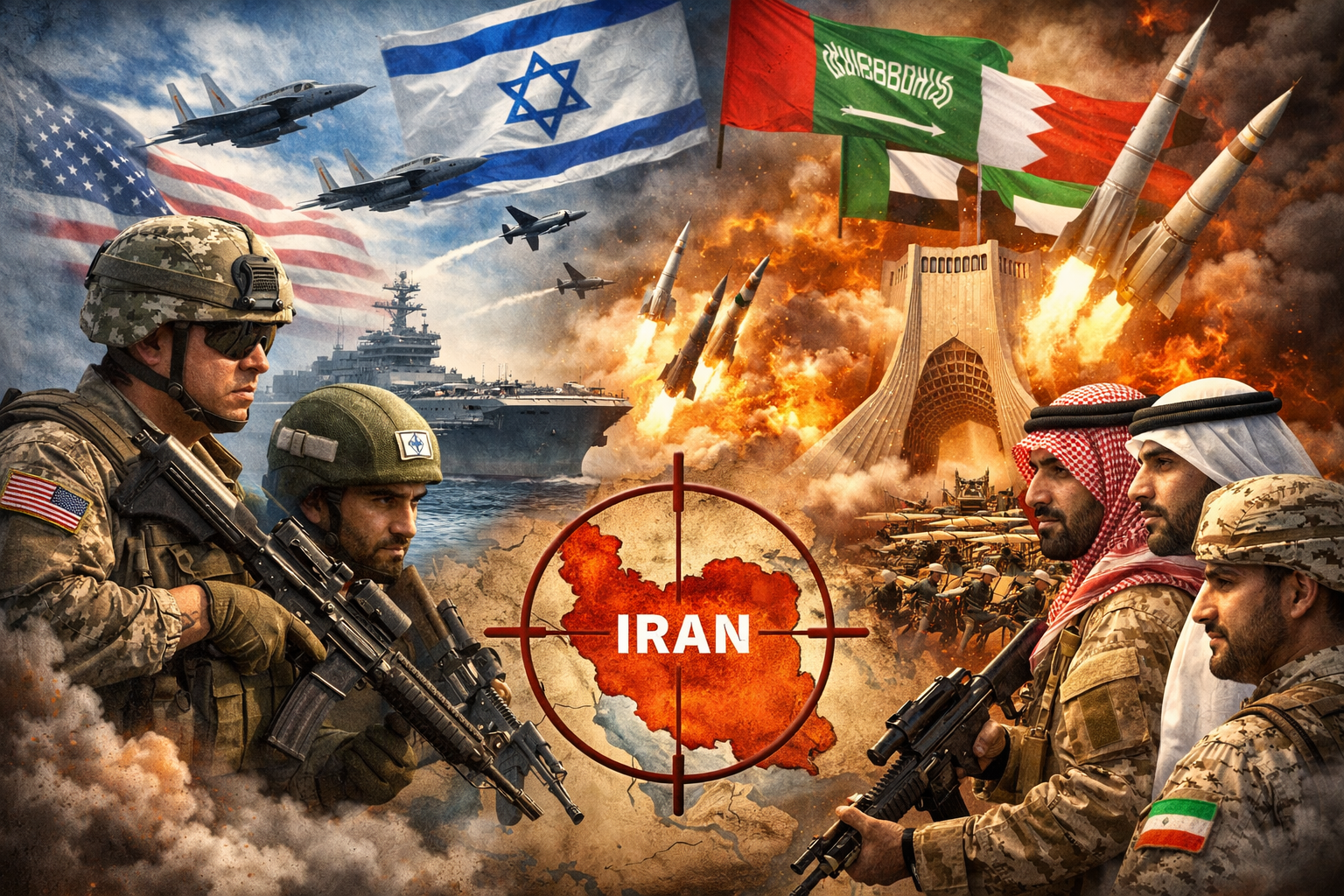
According to unnamed sources reported by the Times of Israel, senior officials from multiple Gulf capitals have said a significant shift is underway in regional strategy. Some key states, according the Israeli media, are in favor of continuing the Israeli-U.S. war on Iran in order to substantially degrade Iran’s military capabilities
According to four high-ranking officials speaking on condition of anonymity, countries such as United Arab Emirates, Saudi Arabia, Qatar, and Bahrain are increasingly aligned on the need to ensure that Iran emerges from the war significantly weakened and unable to pose a continued regional threat.
From Caution to Conditional Support for Escalation
Prior to the outbreak of hostilities, Gulf governments had warned U.S. President Donald Trump against initiating a war with Iran, fearing precisely the kind of regional spillover now unfolding. However, following direct Iranian strikes on Gulf territory—including civilian and energy infrastructure—those same states are now quietly urging Washington to continue its military campaign, according to Israeli media.
One senior Gulf diplomat explained that while skepticism remains regarding how the United States and Israel are managing the war, the strategic priority has shifted decisively.
“Ending the war while Iran retains the tools It is currently using against Gulf states would be a strategic catastrophe,” said the anonymous diplomat to the Israeli media.
Iranian Retaliation Backfires
Iran launched attacks not only on its direct adversaries, but also on all six members of the Gulf Cooperation Council—Kuwait, Oman, Qatar, Saudi Arabia, United Arab Emirates, and Bahrain. Tehran had repeatedly warned over a span of decades, that should an existential war be thrust upon Iran by the U.S., then the numerous U.S. military bases in the region, with substantial American personnel, would be targeted.
It comes as no surprise to any in the Gulf states that they are being targeted by Iran, and suffering deaths, injuries and material damages to property as well as the huge damages to their source of income after the Strait of Hormus has become impassable.
The Gulf states knew this was a possible price to pay for American military security, including advanced air defense systems. However, those air defenses have not kept the Gulf safe. And this is not the first time the U.S. has left them feeling betrayed.
In 2019, the Saudi Aramco facilities at Abqaiq and Khurais were attacked by missiles fired from Yemen. It was a shock and left Riyadh increasingly skeptical of U.S. security systems which did nothing to protect from the significant attack.
In 2025, Israel attacked Qatar in an upscale residential area in Doha’s West Bay Lagoon area, killing at least six people, including Hamas members and a Qatari security official, amidst ceasefire negotiations. Again, the Qataris and their neighbors asked: where are the air defenses we pay the Americans so dearly for? All the U.S. bases in the Gulf are fully funded by the host countries, but they are beginning to feel they have not gotten a return on their investment.
Common Ground Between Iran and its Arab Neighbors
The Gulf Arab states share many commonalities with Iran, and those are divergent from the Israeli and American views. Besides the obvious religion and geography in common, there is the core value that the Palestinians people deserve to be free from occupation.
In 2024, the International Court of Justice (ICJ) declared Israel’s occupation of Palestinian territories unlawful.
In 2025, The General Assembly of the UN, comprising all 193 UN Member States and 142 countries voted in favor of a resolution backing the immediate need for a two-state solution. Iran and Arab Gulf countries voted for, but the U.S. and Israel against the freedom of Palestine.
The Israeli war on the Palestinians in Gaza has killed over 72,000 to 80,000, with thousands more buried under rubble. Total injured exceeds 170,000, and starvation was used as a weapon of war.
The war in Gaza changed the world’s opinion of Israel, and some Arabs were caught ashamed at having held out a hand in friendship to the Jewish State. Normalization plans were put on hold in the aftermath of the genocide.
Iran’s resistance ideology is a foundational doctrine born from the 1979 Islamic Revolution, combining religious ideals with anti-imperialist, anti-U.S., and anti-Israel stances. It frames Iran as a protector of the oppressed, utilizing proxies (Axis of Resistance) to project power and avoid direct conflict. Analysts point to the various proxies: Hamas, Hezbollah, Houthis and the Iraqi resistance groups as the reason Israel keeps attacking Iran, Lebanon, Yemen and Gaza. The current war is not so much about the nuclear issue, as it is to degrade Iran’s capability to support the various proxies.
Current War Thinking
Some Arab officials may feel Iran represents an immediate and systemic threat that must be neutralized.
The strikes have caused casualties and significant disruption to oil, gas, and tourism sectors—pillars of Gulf economies.
Most Arab civilians and leadership in the Gulf, such as in Qatar and Saudi Arabia, largely prefer to avoid a direct war with Iran, prioritizing regional stability and economic development over military conflict, even after enduring, recent Iranian drone and missile strikes on their territory. While some, like Saudi leadership, have expressed a desire for enhanced deterrence against Iranian actions, there is no widespread public sentiment for a direct attack.
Gulf nations generally favor de-escalation and finding ways to coexist as neighbors, recognizing that a full-scale war is not in their interest.
Diverging Views Within the Gulf
Despite growing consensus, not all Gulf states share the same level of support for continued attacks. Oman stands out as a key dissenting voice, advocating for rapid de-escalation.
Omani Foreign Minister Badr Albusaidi wrote in The Economist that both Iran and the United States have a clear national interest in ending hostilities as soon as possible.
Even among states favoring continued attacks enthusiasm varies. Officials note that the UAE appears among the most assertive, while others remain cautious about the duration and scope of escalation.
In a notable development, several Gulf countries—including Saudi Arabia and the UAE—are now actively considering joining U.S. and Israeli military operations against Iran.
This would mark a historic shift from years of foreign policy.
Recent moves suggest this shift is already underway as Saudi Arabia has reportedly allowed U.S. forces to use King Fahd Air Base for operations.
The UAE is tightening economic pressure, including scrutiny of Iranian-linked assets and institutions.
Discussions are ongoing about freezing billions in Iranian holdings.
Saudi Arabia: Balancing War and Diplomacy
Saudi Arabia finds Itself navigating an exceptionally complex geopolitical position. While it did not seek this war, it cannot remain insulated from Its consequences.
Although a China-brokered rapprochement between Saudi Arabia and Iran in 2023 temporarily reduced tensions, it did not resolve the underlying strategic rivalry.
Now, Saudi leadership Is pursuing a dual-track approach in maintaining diplomatic channels with Tehran, while simultaneously reinforcing deterrence through military readiness and new alliances
Analysts point to the emergence of a broader regional defense framework involving Saudi Arabia, Turkey, and Pakistan—a potential group aimed at balancing Iranian influence.
This alignment combines Pakistani missile and nuclear capabilities with Saudi financial and geopolitical weight, and Turkish defense technology.
While officially framed as defensive, its strategic goal includes countering Iran more independently of Washington.
Economic Fallout and Global Risks
The war is already inflicting severe economic damage. Qatar Energy has suspended LNG production, regional airspace closures have canceled over 40,000 flights, and oil prices have surged, with warnings they could reach $200 per barrel if the Strait of Hormuz is disrupted.
Saudi Arabia’s Vision 2030—dependent on foreign investment and stability—is particularly vulnerable.
A Region on the Brink
Gulf leaders are now applying intense pressure on Washington to ensure that any end to the conflict comes only after Iran’s military infrastructure is significantly degraded.
At the same time, they recognize a difficult reality: they may soon have to participate directly in the conflict to restore deterrence.
As one official put It, “We tried to avoid this war. Now we may have no choice but to shape its outcome.”
The fact that the current war began with an unprovoked attack by Israel and the U.S. amid ongoing and productive negotiations with Iran has left the region in a state of shock, waiting for the other shoe to drop.
Steven Sahiounie is a two-time award-winning journalist.

