


Steven Sahiounie, journalist and political commentator
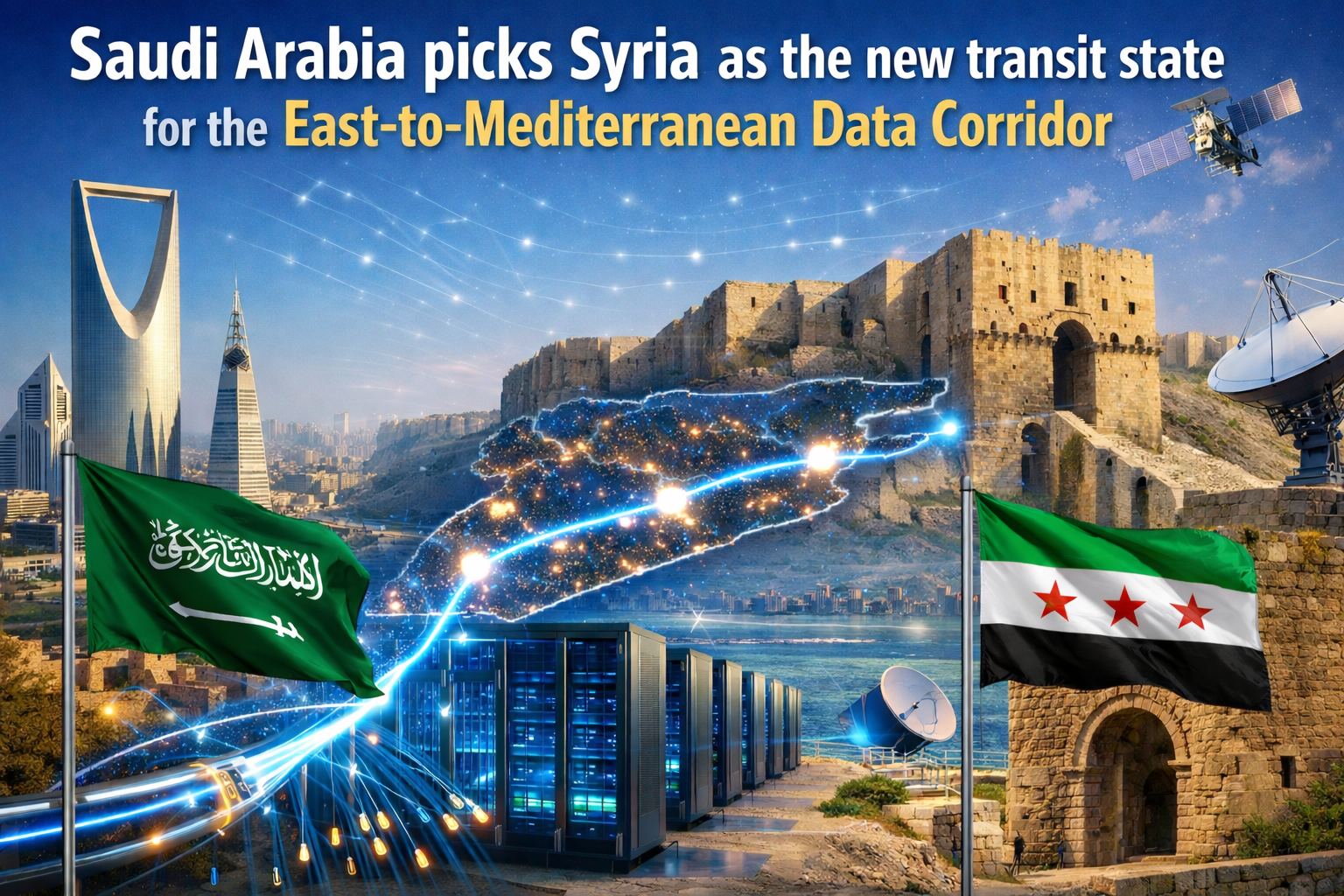
Saudi Arabia has planned to designate Syria as the primary transit country for the East-to-Mediterranean Data Corridor (EMC), a major fiber-optic cable project linking the Kingdom to Greece and Europe. This marks a significant shift from the original route, which was planned to pass through Israel.
The EMC project was announced in 2022 as a partnership involving Saudi Telecom Company (STC), Greece’s Public Power Corporation (PPC), Greek telecommunications firms, and satellite applications companies.
Originally, the cable route was designed to pass through Saudi Arabia, Jordan, and Israel before reaching Greece. However, normalization talks between Saudi Arabia and Israel stalled following the outbreak of the Gaza war on October 7, 2023, prompting Riyadh to reconsider the project’s geopolitical alignment.
STC has since announced plans to invest approximately $800 million in Syria’s telecommunications infrastructure, including the construction of a fiber-optic network exceeding 4,500 kilometers. Saudi and Greek banks have also signed agreements to finance 60 percent of the overall project.
This shift strengthens Damascus’s role in regional energy and data connectivity and could place Greek-Israeli strategic cooperation under new pressure amid changing Eastern Mediterranean alliances.
Saudi Arabia is moving decisively to enter the Syrian market and position itself as a primary partner in rebuilding the country across political, economic, and technological sectors. Riyadh, under the leadership of Crown Prince Mohammed bin Salman, is focused on ensuring that Saudi Arabia becomes Syria’s largest supporter, helping the war-torn nation recover after years of devastating conflict that destroyed much of its infrastructure and economy.
Saudi-Syrian relations are not new. Ties between Riyadh and Damascus span decades and, according to regional experts, have demonstrated resilience even during periods of political tension. Today, the Crown Prince is working to ensure Saudi Arabia secures the largest share in Syria’s reconstruction while also leveraging Syria’s critical geopolitical position as a regional transit hub.
Regional Sources Confirm Strategic Route Change
According to regional sources cited by Middle East Eye, Saudi Arabia is actively seeking to reroute the fiber-optic cable through Syrian territory instead of Israel. Officials stated that Riyadh’s insistence on connecting with Athens via Damascus reflects its broader strategy to elevate Syria’s regional position and potentially isolate Israel from emerging connectivity networks.
A Western official familiar with Saudi investment strategy stated that “Damascus lies at the heart of Saudi Arabia’s regional connectivity vision,” adding that Riyadh wants major infrastructure—including roads, railways, and data cables—to pass through Syrian territory.
Industry experts note that telecommunications companies worldwide are actively seeking alternative land routes between the Indian Ocean and the Mediterranean, and Syria could become a viable option if political and regulatory stability improves.
Expanding Beyond Data: Electricity Interconnection Plans
Saudi Arabia is also considering an electricity interconnection project linking the Gulf to Europe through Syria using high-voltage direct current (HVDC) transmission technology. Such a project would further solidify Syria’s role as a strategic energy and data transit hub connecting Asia, the Middle East, and Europe.
These initiatives reflect Saudi Arabia’s broader effort to use its financial resources to strengthen regional allies and expand its influence amid competition with other regional powers.
Greece’s Strategic Role and Eastern Mediterranean Competition
Greece is positioning itself as a major gateway for data flows between Europe and the Middle East, particularly as Gulf countries expand investments in artificial intelligence infrastructure and data centers.
Historically, Marseille and Genoa served as Europe’s main cable landing points. However, new routes are shifting eastward, placing Greece and Turkey in increasingly important positions.
Several Eastern Mediterranean infrastructure projects—including gas pipelines and power interconnections involving Greece, Cyprus, and Israel—have faced delays or cancellation due to political disputes and regional rivalries.
Economic, Technical, and Geopolitical Benefits for Syria
If implemented, the project could deliver major benefits to Syria, including:
Increased international bandwidth capacity
Reduced latency and faster connectivity
Improved reliability through redundant network routes
Development of internet exchange points and data centers
Acceleration of 5G deployment and cloud computing infrastructure
Economic advantages:
Long-term revenue from transit fees
Job creation for engineers and technical professionals
Expansion of private sector telecommunications companies
Attraction of foreign investment
Geopolitical advantages:
Strengthening Syria’s role as a digital bridge between Europe and the Gulf
Enhancing its regional strategic importance
Supporting broader economic reintegration
However, these benefits depend heavily on political stability, infrastructure protection, regulatory transparency, and sanctions mitigation.
Expert Analysis on Regional Realignment
Kristian Coates Ulrichsen, a Gulf specialist at the Rice University Baker Institute, stated that Saudi Arabia’s attempt to include Syria instead of Israel reflects a major regional realignment.
He explained that the move aligns with Saudi Arabia’s strategy to reintegrate Syria into the regional system while reducing tangible connections with Israel.
Exclusive Statements to Journalist Steven Sahiounie
In an exclusive statement to journalist Steven Sahiounie, Syrian engineer Muhannad Sultan explained the strategic importance of rerouting the fiber-optic cable through Syria.
Sultan said the project represents a long-term technological and economic opportunity with far-reaching strategic implications.
From an engineering perspective, routing the cable through Syria would provide the country with significantly greater international data capacity, measured in terabytes, as well as lower latency measured in microseconds. It would also create a backup route that improves the reliability of Syria’s national network.
Journalist Steven Sahiounie interviewed Mouhannad Sawas, a Syrian Network administrator at the Syrian Ministry of Energy.
According to Sawas, “The potential rerouting of Greece-Saudi fiber connections through Syria rather than Israel represents a significant geopolitical shift in digital infrastructure. This move appears strategically timed amid regional tensions, potentially isolating Israel while economically rehabilitating Syria.”
“While possibly improving regional connectivity across the Arab world, the technical and security challenges of routing through war-torn Syria cannot be overlooked. The stability of infrastructure in a country still experiencing conflict raises legitimate reliability concerns,” added Sawas.
Sawas said, “This decision illustrates how digital infrastructure increasingly mirrors traditional power dynamics, with telecommunications becoming another arena for expressing diplomatic alignments and tensions in the Middle East.”
“The fiber-optic rerouting could provide Syria with critical infrastructure investment after years of devastating conflict, potentially creating jobs and technical training opportunities for Syrians,” said Sawas.
According to Sawas, “The project would reconnect Syria to global digital networks, enhancing internet reliability and speeds that could support economic recovery and attract further foreign investment.”
“Transit fees for hosting this vital digital corridor could generate much-needed revenue for Syria’s depleted treasury while establishing diplomatic leverage with Saudi Arabia and Greece,” added Sawas.
Sawas finally said, “This initiative might signal Syria’s gradual reintegration into regional economics and politics, potentially accelerating the normalization of relations with neighboring countries and beyond.”
A Transformational Project with Global Implications
The East-to-Mediterranean Data Corridor represents more than a telecommunications project. It is a strategic initiative that could reshape digital connectivity across the Middle East and Europe.
Saudi Arabia’s decision to route the corridor through Syria underscores Riyadh’s ambition to reshape regional infrastructure, strengthen its geopolitical influence, and position itself as a global digital leader.
For Syria, the project could mark a turning point—transforming it from a war-damaged state into a critical hub in the global digital economy.
Steven Sahiounie is a two-time award-winning journalist.

