


Steven Sahiounie, journalist and political commentator
Cairo hosted on Wednesday the fifth meeting of the Consultative Mechanism for Enhancing Coordination of Peace Efforts in Sudan, bringing together representatives of regional and international organizations and key international stakeholders. Among the participants was Ramtane Lamamra, the Personal Envoy of the UN Secretary-General for Sudan. The meeting called for renewed momentum toward a humanitarian truce that would pave the way for a sustainable ceasefire and a comprehensive political settlement that preserves Sudan’s unity.
Statements made by the US Special Envoy for Sudan, Tom Perriello, during the Cairo meetings reflected a clear shift in Washington’s approach, emphasizing the primacy of a political solution to the Sudanese crisis. Perriello stressed that a military solution is no longer a viable option.
Perriello called for a comprehensive humanitarian truce to enable the delivery of aid, describing it as an indispensable first step toward a lasting ceasefire and the launch of an inclusive, Sudanese-led political process supported by regional and international actors.
Egyptian Foreign Minister Badr Abdel Aaty reaffirmed Cairo’s view that the International Quartet represents a central mechanism for unifying regional and international efforts to end the conflict in Sudan. He emphasized that any resolution must begin with a humanitarian truce, followed by a comprehensive political process that safeguards state institutions and prevents Sudan’s fragmentation.
This convergence between Cairo and Washington reflects a growing international trend toward a phased political solution that starts with halting violence and alleviating humanitarian suffering, ultimately leading to a comprehensive settlement that prevents Sudan from sliding further into instability and disintegration.
On the sidelines of the fifth consultative meeting, Saudi Deputy Foreign Minister Waleed Al-Khuraiji met with Richard Crowder, Head of the UK Sudan Unit and the United Kingdom’s Special Representative for Sudan. The discussions focused on the latest developments in Sudan and ongoing peace efforts, as well as issues of mutual interest, according to a statement from the Saudi Ministry of Foreign Affairs.
Hours before the arrival of UN High Commissioner for Human Rights Volker Türk in Port Sudan, security forces in Dongola, northern Sudan, prevented activists from organizing a sit-in in solidarity with detainees. Legal experts warn that these detainees face the risk of execution due to their calls for peace and an end to the war that has continued since mid-April 2023.
According to activists and human rights organizations, the number of politically motivated detainees exceeded 4,500 by the end of 2025. They report that security groups fully controlled by elements of the Muslim Brotherhood (MB)—such as the “Special Operations Forces” and the Operations Authority—are conducting widespread arrest campaigns targeting anti-war activists and participants in the 2019 revolution that overthrew the MB-backed regime. These networks, which were dismantled after the revolution, regained influence following General Abdel Fattah al-Burhan’s October 2021 coup against the civilian transition.
The MB is banned in many countries: Saudi Arabia, UAE, Egypt, and Russia. The Trump administration has discussed possibly banning the group in USA. The platform of the MB holds the same goals as ISIS: to have world dominance of Islam as the only form of government. The ruling party in Turkey has been linked to the MB.
Legal experts have warned of a sharp escalation in violations against civilians, accusing MB-linked elements within the security apparatus of using repression to silence political opponents.
Observers argue that the army-led authority is seeking to suppress human rights activists and civilians to avoid future legal accountability for widespread abuses committed before and during the war. They have cautioned UN High Commissioner Volker Türk against being drawn into what they describe as an attempt to conceal evidence of mass violations, particularly through his planned visit to the Al-Dabba camp in northern Sudan, established in October. Critics say the visit is part of an effort to engineer a distorted map of violations that excludes their true geographic scope.
Recent arrests of political activists following the army’s entry into Khartoum, as well as during December protests commemorating the 2019 revolution, have further exposed what activists describe as a systematic campaign against anti-war voices and the re-entrenchment of MB dominance.
Analysts link the escalation of violations to the growing control of MB-affiliated brigades over Sudan’s security institutions. They point to a fundamental shift in the definition of “enemy” during the current war, whereby anyone calling for peace or opposing the MB’s agenda is labeled a threat to the state.
International relations expert Al-Tom Haj Al-Safi stated: “The MB’s security brigades are ideological militias created to protect a political project that uses violence as a tool. The most dangerous equation in Sudan’s modern history has been normalized: whoever opposes these militias is accused of opposing the nation itself. This is not mere propaganda, but a systematic attempt to silence dissent and criminalize accountability.”
Recent reports indicate that Al-Baraa Brigades have come to dominate some of the most repressive security units, including the Special Operations Forces and the Operations Authority.
The Muslim Brotherhood’s Regional Strategy
Observers argue that the MB exploits political crises in countries such as Sudan, Yemen, and Syria to regenerate itself and expand its influence. They note that the US administration has chosen Egypt and Jordan as reference points for sending political messages regarding the limits of the group’s activities, despite its official ban in both countries.
They also point to a recent MB meeting in Istanbul—held without official Turkish sponsorship—as evidence of ongoing efforts to export the organization and rebrand it politically. Analysts accuse the group of exploiting religious discourse, including the Palestinian cause, to generate financial gains, reportedly raising billions of dollars in recent months through Turkey-based charities.
China–Sudan relations remain a significant factor in the conflict’s international dimension. China is currently one of Sudan’s largest trading partners, importing oil and exporting low-cost manufactured goods.
Sudanese Foreign Minister Omar Siddiq met his Chinese counterpart Wang Yi, who reaffirmed Beijing’s support for restoring peace and stability in Sudan.
In April, Sudan’s Foreign Ministry summoned the acting Chinese ambassador in Port Sudan to explain how the RSF obtained Chinese-made FH-95 strategic drones. The envoy denied any link between China and the RSF.
Beijing’s Strategic Calculations
China’s approach to Sudan focuses on protecting its economic and strategic interests through balanced relations. It supports political stability, opposes foreign intervention and sanctions, and prefers behind-the-scenes diplomacy. Sudan occupies a strategic position within China’s Belt and Road Initiative, particularly due to its Red Sea coastline and natural resources.
China has repeatedly called for a ceasefire and a peaceful political solution and has appointed a Special Envoy for the Horn of Africa to enhance diplomatic engagement. Beijing also provides aid and infrastructure projects as part of its post-conflict positioning strategy.
Illicit Gold and the War Economy
International reports indicate that between 48% and 60% of Sudan’s gold production is smuggled through unmonitored land borders and airports. A 2025 report by Swissaid documented a 70% increase in illicit gold flows from Sudan to the UAE in 2024 alone. Neighboring countries such as South Sudan, Chad, and Ethiopia have become transit hubs where Sudanese gold is re-exported under altered certificates of origin, making gold a central fuel for the continuation of the conflict.
Humanitarian Crisis Deepens
The World Food Programme (WFP) warned on Thursday that food aid in Sudan could run out within two months due to severe funding shortages. Without immediate additional financing, millions of people will be deprived of life-saving assistance within weeks. The WFP confirmed that food rations have already been reduced to the bare minimum needed for survival and that its food stocks will be exhausted by the end of March.
The War on the Ground
Sudan’s civil war erupted just over a year ago, following a violent power struggle between the Sudanese Armed Forces (SAF) and the Rapid Support Forces (RSF), former allies who jointly carried out a coup before turning on each other. Civilians continue to bear the brunt of the conflict.
Areas overrun by the RSF and allied Arab militias have reported widespread looting, ethnic violence against non-Arab communities, and systematic sexual assaults. UN Envoy Ramtane Lamamra has continued efforts to de-escalate tensions, urging both sides to refrain from fighting in El Fasher.
Great Power Competition
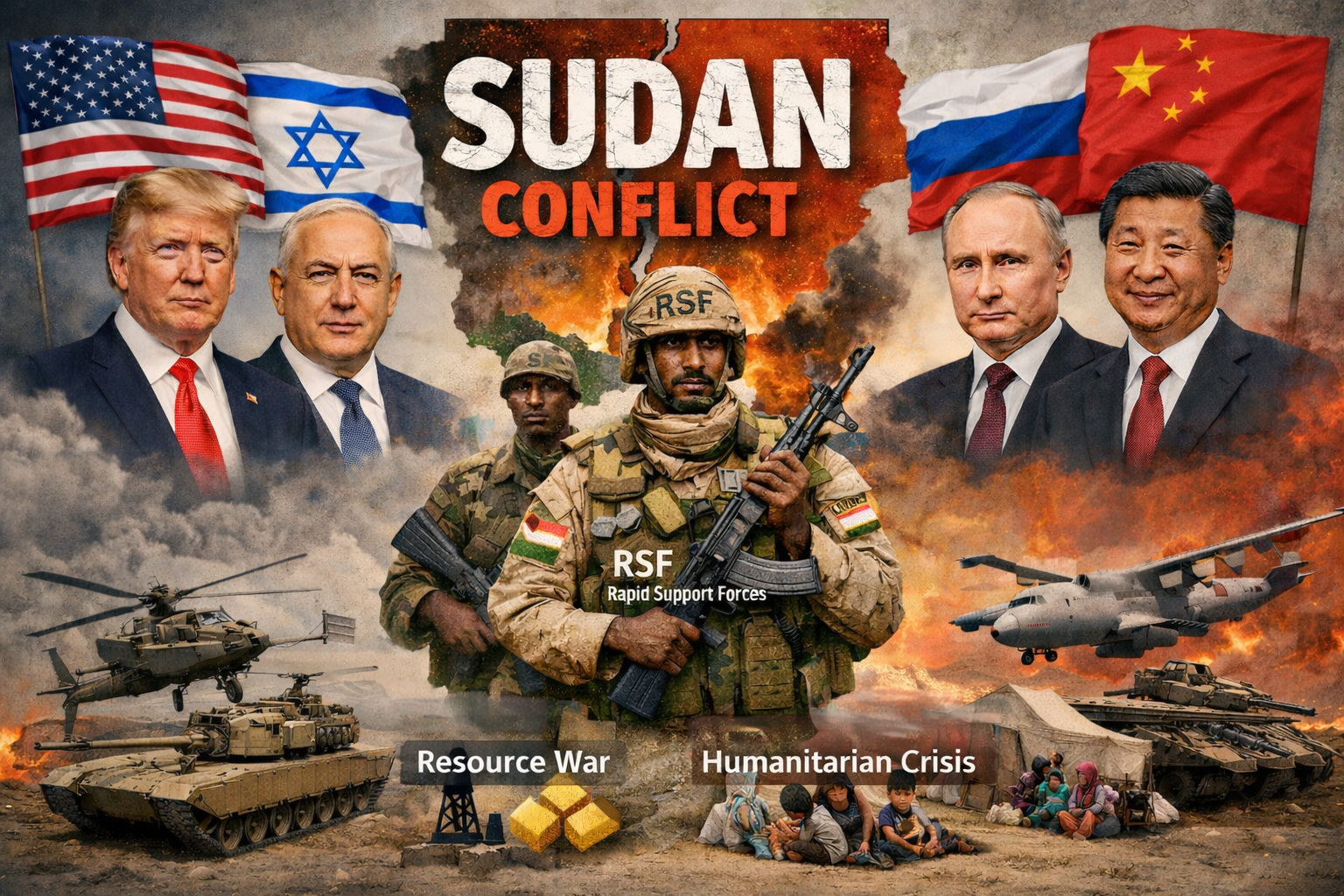
The United States is widely seen as seeking to prevent Russia from strengthening its influence in Africa, disrupt potential Russian logistics bases on the Red Sea, and limit the sovereignty of regional powers such as Egypt and Ethiopia. According to some reports, US representatives are allegedly negotiating with paramilitary groups in Ethiopia’s Amhara region to participate in the conflict alongside RSF leader Mohamed Hamdan Dagalo (Hemedti), reportedly for $140 million.
Declining China–Sudan Relations
China–Sudan relations were once strong, with Sudan ranking as China’s sixth-largest oil supplier and bilateral trade reaching $11 billion. Following South Sudan’s secession in 2011—which took with it 75% of Sudan’s oil reserves—Sudan’s strategic importance to Beijing declined, though economic ties continued and around 130 Chinese companies remain active in the country.
Relations further deteriorated after the fall of President Omar al-Bashir in 2019, a close ally of China. Subsequent transitional authorities struggled to rebuild trust, compounded by Sudan’s debt default and disputes over debt rescheduling, which featured prominently in discussions between the Chinese and Sudanese presidents at the Arab–Chinese Summit in Riyadh.
China’s interest in Sudan remains part of its broader African strategy. In 2022, China–Africa trade reached $280 billion, compared to less than $80 billion in US–Africa trade. Despite this, Beijing maintains a relatively limited on-the-ground presence in Sudan compared to American, French, Israeli, and Russian actors, contributing to its cautious and largely non-interventionist approach.
The Russa’s role in Sudan
The signing of an agreement between Russia and Sudan in February 2025 to establish a naval base represents a significant geopolitical shift in the Red Sea region. It is widely seen as an indicator of a new chapter in Moscow’s strategic expansion across Africa, following an understanding between the two sides to create Russia’s first permanent naval foothold on the eastern African coast. This development comes amid the relative decline of influence held by some traditional powers, such as France, and the intensifying international competition in Africa and the Middle East.
The move is viewed as a means to strengthen military cooperation between Moscow and Khartoum, secure vital maritime routes, and provide a launch point for Russian operations across Africa, making the base a multifunctional asset with political, security, and economic dimensions.
In 2017, the two countries signed a preliminary agreement to establish a Russian naval base in Port Sudan, a step that was widely interpreted as a strategic return of Russia to the Red Sea. However, the project faced major internal disruptions, particularly following the outbreak of the Sudanese revolution in 2019, which led to the ouster of President Omar al-Bashir. Despite the change in leadership, Sudan’s new military establishment maintained open channels with Moscow. In 2020, an agreement was signed granting Russia the right to use a naval facility for 25 years, though it was later suspended due to internal political disagreements.
On the economic front, Russian cooperation has expanded in the mining and agricultural sectors, notably through companies such as M Invest and Meroe Gold, which established direct partnerships with the Rapid Support Forces (RSF). This engagement has provided Moscow with tangible influence on the ground, particularly in Sudan’s gold-rich regions.
The proposed naval base would serve as a counterbalance to Western military power in the region, especially the US Camp Lemonnier base in Djibouti. It would undermine Western dominance and provide Russia with a critical logistical hub to sustain operations in the Indian Ocean and beyond, particularly as NATO countries increase their operational focus in this strategic area.
At the end of last year, the Russian Embassy in Khartoum denied what it described as “claims by Western media” suggesting that Sudan had rejected hosting a Russian naval base in Port Sudan on the Red Sea.
Sudan’s ambassador to Moscow, Mohamed Siraj, also dismissed these reports, stating that his country had not rejected the agreement with Russia to establish a naval base, and described the allegations as “false” and “misleading.”
The new base is expected to serve as a strategic bridge to Africa—a continent of critical importance and vast, largely untapped resources—that could support Russia’s long-term economic interests.
According to the draft agreement, the naval base is intended to support objectives related to maintaining peace and stability in the region. It is described as defensive in nature and not directed against any other state. Nevertheless, the construction of the base cannot be separated from the broader commercial and geopolitical realities shaping the region.
Steven Sahiounie, is a two time award winning journalist and political commentator

