


Steven Sahiounie, journalist and political commentator
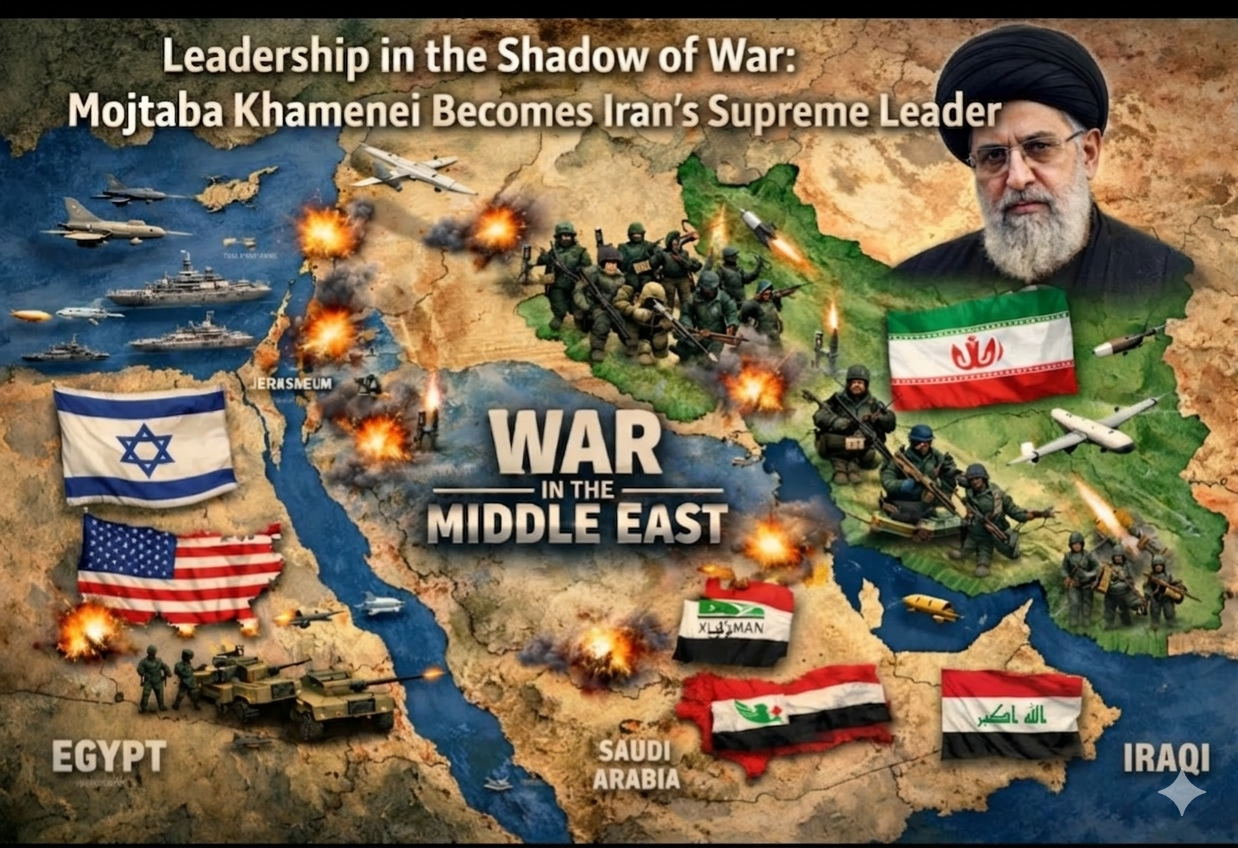
On March 8, Iran’s Assembly of Experts announced that Ayatollah Mojtaba Hosseini Khamenei has been elected as the new Supreme Leader of the Islamic Republic of Iran, succeeding his father Ayatollah Ali Khamenei, who was assassinated by a joint U.S.–Israeli military strike on Tehran on February 28.
Mojtaba Khamenei, 56, assumes the country’s highest authority at a critical moment for Iran. His predecessor and father, Ali Khamenei, led the country for more than three decades after assuming the role in 1989. The elder Khamenei was killed at the age of 86 in Tehran at the beginning of the current conflict.
The strike also killed several members of his family, including Mojtaba’s mother, his wife, and his son.
The announcement came just hours after U.S. President Donald Trump warned that any Supreme Leader chosen without Washington’s approval “would not remain in power for long.”
Trump had earlier told Axios that Mojtaba Khamenei was among the leading candidates to succeed his father but described the possibility as “unacceptable.” He also suggested that the United States should have a role in determining Iran’s next leadership, drawing comparisons to political developments in Venezuela.
Israel had also issued stark warnings prior to the appointment, stating that any successor to Ali Khamenei would be considered “a confirmed assassination target.”
The United States and Israel launched their unprovoked coordinated military campaign against Iran on February 28, resulting in the deaths of senior Iranian officials and military commanders.
As of March 10, the official death toll is 1,400 persons, including 200 children, and thousands of injuries in Iran. Israel reports 28 deaths with about 3,000 injuries. The U.S. has reported seven soldiers killed.
Mojtaba Hosseini Khamenei is widely regarded as one of the most enigmatic figures within Iran’s political establishment.
Unlike his father, he has largely maintained a low public profile throughout his life. He has never held an official government position, rarely delivers public speeches, and has given virtually no media interviews. Only a limited number of photographs and videos of him exist in public circulation.
In 2019, the U.S. Treasury Department placed Mojtaba Khamenei under sanctions, claiming he effectively represented the Supreme Leader in an official capacity despite holding no elected or formal government position.
Domestic Support and Official Pledges of Loyalty
President Masoud Pezeshkian congratulated Mojtaba Khamenei, saying the appointment “heralds the beginning of a new phase of dignity and strength for the Islamic Republic.”
Foreign Minister Abbas Araghchi stated that the selection, given the “dangerous current circumstances,” would safeguard national sovereignty and territorial integrity while strengthening national unity.
The Islamic Revolutionary Guard Corps also issued a statement expressing full support for the Assembly of Experts’ decision and affirming its readiness for “complete obedience and self-sacrifice.”
Images later circulated showing celebrations across parts of Iran, with citizens waving national flags and lighting their mobile phones In public gatherings.
As Iran enters what many officials describe as a “historic and existential moment,” Mojtaba Khamenei now assumes the role of the country’s third Supreme Leader—tasked with guiding the Islamic Republic through one of the most volatile periods in its modern history.
Steven Sahiounie of MidEastDiscourse interviewed Dr. Mahmoud Al-Hashemi, Director of the Union Center for Strategic Studies – Iraq, for his expert views on the choice of the new leader in Iran.
#1. Steven Sahiounie (SS): How do you view the selection of the new Supreme Leader of the Islamic Republic of Iran, Mojtaba Khamenei? Was his appointment a challenge to the United States and President Trump?
Mahmoud Al-Hashemi (MAH): I view the circumstances and challenges currently facing Iran and the region require the appointment of a conservative figure to the position of Supreme Leader, especially after the United States effectively ended the path of negotiations and diplomatic engagement following its recent attack on Iran and its adoption of a hard-line Israeli position.
The current historical moment for Iran requires that the position be held by a person with deep experience in the political trajectory of the Islamic Revolution since its inception. Under such conditions, Iran cannot afford experimentation or risk by appointing an unfamiliar or inexperienced figure.
Mojtaba Khamenei was very close to his father, the late Supreme Leader Ali Khamenei, which means he is more familiar with his father’s strategic thinking and vision regarding the current phase and the future. This also reassures both the religious establishment, political elites, and Iranian society as a whole.
Based on his personal background and activities, it appears that he had long been prepared for such a role, particularly after the death of former Iranian President Ebrahim Raisi, who had previously been considered a potential candidate for the position of Supreme Leader in the event of Khamenei’s passing.
Mojtaba Khamenei’s assumption of the position of Supreme Leader, and the consensus among the 88 members of the Assembly of Experts supporting his nomination, represents a strong shock to the United States and Israel, especially after President Trump publicly objected to his candidacy. This decision forms part of the broader strategy of confrontation with Iran’s adversaries and aims to block any attempts to provoke internal political change within Iran.
It also sends a clear message to the Iranian opposition that they have virtually no prospects of influencing the country’s political future, as Mojtaba Khamenei is known for his firm and uncompromising stance on this issue.
The appointment reassures the Axis of Resistance and supporters of the Islamic Revolution abroad that the revolution’s values and principles will continue along the same ideological path and objectives.
It also signals to countries seeking relations with Iran that Iranian foreign policy will remain consistent with its established principles and diplomatic foundations.
#2. SS: Despite the strikes carried out by both Israeli and American forces against Iran, Tehran remains cohesive and continues to respond militarily to the aggression. How do you analyze this, and do you believe there is a possibility that Washington and Tel Aviv could ultimately be defeated in this confrontation?
MAH: The confrontation between the United States and Iran effectively began with the Islamic Revolution in 1979, when Iranian students seized the U.S. Embassy in Tehran and detained its staff. Shortly afterward, the former Israeli embassy in Tehran was handed over to the Palestine Liberation Organization, and the Palestinian flag was raised over the building.
One of the core pillars of the Islamic Revolution has been hostility toward the United States and the objective of eliminating Israel. This doctrine was not merely rhetorical but translated into practical policy. Iran responded to U.S. sanctions by pursuing self-sufficiency, and it countered economic blockades by expanding trade relations with regional countries to export its goods. Iranian markets today are filled with locally produced and competitive products.
Furthermore, Iran’s eight-year war with Iraq provided it with significant military experience and motivated it to develop its armed forces to confront future threats. At the same time, Iran placed strong emphasis on scientific advancement, education, and the development of universities and research institutions.
Iran possesses numerous research and strategic advisory centers, and its institutions have maintained relative stability over 47 years, which has given the country a strong capacity to absorb shocks and crises and recover quickly. It is therefore not surprising that Iran reportedly prepares multiple succession options for key government positions—sometimes identifying up to four potential replacements in case a senior official dies or is incapacitated.
After the 12-day war between Iran and Israel, Iran identified several internal vulnerabilities. It intensified efforts to pursue individuals collaborating with Mossad, dismantling networks that had reportedly operated for years. At the same time, Iran began transforming the country into a major hub for artificial intelligence development, upgrading its military capabilities while also focusing on protecting key officials and identifying weaknesses among its adversaries.
Iran believes that the recent American attack was the result of Israeli pressure pushing Washington toward confrontation. Tehran is also aware of the internal crises facing the Trump administration, while the Gaza war—known as the “Al-Aqsa Flood” operation—has revived global attention to the Palestinian issue and weakened the Israeli narrative internationally.
In responding to the latest attacks, Iran relied on several principles:
Iran had given the United States ample opportunity for negotiations, but Washington ultimately betrayed the process.
The United States and Israel initiated the attack on Iran, which allowed Tehran to present itself internationally as the victim of aggression and helped unite the Iranian public behind the government in the face of external threats.
The United States failed to influence or destabilize Iranian society, despite the large financial resources and extensive media campaigns directed toward that objective.
There is a widespread belief among Iranians that their civilization is older and more deeply rooted than that of the United States, which they often describe as a relatively young state established only about 500 years ago.
Iran’s military response focused on neutralizing U.S. bases across the region and targeting radar systems, detection equipment, and missile defense systems used against Iranian missiles and drones directed toward Israeli territory.
Iranian strategy also involved harassing and tracking U.S. military personnel in the region, placing them under constant pressure and reducing their operational effectiveness.
Iran initially used conventional weapons against U.S. and Israeli positions to exhaust their missile defense systems before launching more advanced missiles and drones against Israeli targets, which, according to the Iranian assessment, inflicted heavy losses and led to Israeli setbacks.
Iran also maintains a long-term strategic objective of forcing U.S. forces out of the region, a goal it has advocated for decades.
Regional allies within the Axis of Resistance, including groups in Iraq and Lebanon, could become directly involved, and Yemen may also intervene to support Iran’s position.
The Iranian approach to war is based on strategic patience, endurance, and gradual accumulation of advantages, a method deeply rooted in Iran’s historical military doctrine.
Steven Sahiounie is a two-time award-winning journalist.

