


By: Steven Sahiounie journalist and political commentator
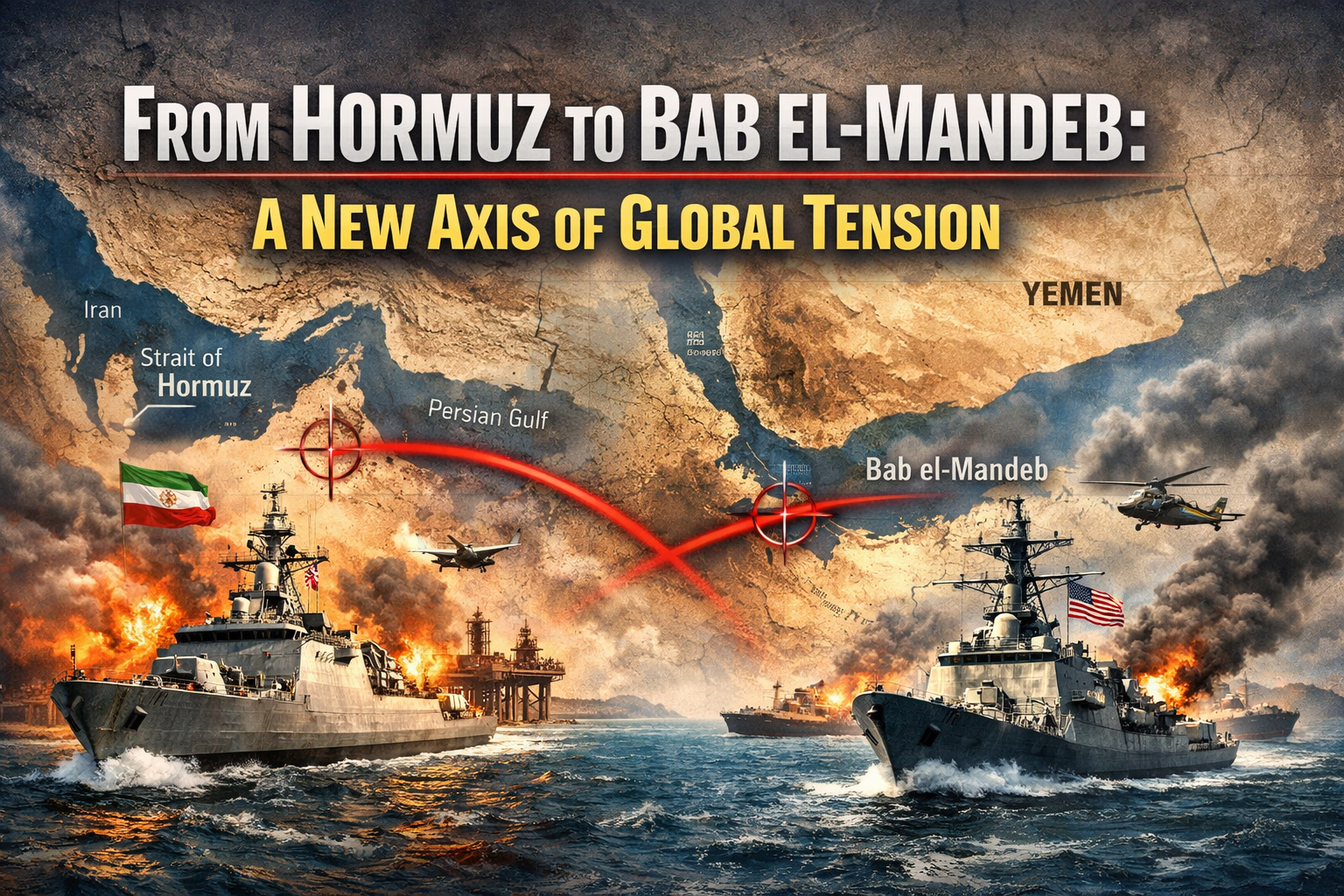
Rising geopolitical tensions across the Middle East are pushing critical maritime chokepoints—particularly the Strait of Hormuz and the Bab el-Mandeb Strait—toward a potential crisis that could trigger one of the most severe global energy shocks since the 1970s.
Recent statements attributed to a senior leader of Yemen’s Houthi movement underscore the seriousness of the situation. Speaking to Reuters, the official stated, “We are at full military readiness with all options available. The timing of any action is left to leadership. We are closely monitoring developments and know when action is required.”
Strategic Chokepoints Under Threat
The Strait of Hormuz remains the world’s most critical energy corridor. Approximately 20–21 million barrels of oil pass through it daily, representing nearly 20% of global petroleum consumption. In addition, about one-fifth of global liquefied natural gas (LNG) trade transits through this passage.
The Bab el-Mandeb Strait serves as a vital link between the Red Sea and the Gulf of Aden, directly affecting access to the Suez Canal and trade routes connecting Asia and Europe. Roughly 10–15% of global trade passes through this narrow corridor.
Together, these waterways form what analysts increasingly describe as a “maritime choke chain” stretching from the Persian Gulf to the Mediterranean.
Escalation Scenario: A Perfect Storm
The most severe scenario under consideration includes closure or major disruption of the Strait of Hormuz, Houthi escalation targeting Bab el-Mandeb, and direct military confrontation between Iran and the United States.
Such a convergence could effectively remove up to a quarter of global energy trade, creating immediate and far-reaching consequences.
Oil Price Projections
Current levels (2026): $100–113 per barrel.
Moderate escalation: $120–160 per barrel.
Severe disruption: $150–200 per barrel.
Worst-case scenario: $200–300 per barrel (temporary spike).
These projections reflect market expectations under varying levels of disruption and international response.
Supply Chain and Shipping Disruptions.
Major global shipping companies, including Maersk, CMA CGM, and Hapag-Lloyd, have already suspended transit through high-risk areas, opting instead for the longer route around the Cape of Good Hope.
This rerouting results in 10–15 additional days per journey, $500,000 to $1 million in extra cost per vessel, and with hundreds of vessels affected, additional daily costs could reach $200–400 million.
Global Economic Impact
The crisis extends far beyond energy markets.
Estimated Daily Financial Losses
Shipping rerouting involves $200–400 million, oil price increases $300–700 million, insurance and logistics $100–300 million increases.
Other indirect costs
Total estimated impact is $700 million to $1.5 billion per day, with a monthly impact of $20–45 billion in global losses.
These figures exclude secondary effects such as inflation spikes, industrial slowdowns, and financial market volatility.
Energy Infrastructure Constraints
Only Saudi Arabia and the United Arab Emirates have operational pipeline infrastructure capable of partially bypassing the Strait of Hormuz.
Saudi East-West pipeline capacity is 5 million barrels per day.
UAE pipeline to Fujairah is 1.5 million barrels per day.
However, only about 2.6 million barrels per day of spare capacity is realistically available—insufficient to offset a full disruption.
The Role of the Houthis
While a complete and prolonged closure of the Bab el-Mandeb Strait remains unlikely due to international naval presence, the Houthis have demonstrated the ability to significantly disrupt maritime traffic.
Their capabilities include anti-ship missiles, armed drones, and explosive-laden boats.
These tactics can raise risk levels, increase insurance costs, and force rerouting—effectively disrupting global trade without fully closing the waterway.
Geopolitical Dimensions
Iran’s strategic posture in the Gulf, combined with its indirect influence via Houthi forces in Yemen, creates a dual-pressure mechanism across two critical maritime fronts.
Analysts argue this structure allows Tehran toexpand the conflict beyond the Gulf, apply pressure on global trade routes, and maintain plausible deniability.
Recent signals from Iran suggest that Bab el-Mandeb could become an additional theater of conflict if escalation continues.
Broader Economic Consequences
If both straits are disrupted simultaneously, the global economy may experience severe inflation, stagflation (high inflation combined with low growth), rising fuel and food prices, and instability in financial markets.
Europe would face supply shortages from Asia, while Asian economies would see disruptions in exports to Western markets.
Egypt would also suffer from reduced traffic through the Suez Canal, with estimated daily revenue losses of $10–15 million.
While a complete and sustained closure of either the Strait of Hormuz or Bab el-Mandeb remains unlikely, even partial disruption is sufficient to destabilize global markets.
The greatest risk lies not in total shutdown, but in prolonged instability—where uncertainty, rising costs, and supply disruptions converge.
In such a scenario, the world would face not just an energy crisis, but a broader systemic shock affecting global trade, supply chains, and economic stability.
Steven Sahiounie of MideastDiscourse interviewed Syrian writer and researchers Tarek Ajib to get his insight on the latest developments in the Middle East
#1. Steven Sahiounie (SS): Ansar Allah has officially entered the conflict, raising concerns about the potential closure of the Bab al-Mandab Strait. In your view, do they have the capability to shut it down? And if they succeed, how would the United States respond? Are we heading toward further escalation or the opposite?
Tarek Ajib (TA) : The ability to close the strait exists as long as there are weapons capable of reaching ships and tankers passing through it. These vessels, especially commercial ones, generally lack their own defense systems, making them relatively easy targets. As a result, even a single attack on a ship or tanker could be enough to halt navigation, as companies would fear for the safety of crews and cargo.
This would likely push shipping companies to suspend operations and insurance companies to withdraw coverage due to the high and declared risks.
This is not a case of simple or primitive piracy like what used to occur off the coast of Somalia. Even then, it required international coalitions, including the European “Aspides” mission, to combat piracy.
In the case of Ansar Allah, they possess missiles and other weapons capable of targeting ships and disrupting navigation. Addressing this would require different types of responses and alliances that may not currently be available. Therefore, the possibility of closure or disruption is real. It is important to remember that disruption is relatively easy—it only takes a single incident to create widespread fear.
As for the American response, it does not require much speculation. Restrictions on ship passage—especially those linked to the United States or Israel—have occurred before without leading to a full closure. We have seen U.S. responses that eventually resulted in agreements with Ansar Allah.
The situation today is somewhat different, but ultimately it may be difficult for the United States to impose full security in the strait through purely military means. Therefore, closing the strait or restricting passage would be a costly pressure tool against the United States, Israel, and the global economy.
Introducing the Bab al-Mandab Strait into the conflict will have consequences that are difficult to predict in terms of escalation or de-escalation. It is tied to the broader issue of tensions involving the United States, Israel, and Iran, as well as the strategic importance of the Strait of Hormuz, which casts a heavy shadow over the global system. The direction of events in Bab al-Mandab will likely depend on developments in Hormuz.
Steven Sahiounie is a two time award winning journalist

