

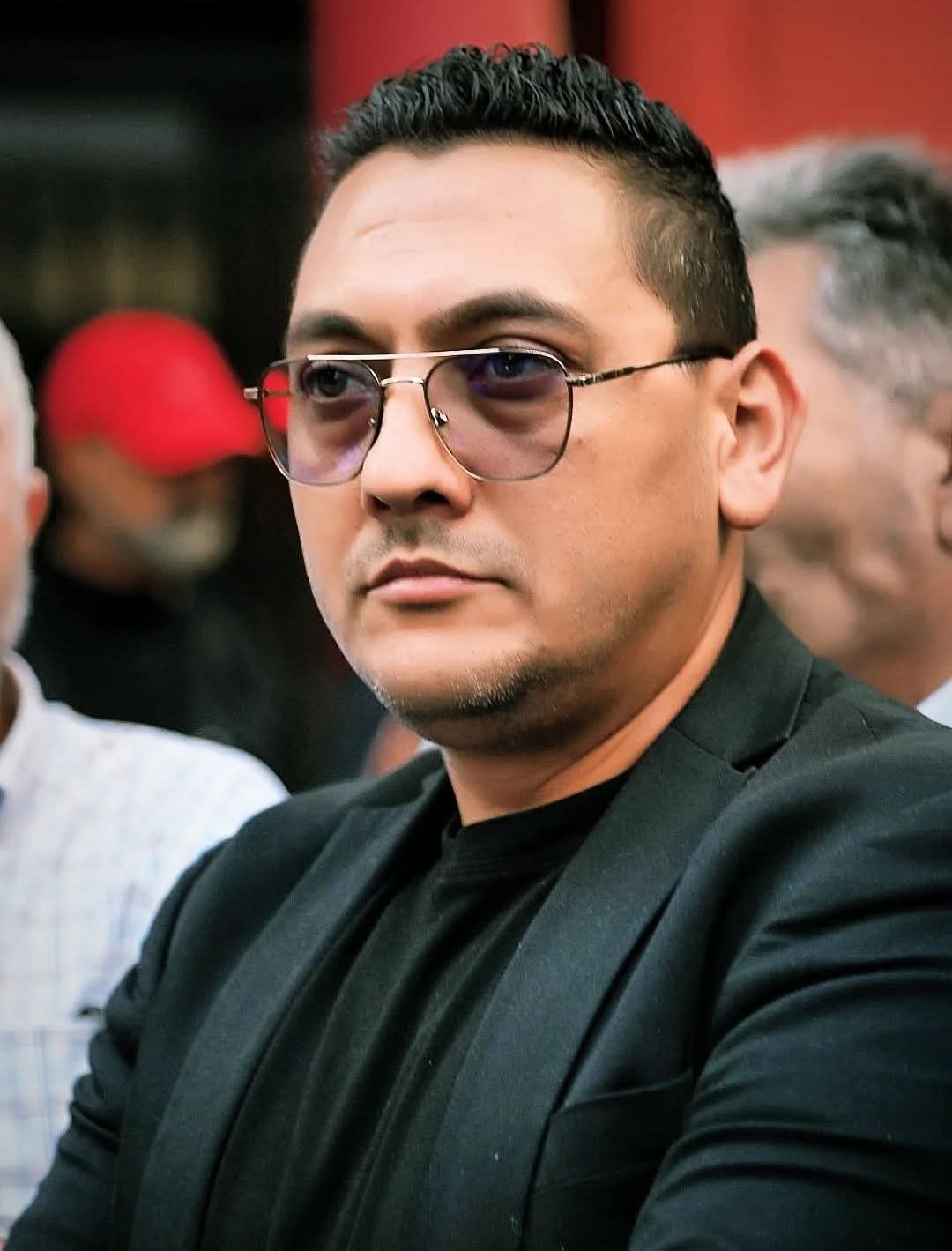

Steven Sahiounie, journalist and political commentator
The Syrian Social Nationalist Party (SSNP) in Lebanon is a secular political party and founded in Lebanon in 1932 by Antun Saadeh. It attracts members from all religions and sects. It advocates for a secular government encompassing all Lebanese people. It has taken a resistance stance and defends Lebanon against all invaders, such as Israel.
Lebanon is currently under occupation and ongoing airstrikes by the Israeli military. Israeli Prime Minister Benjamin Netanyahu has said Israel will remain occupying Lebanon even after Hezbollah has been disarmed.
Hezbollah was founded as an armed resistance group in response to the 18-years of brutal Israeli occupation of the south of Lebanon, and were successful in driving the occupiers out.
It has been the goal of the U.S. and Israel to disarm Hezbollah, and turn over the security of Lebanon to the Lebanese Army alone. This goal had been in the process, but was deliberately halted by the Israeli bombardment, occupation and total destruction of the south of Lebanon, with airstrikes continuing in central Beirut and elsewhere among locations which are not, and have never been associated with Hezbollah.
Israel has been acting with impunity because they enjoy a blazing green-light from President Donald Trump, who has sanctioned more war crimes by Israel than any U.S. President in history.
Steven Sahiounie of MideastDiscourse interviewed Lebanese journalist and official at the Syrian Social Nationalist Party
1. Steven Sahiounie (SS): Talks between Washington and Tehran were held in Islamabad, and there were conflicting statements regarding whether Lebanon would be included in the negotiations. In your opinion, will Washington accept Tehran’s conditions to include Lebanon, and what will be the reaction of the Lebanese government?
Wael Malaeb (WM): It is clear that from the very first day of announcing, or reaching a ceasefire declaration, Tehran has insisted that any ceasefire must include all fronts in the conflict. When Tehran says “all fronts,” it means Beirut, Lebanon, Iraq, Yemen, and all supporting fronts in this war, which it considers auxiliary fronts. However, in my view, we consider the Lebanese front to be the main one, because the core battle is about eliminating the resistance in Lebanon—this is Netanyahu’s battle.
As for Washington, we have also seen contradictory statements from Donald Trump—rejecting something in the morning and then agreeing to it in the evening. I believe the matter is not in Trump’s hands but in Netanyahu’s. We saw the massacre that occurred on April 8 in Beirut, its suburbs, and the mountain regions, which resulted in hundreds of martyrs and wounded. This was a reaction to the ceasefire agreement between the U.S. and Iran and a clear message from Netanyahu that he rejects this path and any ceasefire.
We know that for Netanyahu, a ceasefire means going to court and facing trial. It means defeat and failure to achieve any of his stated objectives. Therefore, Washington today does not really care whether Lebanon is included or not—it wants an agreement. Trump wants to end this war at any cost. Despite his public stance, he likely believes he has become entangled in the Middle East, suffering losses both militarily and morally, and failing to achieve key goals in Iran, including regime change. He wants to end this situation, but Netanyahu and Israel insist on continuing the war and are pressuring against including Lebanon in the agreement.
2. SS: The Lebanese government has announced that it will negotiate directly with Israel in Washington. In your opinion, why is Prime Minister Nawaf Salam insisting on normalization with Israel despite opposition from a large segment—or even the majority—of the Lebanese people?
WM: From our perspective, the current Lebanese government was brought in to implement a clear agenda. Since the election of the Lebanese president—which took place under international and regional diplomatic pressure, particularly from the Quintet Committee—it was clear that either Joseph Aoun would become president or there would be no president after a long vacuum.
Similarly, the appointment of Nawaf Salam as Prime Minister came suddenly. All expectations were pointing toward Najib Mikati, and there was an agreement on him, but suddenly Salam’s name appeared and he was brought directly from the International Court of Justice in The Hague to head the government.
It is evident that there is a prepared project for this authority in Lebanon, and its features are gradually becoming clear. Why insist on normalization? When we say normalization, we mean that those pursuing it are already in contact. For example, when the Lebanese government tasked its ambassador in the U.S. to communicate with the Israeli ambassador, they are already in daily contact.
Lebanon itself is under American political influence, so naturally its ambassador in Washington follows that policy. This normalization is therefore symbolic and part of a broader trajectory. The government wants to set precedents in Lebanon’s history—such as banning resistance activities, instructing the media not to use the term “resistance,” and attempting to reject the Iranian ambassador.
Even though these decisions were not fully implemented, they were still made. Now the government is attempting another precedent—having a Lebanese diplomat sit with an Israeli diplomat, even once. This is happening despite the fact that the majority of the Lebanese population rejects normalization.
No government under daily attacks and occupation would normally pursue such a path. Just yesterday, Israel struck a government building in Nabatieh, killing 13 members of State Security in a brutal and unprecedented manner. Despite this, the Lebanese government is racing to record this step in history.
This trajectory is being followed because it was required of this authority. It was brought in to execute this project, and it is doing so steadily. Meanwhile, a new path may emerge in Lebanon—growing public opposition, which could escalate over time, with unpredictable outcomes.
3. SS: Many experts, analysts, and politicians say that Lebanon’s fate will be determined on the battlefield alone. In your opinion, what is the impact of resistance operations on the Israeli army, and will this pressure the Lebanese government to prevent normalization?
WM: In Lebanon today, there are essentially two realities. One is the Lebanon on the ground—experiencing war, resistance, and fighters defending their villages. The other is the political and diplomatic Lebanon, which seems disconnected from reality and operating in a different world.
While officials pursue diplomatic steps like negotiations or normalization, Israel continues its attacks. For example, on the same day discussions about negotiations took place, Israel bombed a government institution, killing 13 official employees.
The battlefield ultimately has the decisive word. Israeli advances on the ground give momentum to the government’s push for negotiations, but these are two separate tracks. The more the resistance holds its ground, prevents Israeli advances, and inflicts losses—as it does daily—the more the political atmosphere shifts.
Recently, resistance rockets reportedly reached Tel Aviv, including new types such as Scud missiles, directly hitting buildings. The stronger the resistance remains, the more it influences the political landscape.
Even if agreements are signed, they may not reflect reality on the ground. For example, decisions to ban resistance activities or expel the Iranian ambassador were not actually implemented. Therefore, the battlefield remains the decisive factor.
4. SS: There is talk about returning to the 2024 agreement, but the resistance firmly rejects this. What is your reading of the end of the war?
WM: The idea of returning to the November 2024 ceasefire agreement is disconnected from reality. If the resistance had accepted that agreement, it would not have resumed fighting.
That agreement was not respected by Israel, which historically has not adhered to international resolutions since 1948. Over the following year and three months, more than 400 people were killed in Lebanon and many buildings destroyed, without any meaningful response from international sponsors or the Lebanese government.
Therefore, returning to that agreement is unrealistic. The war will not end without a new framework that restores balance—at minimum, pushing Israel back behind the Blue Line and reestablishing equilibrium.
5. SS: What is the position of the Syrian Social Nationalist Party, one of the oldest parties in Lebanon and the region, on the current events?
WM: The Syrian Social Nationalist Party’s position is principled and unchanged since its founding 93 years ago. Even before resistance movements existed, the party warned of the dangers of the Zionist project.
Today, the threats it warned about are clearly visible and widely recognized. The party has been actively confronting this threat for decades.
It remains deeply involved in the current conflict—militarily, politically, and socially. In the last round of fighting, it lost 11 members in direct combat in southern Lebanon. It continues to engage on multiple levels, including organizing protests in Beirut against normalization and in support of resistance.
The party considers itself a founder of the resistance movement in Lebanon, not merely an ally. It was among the first to advocate organized resistance against this threat.
Currently, the party is also studying escalation steps on the domestic front to confront what it sees as the government’s push toward normalization.
Steven Sahiounie is a two-time award-winning journalist.

