


Steven Sahiounie, journalist and political commentator
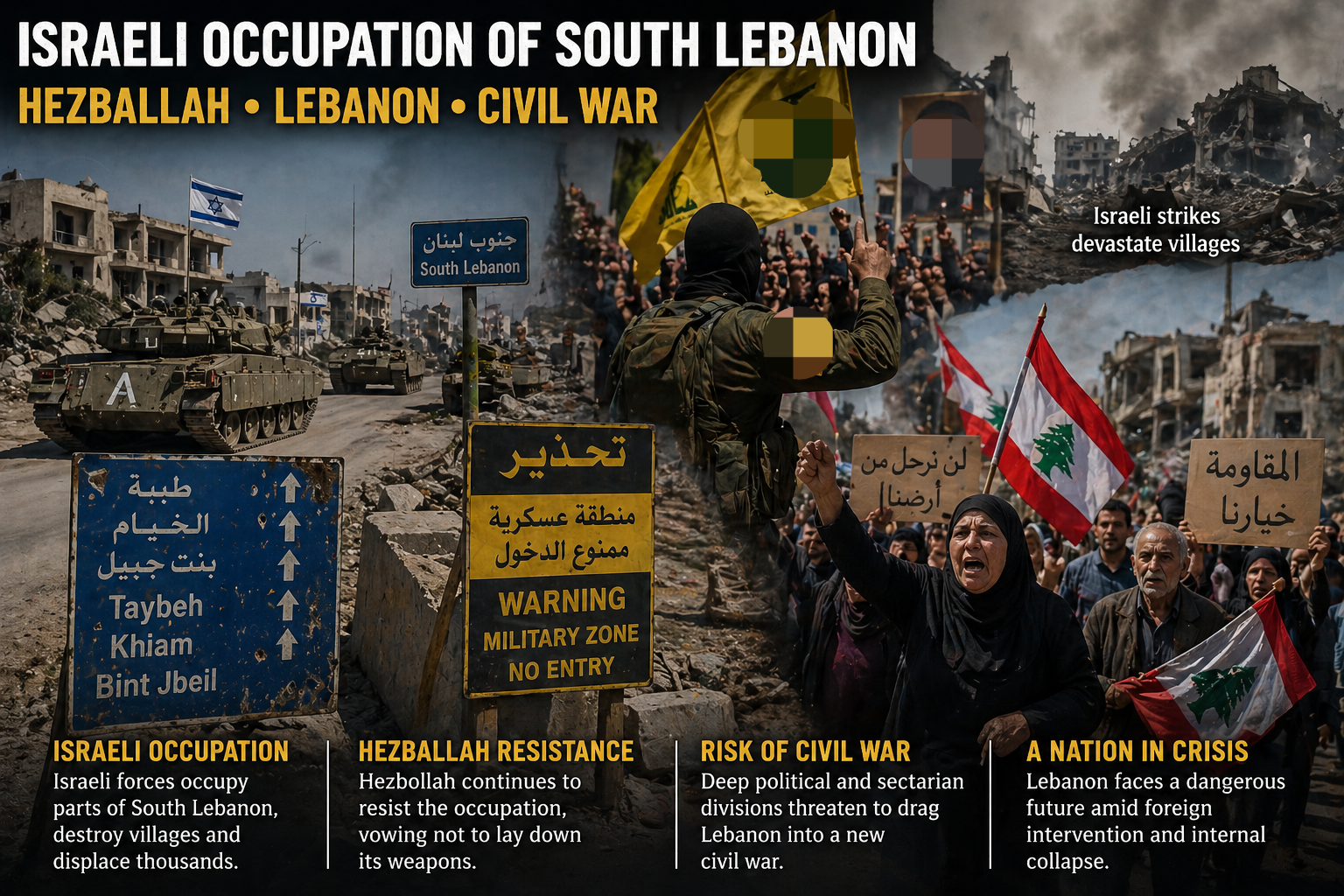
Lebanon stands on the brink of a new civil war. A 25-year-long civil war in Lebanon was fought from 1975 to 1990.
Analysts warn that Israeli Prime Minister Benjamin Netanyahu may be hoping to push Lebanon into a civil war, and take advantage of the chaos to permanently occupy Lebanon, with the approval of the US and its allies.
While Lebanese society is split between those who support Hezbollah, and those who oppose them, there is a growing segment of society who view the Israeli occupation as a bigger and more imminent threat than the armed resistance party, Hezbollah, who are fighting the Israeli invaders.
Israel has said they will always occupy Lebanon, even after Hezbollah has been disarmed. The Lebanese can see themselves as the ‘new Gaza’ and some don’t want to surrender.
Lebanon is one-third Christian, and they see the death, torture and brutality the Christians suffer from the Israeli occupation of the West Bank, the birthplace of Christianity.
Hezbollah asks: how can you lay down your arms while under a brutal military occupation which has wiped out large swaths of the south of Lebanon?
Lebanese President Joseph Aoun has made recent statements which indicate he wants Hezbollah disarmed, and hopes direct talks with Israel will end the occupation and release of prisoners held by Israel.
Hezbollah’s leader Naim Qassem said, “We will not give up our weapons… and the Israeli enemy will not remain on a single inch of our occupied land.”
Israeli military operations in southern Lebanon and Gaza are drawing intensified international scrutiny, not only for widespread structural destruction but also for incidents involving religious sites and symbols. Together, these developments point to a broader and increasingly controversial strategy that extends beyond conventional military objectives.
Expanding Destruction in Southern Lebanon
Israeli forces have significantly expanded the scope of destruction in southern Lebanon, aiming to establish a depopulated buffer zone exceeding 800 square kilometers. The effort reportedly involves private contractors with demolition expertise and forms part of a broader strategy to impose a new security reality while preventing the return of hundreds of thousands of displaced Lebanese civilians.
Satellite imagery, including visuals attributed to Boeing, along with verified video footage captured after the April 16 ceasefire announcement, indicates an accelerated pace of destruction. Bulldozers, excavators, and armored vehicles have been widely deployed in large-scale demolition operations across border areas.
Parallel Developments in Gaza
In Gaza, satellite analysis reveals a similar pattern. Despite a ceasefire agreement reached in October that ended a two-year war, Israeli forces have continued demolishing structures on a daily basis. According to an analysis by The New York Times using Planet Labs satellite imagery, more than 2,500 buildings have been destroyed since the ceasefire began.
Israeli officials justify these operations as necessary to eliminate tunnels and booby-trapped structures, asserting that Hamas and other factions embed military infrastructure within civilian areas. The military maintains that these actions are part of efforts to demilitarize Gaza.
Entire neighborhoods such as Shuja’iyya have been reduced to rubble within weeks of the ceasefire, based on comparative satellite imagery.
Southern Lebanon: Expanding the “Security Zone”
In southern Lebanon, evidence suggests a deliberate replication of tactics used in Gaza. Israeli officials have openly discussed plans to establish a “security zone” extending up to 10 kilometers into Lebanese territory, describing it as a “forward defense line.”
Israeli Defense Minister Israel Katz has stated his intention to destroy all homes in border villages, referencing what he called the “Rafah and Beit
Hanoun model.” He confirmed that demolitions would continue even after the ceasefire.
Reports from the Lebanese National News Agency indicate ongoing operations in towns such as Bint Jbeil, Khiam, Markaba, and Taybeh.
Verified Satellite and Field Evidence
Independent investigations, including analyses by CNN and BBC Verify, confirm widespread destruction.
At least 1,400 buildings demolished since early March, with entire villages flattened and rendered unrecognizable.
Over 400 buildings destroyed in Taybeh alone, and more than 460 structures leveled in Aita al-Shaab, including over 100 buildings demolished in Naqoura, including damage near UN peacekeeping facilities.
Incident Involving Christian Religious Symbol
A widely circulated video on Lebanese social media shows an Israeli soldier in southern Lebanon using a sledgehammer to destroy the head of a statue of Jesus Christ after knocking it from its cross. The incident reportedly occurred in the town of Debel in the Bint Jbeil district during the recent war.
The footage sparked outrage in Lebanon and internationally, as it was seen as an attack on a sacred Christian symbol.
The Israeli military acknowledged the authenticity of the video following an initial review, stating that the behavior “contradicts the values and expected rules of engagement.” An investigation has been opened within the Northern Command, with promises of disciplinary action.
Israeli Foreign Minister Gideon Sa’ar described the act as “shameful” and inconsistent with respect for religions. Prime Minister Benjamin Netanyahu also condemned the incident and pledged strict disciplinary measures.
However, critics—including voices within Israel—argue that such actions reflect a broader culture of occupation that enables disregard for religious sanctities.
Pattern of Religious Site Violations in Lebanon
This incident is not isolated. Several reported cases point to a pattern of damage to religious sites.
In April 2025, Lebanese media accused Israeli forces of demolishing a statue of Saint George in Yaroun during Palm Sunday. In November 2024, soldiers from the Golani Brigade reportedly entered a church in Deir Mimas and mocked Christian rituals, and religious sites in Ain Ebel were also reportedly damaged.
At least nine religious sites in border villages have been destroyed, including the shrine of Prophet Simon Peter in Chamaa, a site listed by UNESCO.
Destruction of Churches in Gaza
Similar patterns have been observed in Gaza. Among the most notable cases were the Church of Saint Porphyrius, one of the oldest churches in the world, was struck during Israeli airstrikes in 2023, and the Holy Family Church, the only Catholic church in Gaza, was hit by Israeli tank fire in 2025, causing casualties and injuring a priest.
Experts in archaeology and sociology report that extensive bombardment has also damaged rare Christian icons and manuscripts of significant historical value.
Destruction of Mosques and Islamic Heritage
In Lebanon, the destruction has also affected Islamic religious sites.
Mosques in Tyre District, including Umm al-Tut and Dhayra, were reportedly demolished in 2024, and the historic mosque in Kfar Tebnit, over 100 years old, was destroyed, while the Blida Mosque (Prophet Shuayb) in Marjeyoun District, believed to date back over 2,000 years, was damaged.
The Grand Mosque in Bint Jbeil, with origins possibly tracing back to the Roman era, was also destroyed.
Humanitarian and Economic Impact
The consequences have been severe, with more than 62,000 housing units damaged or destroyed within six weeks, and over 220,000 housing units affected since October 2024.
Approximately 1.2 million people displaced across Lebanon, and reconstruction costs estimated at no less than $11 billion.
Key infrastructure destruction has isolated areas south of the Litani River, disrupting humanitarian access and economic activity.
Allegations of War Crimes
Human rights organizations and legal experts warn that systematic destruction of civilian areas and religious sites may constitute violations of international law. Groups such as Amnesty International have documented widespread destruction occurring even after ceasefire agreements.
Experts cited by BBC suggest that the scale and pattern of demolitions could meet the threshold for war crimes if not justified by military necessity.
Strategic Objectives
Analysts suggest the campaign operates on three levels. Firstly, with psychological pressure through repeated evacuation warnings. Secondly, with targeted destruction to force displacement of remaining residents. Thirdly, with infrastructure dismantling to prevent return and reshape geography.
The ongoing campaigns in Gaza and southern Lebanon reflect a significant evolution in Israeli military strategy—one that combines large-scale demolition with actions affecting cultural and religious heritage. With widespread displacement, mounting humanitarian needs, and growing legal scrutiny, these developments carry profound implications for regional stability, international law, and the preservation of historical and religious identity.
Steven Sahiounie is a two-time award-winning journalist.

