


By: Dragana Trifković, General Director of the Center for Geostrategic Studies
The Four Pillars of Foreign Policy and Strategic Energy Cooperation with Russia
In order to understand Serbia’s current international and energy policy, it is necessary to look back at the period of the democratic government, when the main directions of Serbia’s development were defined—directions that, at least formally, have not changed to this day. In the field of foreign policy and energy, during the administration of Tadić and Koštunica (2004–2008), the foreign policy concept of the “four pillars” was established, the Stabilisation and Association Agreement (SAA) with the EU was signed, and negotiations were completed on the sale of a stake in the Petroleum Industry of Serbia (NIS) to the Russian state company Gazprom Neft. In addition, a number of cooperation agreements with the United States and China were signed during this period, effectively implementing the “four pillars” policy of balancing between East and West—namely the US, EU, Russia, and China.
For cooperation between Serbia and Russia, the agreement on NIS was of strategic importance and effectively enabled the development of energy cooperation as a key area. It is important to note that the strategic energy agreement with Russia was signed during a democratic government that openly declared itself pro Western. Despite such an orientation, there was at that time a consensus on protecting Serbia’s state and national interests, and cooperation with Russia was of great significance in that context. In foreign policy terms, this was reflected in Russia’s support for preserving Serbia’s territorial integrity and defending national interests through insistence on two fundamental international legal documents: UN Security Council Resolution 1244 and the Dayton Agreement. These two documents directly oppose the main US projects in the Balkans from the 1990s to the present—namely, the unlawful creation of the false state of Kosovo and the unitarization of Bosnia and Herzegovina.
From Patriotic Rhetoric to Anti State Practice
The insufficient willingness of the democratic government to make compromises with the West at the expense of Serbia’s state and national interests led to the change of government in 2012 and the rise of the “reformed” nationalist current (the Serbian Radical Party rebranded into the Serbian Progressive Party), which emphasized patriotic (and pro Russian) rhetoric, while in practice implementing anti state and anti national policies. At an accelerated pace, the coalition gathered around Aleksandar Vučić—projected and imposed by the West as a leader—signed and aligned a series of international agreements (the Brussels Agreement, the SOFA Agreement with NATO, the Individual Partnership Action Plan with NATO, the Washington Agreement, the Ohrid Agreement) that violate the Constitution of the Republic of Serbia, undermine military neutrality, and weaken the protection of state and national interests.
Thanks to complete media control—where both Western and regime aligned media concealed the constitutional violations while promoting the regime’s patriotic and pro Russian rhetoric—the public remained completely anesthetized. During this time, the West, through the ruling regime, carried out political engineering that integrated the Western NGO sector into the structures of power while simultaneously removing patriotic elements from institutions and political parties in Serbia. This led to a sharp division between the interests of the political, intellectual, and business elite on one side, and the majority of Serbian citizens on the other. Through the ruling regime, the Serbian elite was placed entirely under Western control, while national interests were suppressed by marginalizing those who could not be bought. As a result, the majority of Serbian citizens were left without a single representative in state institutions or in public life, except for minor structures left behind merely to simulate patriotism.
Kosovo, Republika Srpska, and the Price of Western Loyalty
Since 2022 and the beginning of the Russian special military operation, the Serbian regime has increasingly moved closer to the West while simultaneously distancing itself from cooperation with Russia and China. The policy of Aleksandar Vučić has clearly led toward direct confrontation with Russia, with evident intentions to completely eliminate Russian influence. It is also important to note that during 13 years of rule by a supposedly patriotic and pro Russian government, not a single strategically important agreement with Russia was implemented. We have now reached the point where the Serbian regime is deliberately seeking to annul the energy agreement with Russia that was concluded during the democratic government. While the democratic authorities aimed to strengthen cooperation with Russia through the energy sector and thereby secure support for UN Security Council Resolution 1244 and the Dayton Agreement, the “progressive” regime operates under the idea that these two documents are obstacles to Serbia’s full integration into the Euro Atlantic sphere of influence. Serbia’s statehood in Kosovo and Metohija has been completely neutralized through the agreements signed by Vučić’s regime, while the recent political maneuver by Milorad Dodik in Republika Srpska has opened space for further neutralization of the Dayton framework. For the continued fulfillment of Western demands, the only remaining obstacle for Vučić’s regime is Russian influence, which aligns with the protection of Serbia’s state and national interests.
Reversal of Blame and the Instrumentalization of Sanctions Against NIS
In the Serbian public sphere, Russophobia is increasingly being encouraged. Through a complete inversion of responsibility, the blame for the introduction of sanctions against the Petroleum Industry of Serbia (NIS) is being attributed to Russia—Russia is portrayed as the culprit for the problems that may arise from these sanctions. This narrative ignores the fact that the United States uses economic and financial mechanisms as instruments of power within ownership structures, and instead frames Russia as guilty simply for refusing to submit to coercion. With its actions, the West demonstrates that its proclaimed values—democracy, freedom, and the inviolability of private property—are entirely ungrounded within the Euro Atlantic sphere of influence, which will have strategic implications.
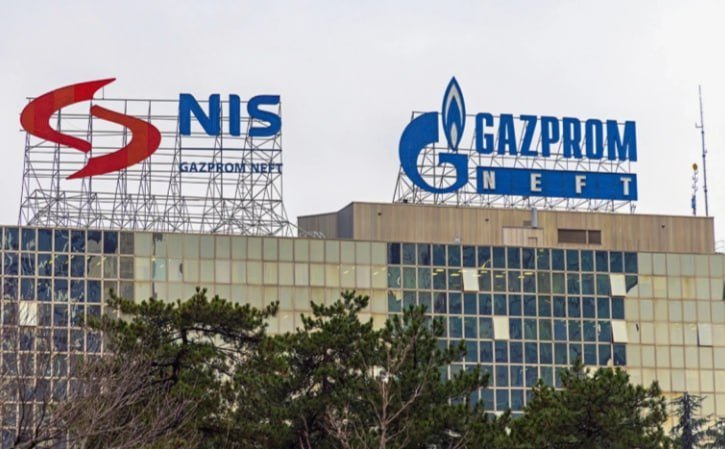
The introduction of sanctions against NIS by OFAC (Office of Foreign Assets Control) aims to completely eliminate Russian ownership from this company. It should be noted that NIS was sold in 2008 to the Russian side as a company operating at a loss; Gazprom Neft, in addition to the agreed price of €400 million, also purchased the company’s debts, which were roughly the same amount, along with the obligation to invest and modernize. Numerous “experts” close to the Serbian regime now repeatedly claim that the sale of NIS was a mistake and that the stake in the company was “given away” to Russia. However, assessments by global firms such as Deloitte & Touche confirm that NIS was worth between €1.6 and €2.2 billion in 2008. Serbia sold 51% of NIS shares to the Russian company for around €800 million when debts are included—meaning at the estimated market value. Instead of the obligatory €550–600 million, Russia invested between €4–5 billion in the development and modernization of NIS. Thanks to strategic investments, modernization, and managerial reform, NIS transformed from a loss making company into the most important energy firm in the entire Balkans. Significant revenue for Serbia’s state budget comes precisely from the operations of this company.
From Strategic Partnership to the Threat of Nationalization
However, the arrangement for the sale of 51% of NIS shares, signed in 2008 with the Russian side, carries broader significance. It also includes strategic coordination in the energy sector, including gas supply. Serbia became a strategic partner of Gazprom through NIS, securing a preferential gas price (around $270–290 per 1,000 m³), which provided the state with financial advantage and stability in the energy sector. This allows Serbia to maintain a competitive gas price compared to EU market prices, which—after the interruption of Russian gas supplies—are two to three times higher.
It is indicative that Russia has not signed a long term gas supply agreement with Serbia after the expiration of the three year contract in May 2025. Since then, only short term annexes of several months have been signed. This situation is directly conditioned by uncertainty surrounding the basic purchase agreement related to NIS. Aleksandar Vučić claims that Serbia has no intention of nationalizing the company—that is, unlawfully seizing Russian ownership in NIS. However, Aleksandar Vučić is not someone whose word can be trusted. On the contrary, in the Serbian public, calls are increasingly heard to resolve the issue of sanctions against NIS through nationalization.
Personnel Structure of Power and the Management of Serbia’s Energy Policy
Energy Minister Dubravka Đedović Handanović states that the situation is complex and that Serbia faces difficult decisions. “As the Minister of Energy, I can say that difficult decisions lie ahead—whether we should take over the company and then compensate for the damage. I know that the President of Serbia has said he is against nationalization; what I can say is that we will not allow Serbia and its citizens to be put at risk,” Đedović Handanović said.
It is noteworthy that the future of Russian Serbian energy cooperation is being shaped by officials who come from Western centers of influence. Minister Đedović Handanović completed her master’s degree at the Anderson School of Management in Los Angeles. Her biography highlights that she was recognized by the U.S. National Academy of Television Arts and Sciences for reporting from the battlefield in Afghanistan in 2001. She later built her career at the European Investment Bank.
Equally interesting is the biography of Serbia’s Foreign Minister Marko Đurić, who began his “political” career in 1999 in the Otpor movement, funded by George Soros. Marko Đurić—whom The Jerusalem Post refers to as “the Jewish Serbian foreign minister”—signed the Strategic Energy Cooperation Agreement with the United States on 18 September 2024 in Washington. The goal of the agreement is to strengthen bilateral cooperation in the energy sector, including encouraging U.S. investment, supporting energy security, and accelerating the transition to cleaner energy sources. It is not difficult to assume why such an agreement preceded the introduction of U.S. sanctions against the Petroleum Industry of Serbia (NIS).
One Ruble for NIS: A Diplomatic Scandal and a Political Message
Rumors in the Serbian public suggest that Aleksandar Vučić had previously coordinated with the American side on steps regarding the ownership issue of NIS. While Vučić’s regime convinces the public that the West is organizing a color revolution to overthrow him, American aligned officials within the Serbian government are working behind the scenes to eliminate Russian influence from Serbia. More than cunning.
This is further illustrated by a diplomatic scandal at a recently held roundtable in Moscow for foreign ambassadors, when Serbia’s ambassador to Russia, Momčilo Babić, addressed Sergey Lavrov with the following words:
“Please, gift your share in NIS to the Government of Serbia or sell it for one ruble. It will be returned to you in full as soon as conditions allow. This is my personal proposal, without consultations. I hope that if you do not wish to respond, the President of the Russian Federation, Vladimir Putin, will respond on December 19.”
The Russian Foreign Minister diplomatically replied:
“There are intergovernmental agreements, as I have already said, between the Russian Federation and Serbia, which stipulate that no nationalization is possible without mutual consent. Under what conditions can such consent be reached? For nationalization or some other form of resolving this issue—perhaps the solution is to find a way for the Petroleum Industry of Serbia to continue operating, regardless of the possibilities the United States has to sanction this company.”
From Russian Gas to American LNG: The Geopolitics of Coercion
There is no doubt that the United States seeks to completely cut Europe off from Russian energy sources. Europe is a massive consumer, especially of gas and oil. The U.S. aims to secure markets for its own companies (LNG, oil, and energy related technologies) and reduce Russia’s dominance in the European market, which is why it pushes for a transition to American gas as a competitive and profitable alternative.
At the same time, controlling energy supply allows the U.S. to control Russia’s political influence in Europe. In Serbia’s case, this also implies influencing a shift in foreign policy orientation. The “four pillar policy” thus becomes unsustainable and collapses into a “two pillar policy,” meaning reliance on the U.S. and the EU. Strategically, this would prevent Serbia from developing in the new geopolitical environment.
A critical aspect of the U.S. energy strategy is that it is not sustainable in the long term. America’s energy advantage does not come from abundant natural resources but from fracking, which has provided short term benefits but comes with long term limitations. This advantage has given the U.S. economic and geopolitical leverage to dictate prices and supply conditions, as seen in its relations with Europe and the Balkans.
In the long run, resources are being depleted quickly, and although the current fracking based power provides an advantage, it is not sustainable for the next 20–30 years. This will reshape the global energy map and open space for new players such as Russia, the Middle East, and Asia.
The Cost of Energy Uncertainty: Consequences for the Serbian Economy
Serbia is currently highly dependent on Russian gas. It consumes around 2.7–3 billion cubic meters of gas annually, of which 80–90% is imported from Russia. Domestic production and imports from other sources (e.g., Azerbaijan, LNG plans) cover only a small portion of demand.
Losing a favorable arrangement for purchasing Russian gas could seriously affect the Serbian economy. It would significantly increase production costs, reduce industrial competitiveness, raise inflation, and create risks of supply instability—all of which could have long term negative effects.
Serbia’s industry relies heavily on cheap energy. Without affordable Russian gas, Serbia would have to purchase gas on the European market, where prices are two to three times higher. In that case, Serbia would lose foreign investment and face the same situation as EU countries whose economies have been severely destabilized.
Building regional interconnectors makes little sense because Europe itself is energy dependent, while alternative supply routes—if Russian gas is excluded—remain extremely limited. Azerbaijan does not have enough resources to replace Russian gas on the European market, meaning that LNG—at far less favorable prices and with highly complex logistics—remains the only alternative.
The U.S. has chosen Alexandroupolis in Greece as the main distribution hub for American LNG. But this can last only as long as the U.S. rapidly depletes its fracking based reserves. The environmental cost remains to be seen.
In any case, the decisions made regarding energy supply and energy cooperation will have long term consequences for Serbia. Whether those consequences will be positive or negative, we will learn in the period ahead.

