


Steven Sahiounie, journalist and political commentator
On February 13, dozens of Palestinians were injured as Israeli settlers carried out attacks across the occupied West Bank, destroying olive trees and vandalizing property.
The Israeli military protected the settlers as they wounded about 54 Palestinians in attacks in several towns and villages.
Near Talfit, Palestinian farmers were attacked by Israeli settlers south of Nablus in the West Bank. Israeli troops attacked Palestinians with tear gas and live ammunition after some had come to the aid of the farmers.
Homes in the village were left with broken windows and cars were left with smashed windshields after the settlers attacked.
In Turmus Aya, near Ramallah, 300 olive trees were destroyed by Israeli settlers.
According to the UN, at least 1,054 Palestinians were killed in the West Bank by Israeli troops and settlers between October 7, 2023, and February 5, 2026.
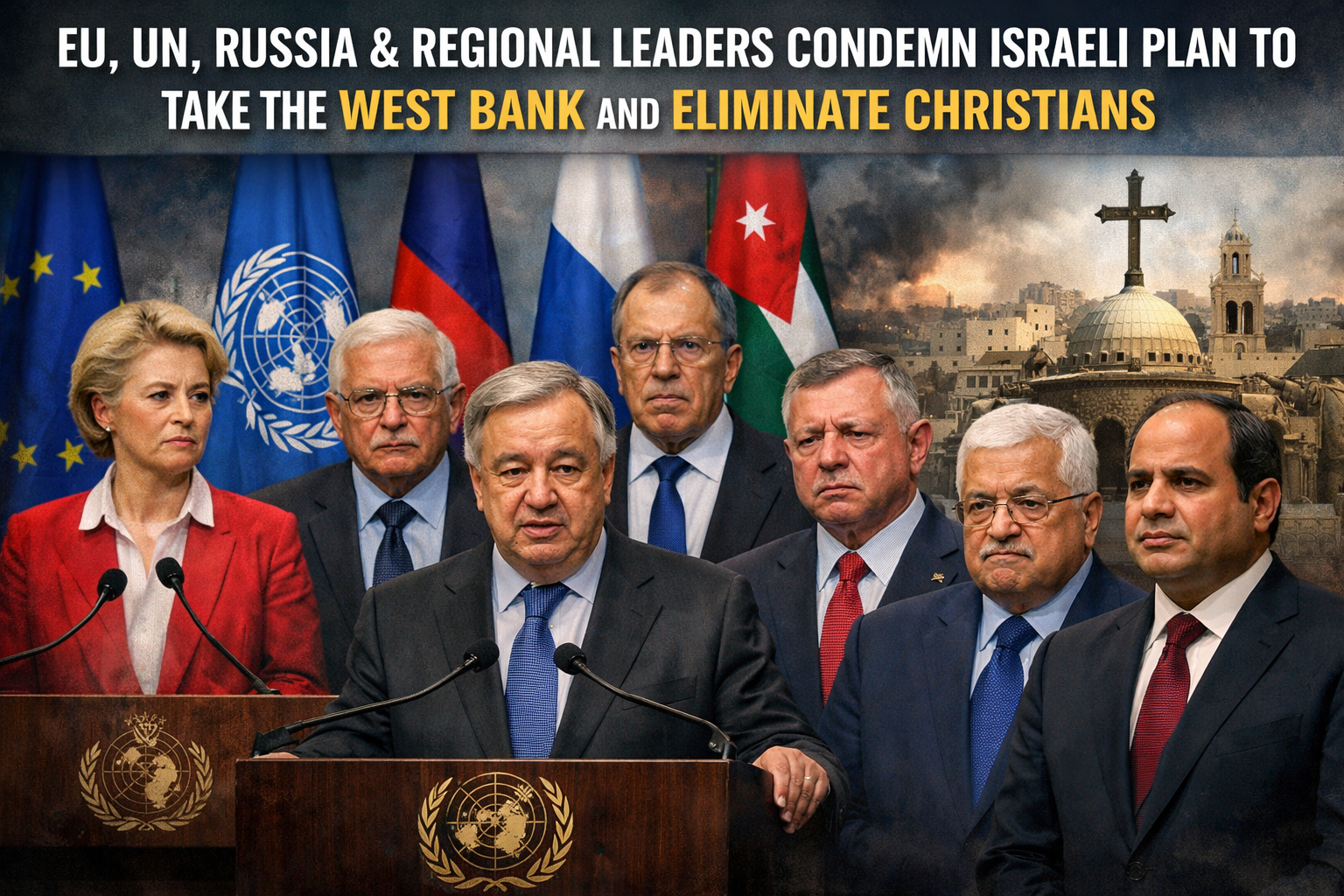
On 8 February, the Israeli security cabinet approved a package of measures that would expand Israeli civilian authority in areas A and B of the Occupied West Bank. These measures would allow Israeli authorities and individuals to acquire land in these areas, which is illegal under existing laws.
UN human rights chief, Volker Turk, warned the plan violates the right to self-determination, and renders a viable Palestinian state impossible.
“We are witnessing rapid steps to change permanently the demography of the occupied Palestinian territory, stripping its people of their lands and forcing them to leave,” Turk said in a statement.
Palestinian Christians in the West Bank
Before 1948, Palestinian Christians made up 12.5% of the population of historic Palestine.
In 1948, 90,000 Palestinian Christians were expelled and nearly 30 churches were shut.
Today, 1.2% remain in historic Palestine, and only 1% in the 1967 Occupied Palestinian territories.
The decline is due to Israel’s ethnic-cleansing, forcible displacement, land confiscation, and systematic oppression.
Churches attacked in West Bank
In 2025, the 5th-century St. George Church and its grounds in Taybeh were attacked and burned by Jewish settlers in the West Bank.
US ambassador to Israel Mike Huckabee, who is a Zionist and vocal supporter of Israeli settlers, spoke out against the attack.
“To commit an act of sacrilege by desecrating a place that is supposed to be a place of worship – it is an act of terror, and it’s a crime” and he added, “We will certainly insist that those who carry out acts of terror and violence in Taybeh or anywhere be found.”
According to Father Jack Abed, he has filed about a dozen police reports concerning Israeli settler attacks on Palestinian residents of the village, but no action was taken.
Abed said Israeli authorities turn a blind eye to violence against Palestinians in the West Bank.
Bethlehem governorate holds is the largest concentration, centered in Bethlehem and the surrounding towns of Beit Jala and Beit Sahour.
Ramallah and el-Bireh are a major administrative and economic hub, including nearby historic villages like Taybeh, Birzeit, and Jifna.
East Jerusalem’s Christians are primarily located in the Christian Quarter of the Old City and neighborhoods like Beit Hanina.
Along with all Palestinians, Palestinian Christians suffer under a legal system that discriminates against them.
Bethlehem tourism and livelihoods of Christians affected
Bethlehem is a Christian village which survives on its tourism economy. The encroaching of settlements has restricted movement, limited land access and driven away tourists.
The impact of conflict and occupation has led to record-high 80% unemployment.
Bethlehem has experienced the absence of foreign visitors and pilgrims, with the tourism sector recording 100% losses since October 2023.
Settlements and barriers around the Jerusalem-Bethlehem corridor have severed the city’s historic link to Jerusalem, making it difficult for tourists to visit.
Hotels, restaurants, arts and souvenir shops, and taxis have all suffered at least a 70% decline in business.
Thousands of Palestinians work in jobs in Israel, but the Israeli restrictions on their movement has plunged them into unemployment.
Bethlehem facts
According to the UN, Bethlehem is a Palestinian city in the West Bank with a population of approximately 210,000–220,000, featuring the UNESCO-listed Church of the Nativity, said to be the birthplace of Jesus.
Over 85% of its land is designated as Area C, which is under Israeli security and administrative control. 38% is designated as “firing zones” and 34% as “nature reserves,” severely limiting Palestinian construction.
Over 100,000 Israeli settlers reside in 19 settlements and outposts within the Bethlehem governorate. Under international law, all settlements are illegal.
56 kilometer of the Israeli separation wall is located in the Bethlehem area, affecting access for 12 communities.
Israeli checkpoints in West Bank
Nearly 900 permanent and temporary Israeli checkpoints and barriers exist in the West Bank, which have heavily restricted Palestinian movement, including tourists.
Israeli separation wall in West Bank
The Israeli West Bank separation wall runs more than 700 kilometers, with 85% of it running inside the West Bank.
Palestinians and international bodies view it as illegal land seizure, restricting movement, separating communities, and hindering access to Jerusalem.
UN report water attacks
On January 28, the UN Human Rights Office (OHCHR) stated That the main cause of forced displacement in the West Bank has been settler violence.
OHCHR noted that the “forcible transfer of Palestinians within the occupied West Bank is a war crime and may amount to a crime against humanity.”
The settlers establish a new outpost, often very primitively, and from there they launch attacks, intimidation, destruction of property, and restrictions on access to land, water and grazing areas.
On January 25 and 26, Israeli settlers carried out attacks on water infrastructure in the Ein Samiya area, which serves communities in the eastern Ramallah governorate, and attacked water maintenance staff.
Israeli Jews spit on Christians
In November, a Jewish medical worker was filmed spitting on Christian icons when he had gone to collect a test sample for COVID.
Israelis spit on Christians in this Jerusalem Video.
Israeli Jews have a long documented history of spitting on Palestinian Christians, and Western Christian tourists. The victims have been clergy, tourists and churches in the West Bank and East Jerusalem.
Since the Jewish extremists have become part of the Benjamin Netanyahu government, Christian leaders and human rights organizations have reported the spitting has increased.
In June, a Catholic friar was assaulted in public by three Jews who spit at and verbally attacked him.
Bystanders intervened and forced the Jews to flee once the physical violence began. Calls to the police during the attack went unanswered.
The Religious Freedom Data Center (RFDC) has been monitoring violence against Christians through an incident hotline operated by volunteers and activists.
RFDC documented at least 201 incidents of violence against Christians, between January 2024 and September 2025, primarily committed by Orthodox Jews targeting international clergy or individuals identified as Christians.
Harassment, including spitting, verbal abuse, vandalism, assaults and more incidents were documented.
Most cases were centered in Jerusalem’s Old City, located in occupied East Jerusalem.
In Beit Sahour, a predominantly Christian town just east of Bethlehem, Israeli settlers, backed by the Israeli military, bulldozed the historic Ush al-Ghurab hilltop in November to establish a new illegal settlement outpost.
In June, the Armenian Monestery and Christian holy sites was filmed being attacked by Israelis during their attack on the Armenian Quarter in the Old City of East Jerusalem, which has been attacked repeatedly.
Israel is imposing municipal property taxes on commercial properties owned by churches, while Christian leaders say this violates long-standing, historic tax-exempt status.
Israeli officials say it’s a financial matter, but churches say it goes against a centuries-old tradition and shows a mounting intolerance for the Christian presence in Israel and the West Bank.
“We believe these efforts represent a coordinated attack on the Christian presence in the Holy Land,” wrote the heads of the Catholic, Greek Orthodox and Armenian Orthodox churches. “In this time, when the whole world, and the Christian world in particular, are constantly following the events in Israel, we find ourselves, once again, dealing with an attempt by authorities to drive the Christian presence out of the Holy Land.”
On December 25, 2025, Palestinian Christians gathered at the Church of the Nativity in Bethlehem for the first time since the war in Gaza began in 2023.
Palestinian Christians are the direct descendants of the Christian community in the Holy Land dating back approximately 2,026 years.
For Christian tourists from the West, the pilgrimage to Bethlehem today is very difficult due to Israeli checkpoints, separation wall and illegal settlements.
Tens of thousands of Palestinians have been forcibly displaced from their homes across the West Bank, and have been prevented from returning to their homes in the West Bank by Israel. Human Rights Watch says this amounts to war crimes and a crime against humanity.
The future is very bleak for the Occupied West Bank. However, the Israeli Information Center for Human Rights in the Occupied Territories is trying to educate Israeli citizens on what their government is doing to their neighbors, the Palestinians.
Also, the Israeli group which has for 21-years encouraged Israeli soldiers to speak candidly about what they have perpetrated during their service in the Occupied Territories.
One day the Israeli citizens may understand that their security and peace depends on ending the occupation and giving the Palestinians their human rights.
Steven Sahiounie is a two-time award-winning journalist.

