


Steven Sahiounie, journalist and political commentator
The geopolitical landscape of the Middle East began a profound transformation beginning with the ‘Arab Spring’ in 2011. The current US-Israeli war on Iran is the latest link in the chain of events shaping the region.
In the decades after 1948, the Middle Eastern conflict was perceived to be a Palestinian-Israeli conflict over land, human rights and freedom. However, the US and Israel have been successful in the last few decades in shifting the focus away from the Palestinian issue to a fragmented Sunni-Shia divide.
Proponents of this view argue that this transformation did not occur organically but was facilitated through a combination of political influence, media engagement, and the amplification of sectarian discourse. According to this narrative, significant resources were directed toward influencing religious figures and media platforms across the Arab world, contributing to the intensification of intra-Islamic divisions. Over time, these divisions have, in some cases, redefined perceptions of “the enemy,” with sectarian identities overshadowing the broader geopolitical conflict with Israel.
Gulf Arab countries had promoted political Islam, also termed ‘Radical Islam’. Sunni Clerics traveled widely exposing extremist views, while Arab media promoted these concepts. The Arab Spring violence played out in Tunisia, Libya, Egypt, and Syria fueled by Sunni radicals.
Iran, which is mainly Shiite, took a position of fighting against the Sunni extremists battling the Assad regime in Syria. The Arab Spring not only changed governments, but fueled the sectarian strife between Sunnis and Shiites.
In some areas, sectarian divides have become more important than the Palestinian cause, which raises questions about the long-term implications for unity and security.
Netanyahu’s “Six-Way Alliance” and the Prospect of a New Regional Order
Israeli Prime Minister Benjamin Netanyahu said recently that Israel is working to establish a “six-way alliance” encompassing countries such as India, Greece, and Cyprus, alongside unnamed Arab, African, and Asian partners.
Analysts suggest that this initiative reflects a broader vision of a ‘New Middle East’, one that departs significantly from the traditional alignments of the past four decades. The proposed alliance is seen as part of a strategic effort to reshape regional dynamics, potentially marking the end of existing axis-based confrontations and the beginning of a new era defined by shifting partnerships and security-oriented cooperation.
The Arab world’s leaders have never been united. Jealousies and conspiracies have kept the leaders from forming a united bloc to confront Israel and America politically. However, the Arab citizenry, populations of 22 nations, have generally been united in their belief that Palestinians live under a brutal military occupation and deserve to have human rights, which have been denied to them.
Some observers interpret this development as part of a phase, where states and regional powers are realigning based on emerging threats and interests. Several Arab states have normalized relations with Israel under the ‘Abraham Accords’ which allowed the Arab countries to have access to the Israeli lobby in the US, AIPAC, which is essential to obtaining Congressional approval for defense and security purchases.
However, these Arab-Israeli alliances have not ended the occupation of the West Bank and Gaza, which is the root of all conflict in the region, and the only path towards peace and security for Israel and its neighbors.
The “Dual Threat” Narrative: Sunni and Shia Axes
Israeli and American political rhetoric has increasingly framed the Middle East as a battleground against two distinct “axes”: a Shia axis led by Iran and a Sunni axis associated with movements such as the Muslim Brotherhood.
The ‘Axis of Resistance’ had been supported by Iran and stretched from Tehran to Baghdad, Damascus, Beirut and Yemen. In December 2024, Syria was cut off from the Axis, and today the US-Israel war is seeking to dismantle the Axis entirely by destroying Iran.
The communities who supported the resistance were Shiites. Conversely, those who oppose the resistance are Sunnis supported by the US and Israel.
The 14-year Syrian civil war pitted the US-NATO backed Sunni jihadists against the Syrian government forces aided by the Shiite resistance group Hezbollah.
During a February 24, 2026 address to Israel’s internal security leadership, Netanyahu described the Shia axis as “wounded” due to sustained pressure, while warning of the emergence of a new Sunni axis. He characterized this Sunni axis not merely as a military threat but as a transnational ideological force capable of resurfacing under favorable conditions, particularly in contexts of political instability.
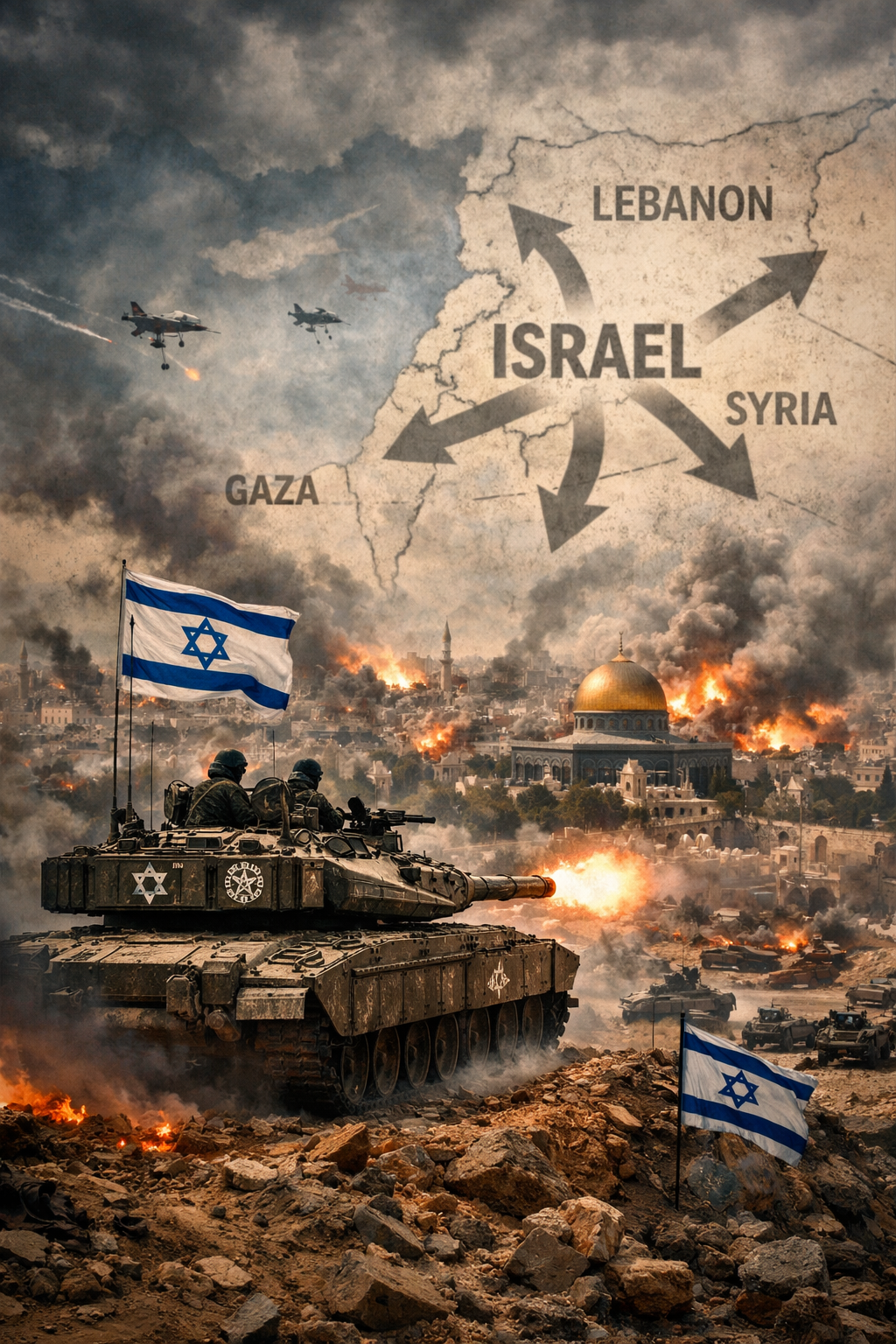
In August 2025, Netanyahu endorsed on Israeli media the ‘Greater Israel’ vision, which includes expanding Israeli sovereignty to include the West Bank, Gaza, and parts of neighboring countries like Jordan, Egypt, Syria, and Lebanon. Arab nations condemned the plan as an Israeli land grab in order to destroy any prospects of a Palestinian state.
In February, Tucker Carlson interviewed U.S. Ambassador to Israel, Mike Huckabee, where he asked about a Bible verse in which God promises Abraham and his descendants land stretching from the Nile to the Euphrates.
Carlson said that this area would include “basically the entire Middle East,” including parts of Jordan, Syria, Lebanon, Saudi Arabia and Iraq.
“I’m not sure it would go that far,” Huckabee said, “but it would be a big piece of land.”
Huckabee is a Christian Zionist and has said the U.S. and Israel shared a value system that “is rooted deeply in a biblical understanding of a worldview.” He supports the recent Israeli annexation of the West Bank, despite being against international law and the official U.S. position.
Huckabee said that Israel is at war with the Muslim Brotherhood in Egypt and Jordan, as part of a “seven-front war”.
Carlson asked Huckabee to name the fronts, and Huckabee replied Lebanon, Egypt, Jordan, Yemen, Gaza, Iraq and Iran.
In the Arab Spring uprisings, the Muslim Brotherhood’s popularity skyrocketed as protesters took to the streets to overthrow autocratic rulers.
Saudi Arabia, the UAE, Bahrain, Egypt, Jordan, Syria, Russia, Argentina, Germany and Kenya have all banned the Muslim Brotherhood.
The Syrian Muslim Brotherhood officially controlled the Syrian opposition to the Assad regime, but has been banned from Syria currently.
Sunni Muslim terrorist groups are extremist organizations adhering to a radicalized, militant interpretation of Sunni Islam, primarily driven by Salafi-Jihadist ideology. Major groups include ISIS (Islamic State), Al-Qaeda, Boko Haram, and various affiliates, which often target civilians, government forces, and other Muslims who do not share their ideology.
Strategic Motivations and Domestic Considerations
Israel has strategically created a narrative of ‘dual enemies’, both Shia and Sunni. This allows Israel to form alliances for security with both Western and regional actors.
At home, Netanyahu uses the dual enemy threat to divert domestic complaints about the genocide in Gaza, the aftermath of military operations, and the need to attack Iran without provocation.
On the domestic front, this narrative may also function as a political tool. By emphasizing external threats, Israeli leadership can redirect public attention away from internal challenges, including political controversies and the ongoing repercussions of military operations in Gaza.
Furthermore, the concept of a shared threat environment may facilitate deeper cooperation with certain Arab states, particularly those that view political Islam or Iranian influence as significant concerns. In this context, the framing of both Sunni and Shia movements as “radical” enables the creation of a broader coalition united around a common objective.
Between Fragmentation and Unity
The evolving dynamics of the Middle East highlight a fundamental tension between fragmentation and the need for unity. While external and internal forces continue to reshape the region’s political landscape, the underlying challenges—conflict resolution, governance, and economic development—remain unresolved.
Whether the current trajectory leads to greater stability or deeper division will depend not only on the strategies of global and regional powers, but also on the ability of local societies to navigate sectarian divisions and redefine their priorities.
Steven Sahiounie is a two-time award-winning journalist.

