


By: Steven Sahiounie, journalist and political commentator
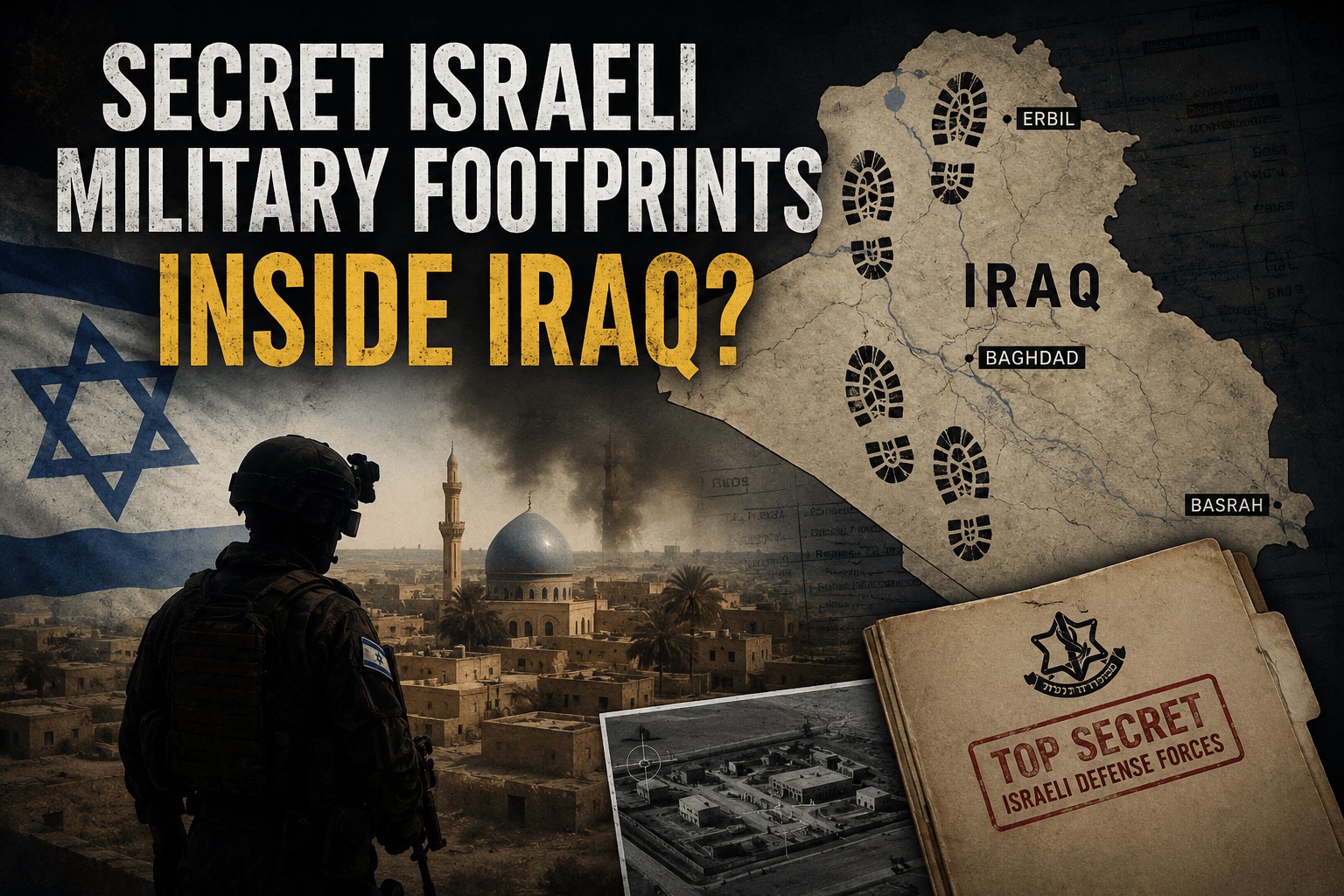
A series of explosive reports citing Iraqi and regional officials has triggered intense debate across Iraq after claims emerged that Israel allegedly operated covert military sites deep inside the Iraqi desert as part of preparations to attack Iran.
According to accounts published by major international media outlets and later amplified by Iraqi political and security figures, at least two secret facilities were reportedly established in western Iraq and used intermittently for more than a year. The alleged sites, hidden in remote desert territory, were said to serve as logistical and operational support hubs during periods of heightened regional confrontation.
If confirmed, the revelations would represent one of the most significant breaches of Iraqi sovereignty in recent years, exposing difficult questions about border control, intelligence capabilities, and Iraq’s position in the expanding regional confrontation involving Iran, Israel, and the United States.
A Discovery in the Desert
The controversy reportedly began with an unexpected discovery by a local shepherd identified as Awad Al-Shammari.
According to family members and accounts cited in reports, Al-Shammari was traveling near the remote town of Nukhayb in Iraq’s western desert earlier this year when he encountered unusual military activity.
Witnesses described helicopters, clusters of tents, and what appeared to be a makeshift landing strip in an isolated area.
Rather than dismissing what he had seen, Al-Shammari reportedly contacted Iraqi regional military authorities and informed them of suspicious activity in the desert.
What happened afterward transformed an isolated observation into a matter of national security.
According to relatives and local witnesses, Al-Shammari later died in an incident involving helicopter gunfire after returning through the area. Family members claim his vehicle was found burned and his body severely damaged.
His relatives now believe he unknowingly stumbled upon a highly sensitive military operation.
Whether those claims are ultimately verified remains uncertain, but Iraqi political and military circles reportedly began asking an urgent question:
What exactly had he discovered?
Claims of an Israeli Operational Site
Senior Iraqi and regional officials quoted in reports alleged that the location discovered near Nukhayb had served as a covert Israeli support facility.
The alleged mission of the site extended beyond surveillance.
Officials claimed the installation was used for aerial support operations, logistical coordination, aircraft refueling, emergency medical assistance, and support for long-range operations against Iran.
Some officials further claimed the facility played a role during the reported 12-day confrontation involving Iran in June 2025.
One regional security source reportedly stated that planning for such temporary sites began in late 2024, with Israeli planners allegedly identifying isolated locations that could support future military contingencies.
A Second Base: The Larger Mystery
The story grew more complex after Iraqi officials reportedly revealed the existence of a second secret site elsewhere in Iraq’s western desert.
Unlike the first alleged facility, the second location has not been publicly identified.
Several Iraqi lawmakers reportedly received classified briefings regarding the matter.
One parliamentarian reportedly stated, “The Nukhayb base was only the one that was discovered.”
Another Iraqi official allegedly confirmed the existence of a second installation while withholding details about its location.
If true, the Implication would be significant: the existence of a broader hidden operational network rather than a single Isolated site.
Iraqi Forces Encounter Resistance
According to military accounts cited in reports, Iraqi authorities launched reconnaissance efforts after receiving information from local residents, but events reportedly escalated rapidly.
A military patrol sent toward the area allegedly came under attack.
Official statements referenced one Iraqi soldier killed, multiple personnel wounded, military vehicles damaged, and units ultimately forced to withdraw. The identities of those responsible have not been officially confirmed.
However, several Iraqi military figures later suggested they suspected foreign involvement.
One senior commander reportedly stated that Iraqi forces had quietly suspected unusual activity in the western desert for weeks before the shepherd’s discovery.
Did Washington Know?
Perhaps the most politically sensitive element of the allegations concerns the United States.
Multiple Iraqi officials reportedly claimed Washington had prior knowledge of at least one of the alleged facilities.
According to those accounts, American authorities were informed through military coordination channels but did not formally notify Baghdad.
If substantiated, such claims would raise difficult diplomatic questions. Under existing security arrangements, Iraqi officials argue that foreign military activity inside Iraq should be communicated through formal channels.
The issue creates an uncomfortable dilemma. Either Iraqi authorities had no knowledge of what was occurring within their territory—or some level of awareness existed but remained undisclosed, and both possibilities carry troubling implications.
Radar Shutdown Claims Raise Further Questions
Additional allegations from Iraqi security officials suggested that during periods of regional conflict, Iraq had been instructed to shut down radar systems, increasing dependence on American monitoring capabilities.
Critics argue that such circumstances could leave Iraq vulnerable to external activity occurring beyond its independent surveillance capabilities.
Supporters of security cooperation, however, may contend that complex regional threats often require intelligence-sharing arrangements.No definitive public clarification has resolved the issue.
The Geography of Secrecy
Western Iraq’s vast desert regions have long presented security challenges. Stretching across sparsely populated territory and bordering strategic routes leading toward Syria and other regional corridors, the landscape has historically been used by terrorists and smugglers.
During the war against ISIS and the U.S. attack, invasion and occupation the area repeatedly emerged as difficult terrain to monitor comprehensively.
Analysts note that the remote geography creates ideal conditions for temporary operations hidden from public view.
Iraq’s Strategic Dilemma
For years, Iraq has attempted to maintain a fragile balance between the U.S. and Iran.
Baghdad maintains security relations with the United States while simultaneously navigating political realities shaped by Iran and powerful domestic armed factions. This balancing act has often placed Iraq at the center of struggles it did not initiate.
The latest reports reinforce fears that Iraq risks becoming not merely a neighboring observer of regional conflict, but an active operational arena.
As one Iraqi official reportedly remarked, “This reflects a blatant disregard for Iraqi sovereignty.”
Beyond One Base
The larger issue may not ultimately be whether one secret facility existed. The more consequential question concerns what such reports reveal about Iraq’s institutional vulnerabilities.
If foreign actors can allegedly establish temporary operational infrastructure in remote areas without detection, critics argue that it exposes structural weaknesses extending far beyond a single incident.
Others caution that many elements of the story remain based on anonymous sources, partial intelligence disclosures, and unverified accounts. Yet even unanswered allegations can reshape public perception.
An Unfinished Story
According to reports, activity at the Nukhayb site has since ceased. The fate of the alleged second installation remains unknown.
Meanwhile, Al-Shammari’s family continues to seek an investigation into the circumstances surrounding his death. His relatives say they want accountability—and answers.
For Iraq, the episode may become more than a story about secret bases. It may become a test of whether a state positioned at the center of Middle Eastern rivalries can fully control what happens within its own borders.
As the region’s shadow conflicts continue expanding across invisible front lines, Iraq finds itself possibly being used by the U.S. and its allies in a war against Iran which has turned into a global economic nightmare.
Journalist Steven Sahiounie conducted an interview with Iraqi journalist and political researcher Ali Habib
1- Steven Sahiounie: Reports recently surfaced in the media about the discovery of two Israeli military bases in Iraq. In your opinion, what is the Iraqi government’s official response to these reports, and what is the Iraqi public’s opinion regarding the presence of such bases on its territory?
1- Ali Habib: The Iraqi government’s response and public opinion regarding the Israeli bases.The Iraqi government’s official response was a firm denial, accompanied by practical measures to enforce sovereignty. The government denied the existence of permanent Israeli bases and described reports from The New York Times and The Wall Street Journal as “rumors” or “temporary unidentified movements” that had already been addressed.
The Iraqi Joint Operations Command stated that it had no information regarding unauthorized foreign bases and escorted journalists to locations in the Nukhayb desert (west of Najaf/Karbala) to demonstrate that the area was free of any military deployment.
Prime Minister Ali Al-Zaidi held a meeting with army, interior ministry, and Popular Mobilization Forces commanders and requested a plan to:
Verify the alleged locations
Establish permanent monitoring centers in the western desert
Prevent any recurrence
Statements by advisers such as Hussein Allawi and security officials referred to an “unidentified airborne operation,” as they described it, that allegedly took place in March 2026 and was confronted by Iraqi security forces. There were also implicit accusations of possible American support, including allegations of radar interference.
Parliament summoned the Ministers of Defense and Interior for questioning, while members of parliament such as Abu Turab Al-Tamimi described the issue as a “security scandal” requiring accountability.
Iraqi public opinion: There was intense anger and widespread public rejection, particularly among Shiite and nationalist circles. The matter was viewed as a “blatant violation of sovereignty” and “evidence of state weakness,” accompanied by accusations of “American-Israeli collusion.”
Public opinion linked the issue to foreign influence and demanded stronger action from the Popular Mobilization Forces and armed factions. Reactions on social media reflected anger over the government’s initial “silence,” along with calls for “real sovereignty.” This further strengthened anti-Israel resistance rhetoric, which dominates much of public discourse.
2- Steven Sahiounie: More than twenty years have passed since Iraq was occupied by the international coalition led by Washington, yet many issues remain unresolved, particularly the high levels of corruption. In your opinion, are these problems among the consequences of the American occupation of Iraq, and what are the plans of the new Iraqi government to resolve these crises affecting the Iraqi people?
3- Ali Habib:The effects of the American occupation and the new government’s plans Yes, a large part of the probem stems from the consequences of the 2003 American occupation, as many politicians—including leaders of the Coordination Framework—have stated. The occupation established a sectarian quota-based system that produced institutional corruption, fragmented the state, and contributed to the spread of uncontrolled weapons.
Previous statements by former Prime Minister Mustafa Al-Kadhimi and others described corruption as an accumulated problem inherited from the post-2003 period, with corruption becoming “an obstacle to development,” as Al-Zaidi stated.
However, Iraqi politicians also emphasize the responsibility of domestic political elites that continued the system of quotas and corruption until today.
The new government’s plans under Ali Al-Zaidi focus on comprehensive reform:
Combating corruption: Protecting public funds, supporting oversight institutions, and introducing judicial figures into ministries to reduce favoritism and patronage. The government announced progress in the Corruption Perceptions Index for 2025–2026.
Economic and financial program: Creating employment opportunities without discrimination, implementing financial reforms, and promoting development.
Security and sovereignty: Restricting weapons to state control, regulating armed factions, and strengthening security oversight.
The government also emphasizes stability to attract investment while balancing American pressures regarding corruption and armed groups with Iranian influence.
Success depends on genuine political will beyond political compromises, according to analysts and members of parliament.
4- Steven Sahiounie:
Iraq’s official position during the ongoing conflict between Washington and Tehran has been one of neutrality. However, with the presence of American military bases and Iranian-backed factions, can Iraq truly remain neutral in this conflict, especially considering Baghdad’s good relations with both sides and its broader Arab environment?
2- Ali Habib:
The possibility of Iraq remaining neutral in the Washington–Tehran conflict
Iraq’s official stance has been one of neutrality, as successive governments, including Al-Zaidi’s administration, have emphasized. Baghdad enjoys good relations with both sides: a strategic partnership with the United States through the Strategic Framework Agreement and historical, religious, and economic ties with Iran, in addition to its broader Arab relations.
However, reality makes neutrality difficult:
The presence of American bases exposes Iraq to possible attacks or retaliatory actions.
Iran-backed factions within the Popular Mobilization Forces sometimes target American interests, potentially dragging Iraq into the conflict.
Iraq’s geography makes it a potential battleground.
Politicians such as Foreign Minister Fuad Hussein and others have stated that Iraq seeks to play the role of mediator and rejects becoming a battlefield. The government summons ambassadors to protest violations and demands respect for Iraqi sovereignty.
Balancing relations is theoretically possible because of Iraq’s good ties with all parties, but it requires:
Restricting weapons to state authority
Regulating armed factions
Strengthening diplomacy with neighboring Arab countries
In conclusion, Iraq lives under a delicate balance: internal sovereignty combined with balanced international relations. The greatest challenge is turning statements into actions on the ground, especially amid regional pressures. Iraqis seek a strong and independent state free from external domination.
Steven Sahiounie is a two-time award-winning journalist.

