


Steven Sahiounie, journalist and political commentator
The Gulf countries are suffering in the current war on Iran. The security situation has become so dire that leaks have surfaced of Gulf officials pondering military action against Iran.
How can a region full of military bases, personnel and hardware, manned by the military might of America be so vulnerable to attacks?
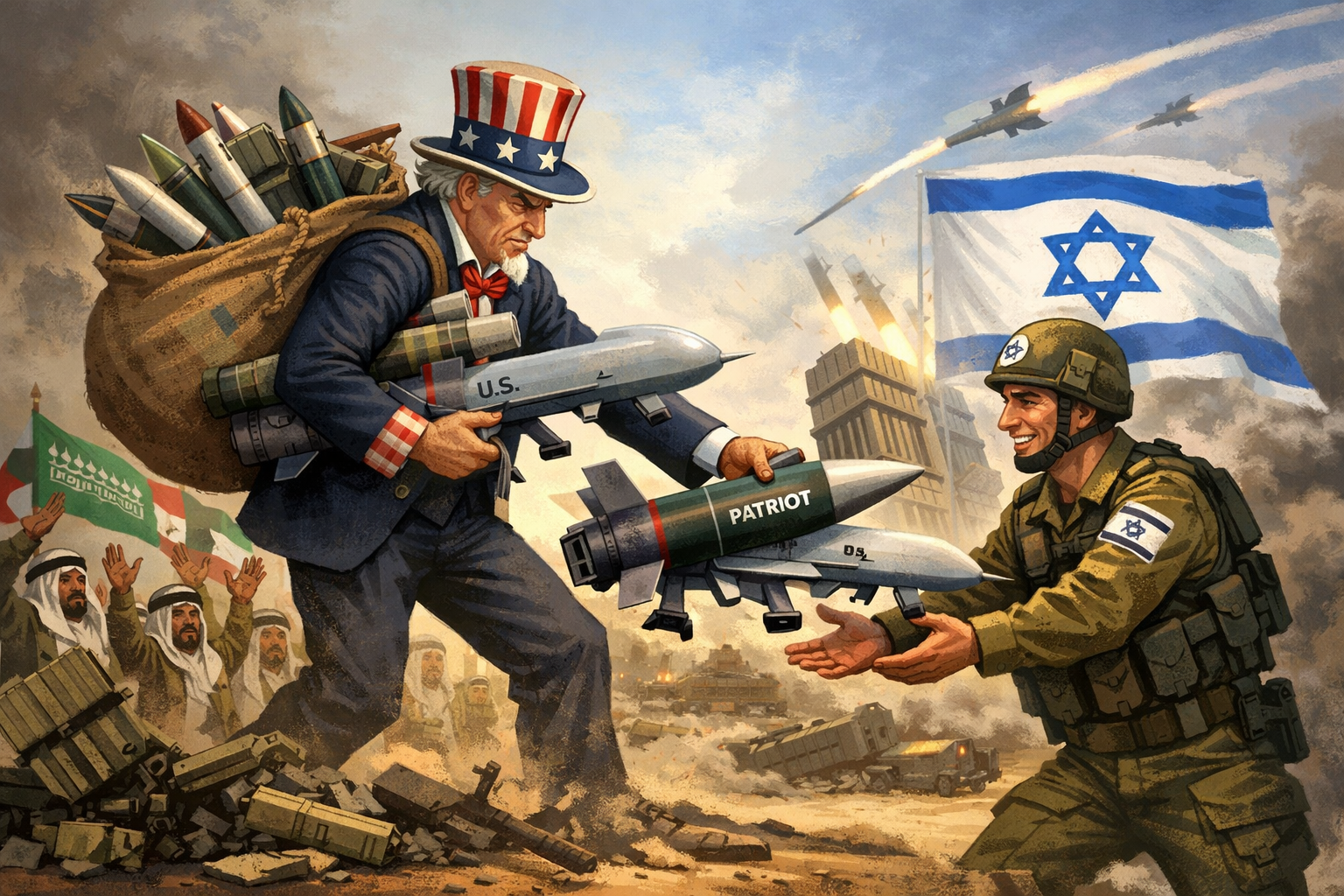
From October 2024, and through 2025, the U.S. began actively redeploying air defense systems, specifically the Terminal High Altitude Area Defense (THAAD) and Patriot batteries, from Gulf nations to Israel following the escalation between Israel and Iran.
In October 2024, President Biden ordered a THAAD battery and its crew to be moved to Israel to bolster its defenses.
By August 2025, the U.S. had redeployed a THAAD battery previously stationed in Abu Dhabi (UAE) to Israel to support their missile shield against Iranian threats.
This relocation represented a major strategic shift, leading to complaints from regional allies, such as Saudi Arabia, that the U.S. was prioritizing Israeli security over Gulf state defenses.
The U.S. had previously withdrawn Patriot systems from Saudi Arabia in 2021 before moving to replenish them in 2022, only for regional focus to shift back to Israel in 2024/2025.
In August 2025, Israel hosted up to six THAAD batteries drawn from the American global pool, marking a concentration of U.S. air defenses in Israel amid dwindling U.S. interceptor supplies.
In July 2025, the U.S. asked Saudi Arabia to send its missile interceptors to Israel during the conflict with Iran.
In August 2025, a Saudi official said, “US abandoned us and redirected its air defense to protect Israel.” The move left all the Gulf states that host American bases at risk.
As early as 1991, U.S. military personnel have operated the Patriot air defense system in Israel.
Saudi Arabia spends a great deal on defense and has not yet developed a domestic production. The Kingdom buys most of its defense materials from the U.S. in an agreement where Saudi petrodollars are forced into the American economy buying inferiorly made weapons, but at top prices.
Saudi Arabia avoids purchasing major Russian air defense systems (like the S-400) to prevent U.S. sanctions under CAATSA, avoid damaging their strategic military alliance with Washington, and to ensure defense systems are interoperable with existing Western technologies.
Several Gulf countries, particularly those that normalized relations through the Abraham Accords, purchase defense materials from Israel. The United Arab Emirates (UAE) is a key partner, having signed a $2.3 billion deal for Israeli Elbit Systems defense tech and engaging in joint, localized military production
The United Arab Emirates (UAE) fields batteries of two different Israeli and one South Korean medium-range SAM systems.
U.S. bases don’t protect the Gulf
The American military has been viewed as the most powerful military in the world, and representing the might of the superpower. But, there are cracks in that perception, which are laid clear for all to see in the current U.S.-Israeli unprovoked war on Iran.
U.S. bases in the Gulf gave an illusion of security to those oil-rich countries who paid for the bases, maintained them and have defended the bases instead of the bases defending the Gulf. The Gulf monarchies saw the bases as an insurance policy, protecting them against any eventual hostilities, but they now view those insurance payments as worthless.
The Iranian attacks on their Gulf neighbors continue and have not only killed and destroyed, but have effectively shut the source of income. With facilities hit and the waterway closed to shipping of their gas and oil, the Gulf countries must accept responsibility for their own decisions. They trusted the wrong partner for their security.
Iran is hitting the Gulf because they house thousands of American troops, who are actively killing, maiming and destroying parts of Iran with the express intent to change the government and institute a puppet regime.
The Gulf countries cannot evade their role in the current war on Iran: they are active participants in the war against Iran.
A Fractured Gulf Response
The Gulf states are increasingly exposed in a war they neither initiated nor fully control. As the United States redirected key air defense systems—including THAAD and Patriot batteries—from the region to reinforce Israel, long-standing assumptions about security in the Gulf have been shaken. For decades, American military presence was seen as a shield; today, many in the region are questioning whether that shield has been selectively repositioned.
This shift has unfolded as Iran’s retaliatory strikes have directly impacted Gulf infrastructure and economic lifelines, underscoring a new reality: proximity to U.S. military assets may now invite risk rather than guarantee protection. While Gulf governments continue to project unity, their internal calculations reveal a far more complex and fragmented picture.
Saudi Arabia, under Mohammed bin Salman, appears to be navigating this moment with caution. Riyadh sees strategic value in sustained pressure on Iran, yet remains deeply reluctant to be drawn into direct confrontation. Its preference is clear: a weakened Iran achieved externally, without exposing the kingdom to escalation or the consequences of a potentially inconsistent U.S. commitment.
The United Arab Emirates has taken a somewhat firmer line. With deeper security cooperation and growing defense ties, including with Israel, Abu Dhabi has shown greater openness to collective military measures, particularly those aimed at safeguarding maritime routes. It appears more willing than its neighbors to accept the risks of a prolonged confrontation if it produces a decisive shift in the regional balance.
For Bahrain, the situation is less about choice than exposure. Hosting the U.S. Fifth Fleet, it sits on the frontline of any escalation and remains heavily dependent on American protection. Its alignment with Washington reflects structural necessity rather than strategic autonomy.
At the other end of the spectrum, Oman continues to emphasize de-escalation. With longstanding channels to Tehran, Muscat views the conflict as a destabilizing rupture rather than an opportunity. Its priority remains preserving diplomatic pathways and preventing further regional fragmentation.
Between these poles sit Qatar and Kuwait. Qatar balances its role as host to a major U.S. military presence with its pragmatic ties to Iran, positioning itself as a potential intermediary. Kuwait, shaped by domestic political sensitivities and a cautious foreign policy tradition, has leaned toward restraint, focusing on limiting spillover and maintaining internal stability.
Across the region, a common pattern emerges. Gulf states are attempting to balance three parallel imperatives: avoiding direct military involvement, strengthening defensive and security coordination—often still with the United States—and keeping channels open to de-escalate tensions with Iran.
The result is not a unified strategy but a spectrum of risk tolerance. The UAE leans toward a more assertive posture; Saudi Arabia offers conditional support from a distance; Bahrain remains tightly aligned but vulnerable; Oman prioritizes diplomacy; and Qatar and Kuwait hedge between these positions.
What ultimately unites them is a deeper unease. The Gulf states now find themselves on the frontline of a confrontation driven by external powers, while facing the possibility that those same powers may not remain indefinitely committed. In that uncertainty lies the region’s greatest strategic concern.
Journalist Steven Sahiounie sought the expert opinion of Dr. Mohammed Mustafa, researcher in regional affairs and International relations.
Steven Sahiounie: What is your opinion on the role of Arab countries in this war? How do you view the leaks about Gulf states entering the war alongside the United States against Iran? And how do you think Iran would respond?
Dr. Mohammed Mustafa: In my assessment, Gulf countries do not appear to be heading toward direct involvement in the war alongside the United States against Iran. At the same time, they are no longer able to treat the ongoing developments as a distant external matter. This war is no longer confined to the Gulf alone; it now directly affects its internal security, infrastructure, maritime routes, and economic and strategic interests. From this perspective, the growing Gulf concern about the expansion of the confrontation can be understood, as well as the perception of its consequences as a serious threat to regional stability, as reflected in recent international deliberations.
It appears that Gulf capitals, under the pressure of this war, are attempting to balance between three main paths:
First, avoiding involvement in any direct offensive action against Iran.
Second, raising the level of defensive readiness, both at the national level and within the framework of collective coordination, by strengthening protection and security systems, developing existing defense partnerships with the United States and other international partners, and expanding areas of security cooperation with various regional and international powers in a way that serves the requirements of stability and protects vital interests.
Third, maintaining open channels for de-escalation with Iran, based on a general understanding that regional security ultimately requires reducing tensions and avoiding a slide into a broader confrontation. Nevertheless, Arab—and particularly Gulf—assessments of the seriousness of this war and its consequences vary from one country to another, depending on national considerations, geographic location, and the nature of their interests.
Accordingly, the most realistic scenario is not the establishment of an offensive Gulf alliance against Tehran, but rather a Gulf orientation toward strengthening the defensive umbrella and increasing levels of security coordination, alongside continued political caution and efforts to contain escalation.
Based on this, it is likely that defense and intelligence cooperation with the United States will increase in the coming period. The presence of U.S. bases in the region, the acceleration of measures related to protecting maritime navigation, and the redeployment of certain U.S. military capabilities are all indicators of growing security coordination—without constituting, so far, clear public evidence of a collective Gulf decision to engage in the war.
As for Iran, if it perceives direct and explicit Gulf involvement in this confrontation, its response is likely to be selective and limited rather than comprehensive. This could include pressure targeting vital facilities, maritime routes, or cyber domains, with the aim of sending calculated deterrent messages. At the same time, Tehran likely understands that it is in its interest to avoid any course of action that would push Gulf states into fully aligning against it, while keeping the possibility of mediation and de-escalation open.
Therefore, the most probable scenario does not point toward an open Gulf–Iran war, but rather toward a highly sensitive situation characterized by mutual deterrence, increased levels of security coordination, and continued efforts aimed at preventing escalation into a broader regional confrontation.
Steven Sahiounie is a two-time award-winning journalist.

