


Steven Sahiounie, journalist and political commentator
Libya is witnessing one of the most significant political moments since US President Obama took out Muammar Gaddafi in 2011, as regional and international actors intensify efforts to end years of institutional division and pave the way for long-delayed national elections.
At the center of these efforts is a US-backed initiative championed by Massad Boulos, Senior Advisor to US President Donald Trump for Arab, Middle Eastern, and African Affairs, aimed at unifying Libya’s rival administrations and state institutions.
Regional Powers Back Libyan Unification
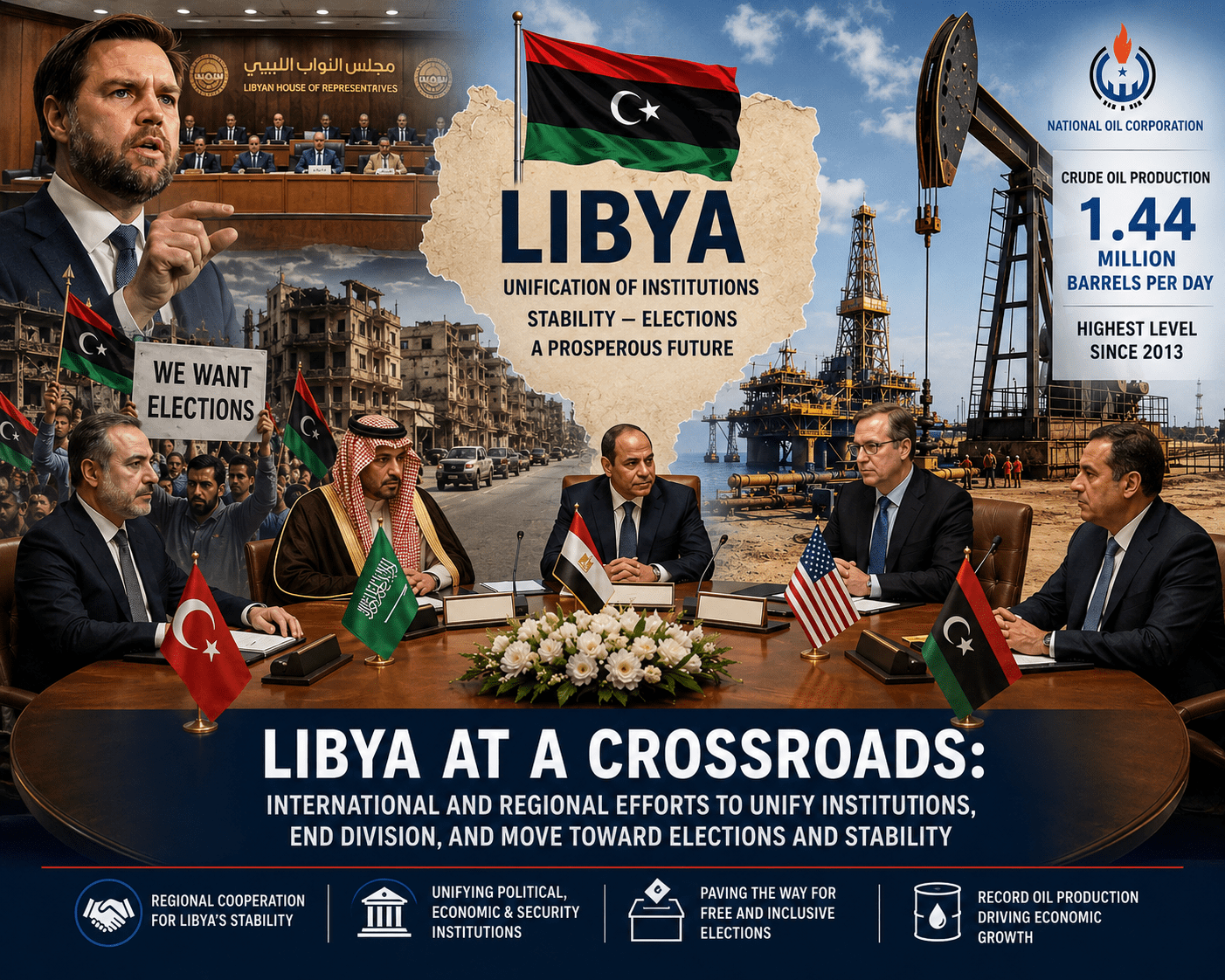
On June 20, a high-level quadrilateral meeting was held in Cairo, bringing together Egyptian Foreign Minister Badr Abdelatty, Saudi Foreign Minister Prince Faisal bin Farhan, Turkish Foreign Minister Hakan Fidan, and US presidential advisor Massad Boulos.
According to a statement issued by Boulos, the participants emphasized the importance of continuing efforts to unify Libya’s political, economic, and security institutions. They stressed that creating unified state structures is essential for establishing the conditions necessary for comprehensive national elections and achieving long-term stability.
The meeting also highlighted the need to build upon previous achievements and ongoing efforts aimed at reducing tensions and enhancing security throughout Libya and the wider region. The four countries reaffirmed their commitment to supporting Libya’s sovereignty, unity, and long-term stability.
The American Initiative
Boulos recently revealed that Washington is working to mediate a power-sharing arrangement between Libya’s competing administrations in the east and west.
“Our plan is to form a unified government and unify all institutions,” Boulos stated.
Although no official proposal has yet been publicly adopted by Libyan parties, reports indicate that the initiative envisions merging the internationally recognized Government of National Unity (GNU), led by Abdul Hamid Dbeibeh in Tripoli, with the eastern-based administration appointed by the House of Representatives and headed by Osama Hammad in Benghazi.
According to widely circulated reports, the proposed arrangement could allow Dbeibeh to remain prime minister of a unified government while a newly structured Presidential Council would include representatives from both eastern and western Libya. Some reports have suggested that Saddam Haftar, Deputy Commander of the Libyan National Army forces in the east, could play a leading role in a future presidential structure, although no official agreement has confirmed these details.
Mixed Reactions Inside Libya
The initiative has generated sharply divided reactions among Libya’s political institutions.
The leadership of eastern military forces announced its readiness to engage in direct negotiations regarding the American proposal, describing it as a potential pathway toward resolving the country’s prolonged political crisis and accelerating elections.
More than 104 members of Libya’s House of Representatives have publicly welcomed the initiative through separate statements, arguing that it could help end institutional fragmentation and move the political process forward.
Support has also emerged from numerous municipal councils across eastern, central, and southern Libya, whose mayors issued coordinated statements endorsing Boulos’ efforts and calling for national reconciliation.
However, opposition remains strong among other key political actors. Mohamed Takala, President of the High Council of State, and Mohamed al-Menfi, President of the Presidential Council, have both rejected the American initiative, arguing that Libya’s future should be determined through domestic consensus rather than externally sponsored arrangements.
A Competing Political Roadmap
The debate surrounding the American proposal coincides with a separate political initiative agreed upon by House of Representatives Speaker Aguila Saleh, Takala, and al-Menfi.
The three leaders announced a domestically inspired roadmap that calls for simultaneous presidential and parliamentary elections before February 2027 and the creation of a high-level committee to supervise the electoral process.
The United Nations Support Mission in Libya (UNSMIL) continues to facilitate discussions aimed at reaching a comprehensive political settlement capable of ending the country’s institutional division.
Dbeibeh Meets Egyptian Intelligence Chief
Amid these developments, Prime Minister Abdul Hamid Dbeibeh met with Egyptian General Intelligence Service Director Major General Hassan Rashad during the latter’s visit to Libya.
According to the Government of National Unity, the meeting focused on strengthening bilateral cooperation and discussing political developments in Libya. Both sides stressed the importance of maintaining coordination to support security, preserve national unity, and advance efforts to unify state institutions through peaceful political processes.
Libya’s Continuing Political Division
Libya remains divided between two rival administrations.
The Government of National Unity, led by Abdul Hamid Dbeibeh and headquartered in Tripoli, controls western Libya and retains international recognition.
Meanwhile, the eastern administration, headed by Osama Hammad and backed by the House of Representatives and Field Marshal Khalifa Haftar’s forces, governs eastern Libya and much of the south.
The roots of this division trace back to the collapse of the electoral process that was expected to follow the formation of Dbeibeh’s government in February 2021 under the UN-sponsored Libyan Political Dialogue Forum.
Despite international backing, elections were repeatedly postponed due to disputes over constitutional arrangements, candidate eligibility, and institutional authority.
Record Oil Production Strengthens Libya’s Economic Position
While political divisions persist, Libya’s energy sector has recorded remarkable progress.
National Oil Corporation (NOC) Chairman Masoud Suleiman announced that crude oil production has reached 1.44 million barrels per day, the highest level since 2013.
The achievement brings Libya close to its strategic target of producing 1.5 million barrels per day.
Recent developments include the successful drilling of a new development well at the Al-Khair field by Sirte Oil and Gas Production and Manufacturing Company. The well produces approximately 3,209 barrels of oil per day and nearly 2 million cubic feet of associated natural gas daily.
The NOC has also signed production-sharing agreements with several major international energy companies following Libya’s first licensing round in nearly two decades.
According to Suleiman, Libya possesses approximately 80 trillion cubic feet of natural gas reserves, including both conventional and unconventional resources, highlighting the country’s enormous energy potential.
U.S. Vice President Sparks Controversy
Political tensions were further heightened after US Vice President J.D. Vance referenced Libya as an example of state failure and instability during comments related to US-Iran policy.
Defending a memorandum of understanding involving Iran and criticizing some Israeli positions, Vance questioned whether it would serve American interests for Iran to become “another Libya.”
The remarks triggered strong criticism from the Foreign Affairs Committee of Libya’s House of Representatives, which described the comparison as unfair and insulting to the Libyan people.
The committee argued that Libya’s difficulties cannot be separated from international interventions that followed the 2011 uprising and called on Washington to adopt a more balanced and respectful political discourse.
The Legacy of 2011
Fifteen years after the NATO-backed war on Libya for regime change that overthrew Muammar Gaddafi, Libya has not recovered.
Critics of the intervention argue that Western powers dismantled Libya’s state institutions without establishing a sustainable political framework for governance.
The anti-Gaddafi coalition included a diverse range of actors, among them tribal groups, political activists, defected military officers, and the Muslim Brotherhood. Following the collapse of the former regime, extremist organizations, including Al-Qaeda-linked groups and later ISIS affiliates, established footholds in parts of the country, contributing to prolonged instability.
Former intelligence officials and scholars have pointed to the Obama administration as the cause of the destruction of Libya.
The result has been more than a decade of political fragmentation, competing governments, economic disputes, militia influence, and repeated delays to democratic elections.
National Reconciliation and the Road Ahead
Libya now stands at a decisive crossroads. On one side are international and regional efforts, including the American initiative, seeking immediate institutional unification through negotiated power-sharing arrangements.
On the other are domestic political roadmaps emphasizing a gradual transition toward elections under Libyan-led mechanisms.
Meanwhile, rising oil production and renewed international investment are providing economic momentum that could strengthen future stabilization efforts.
Whether Libya ultimately achieves national reconciliation will depend on the ability of its political leaders, regional stakeholders, and international partners to bridge longstanding divisions and create a framework capable of delivering legitimate elections, unified governance, and lasting security.
For the first time in years, however, multiple political tracks are converging around a common objective: ending Libya’s prolonged transitional period and restoring a unified state capable of meeting the aspirations of its people.
Steven Sahiounie is a two-time award-winning journalist.

