


By: Muhammad Asif Noor, Journalist and researcher
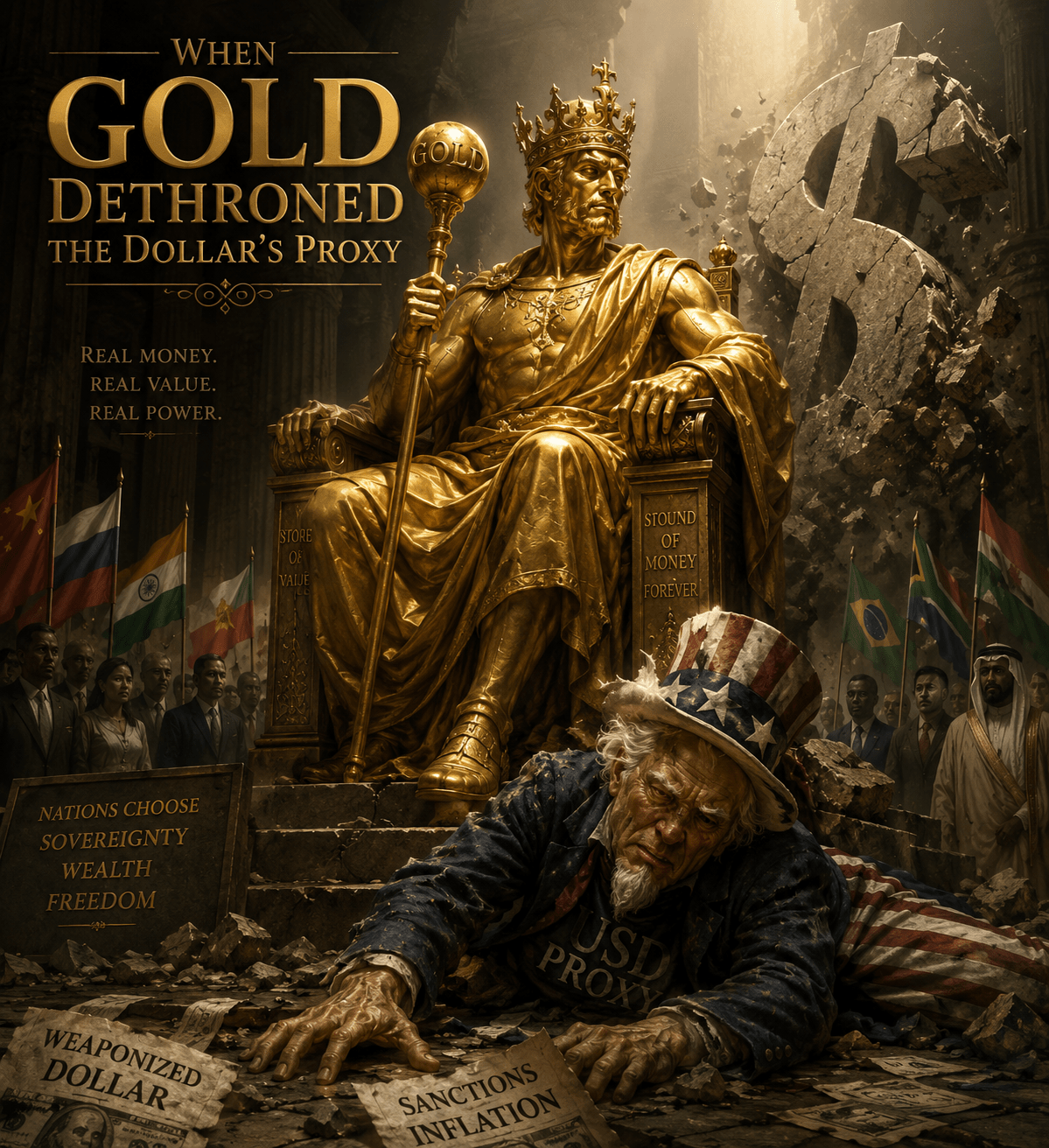
For seven decades, the U.S. Treasury bond served as the world’s security blanket. Central banks globally held American government debt the way previous generations held gold. A most reliable store of sovereign wealth in an uncertain world. That consensus cracked over three years of geopolitical tremors. On June 2, 2026, the European Central Bank made it public. The ECB’s annual report on the international role of the euro confirmed that gold ended 2025 as the world’s largest official reserve asset by market value, accounting for 27% of global reserves. U.S. Treasuries fell to 22%, and the euro trailed at 15%.
For anyone tracking the slow rewiring of the international monetary system, the numbers were not a surprise.
This is the first time in the modern financial era that a non-sovereign, non-yielding asset has outranked the US government’s own debt in the portfolios of the very institutions that sustain the international monetary system. The world absorbed this important data without a market tremor. That composure deserves scrutiny, because the number itself is anything but calm.
The ECB attributed the headline shift primarily to valuation effects, since gold prices rose approximately 60% in 2025 after gaining 30% in 2024. Using end-2023 gold prices would leave gold at around 16% of reserves, roughly level with the euro, and Treasuries still commanding 26%. The ECB’s own arithmetic, in other words, tells us that much of what happened was price, not policy. That is an important qualification. It is also an incomplete one. Price does not rise in a vacuum. Gold at these levels was bought, consistently and deliberately, by institutions whose job is to protect sovereign balance sheets over generational time horizons.
Since Russia-Ukraine war, China acquired more than 350 tonnes of gold, Poland added 320 tonnes, Turkey bought 220 tonnes, and India accumulated 130 tonnes, with Poland remaining the largest official-sector buyer in 2025. The geography of that list carries its own argument. Poland is a NATO frontline state with deep institutional ties to Western financial architecture. Its decision to accumulate gold at this pace is a statement about reserve prudence by a government that watched, in February 2022, what happened when a sovereign’s dollar assets became a policy instrument overnight. Western sanctions froze nearly $300 billion of Russian central bank reserves, cutting major banks from the SWIFT system and demonstrating that dollar exposure carries political risk alongside financial risk.
The U.S.-China dimension of this story runs deeper than the reserve data alone can show. China cut its U.S. Treasury holdings to a 16-year low during the trade war escalation of 2025, dropping to $757 billion, down from $769 billion a year earlier, as tariff tensions rattled confidence in American government bonds as the world’s safest asset. Despite a fragile truce following a May 2025 summit between Trump and Xi, high tariffs, rare earth restrictions, and technology export controls remain major sticking points between the world’s two largest economies. What is easy to miss in the trade coverage is the monetary signal running underneath the geopolitics. Every time Washington uses financial architecture as a policy lever, whether through sanctions, tariffs, or debt ceiling standoffs, it accelerates the very diversification trend that erodes Treasury demand over the medium term.
The ECB report captured something important in its own analysis of euro-denominated assets. International debt issuance in euros rose 30% in 2025 to nearly €1 trillion, while foreign investors added a net €850 billion to euro-area assets, pushing portfolio inflows close to record levels. Europe is the quiet beneficiary of this moment, though perhaps not as much as it could be. The euro’s share in foreign exchange reserves actually fell 0.5 percentage points to 20.2%, suggesting that reserve managers avoid abrupt changes to strategic benchmarks even during periods of heightened uncertainty.
Lagarde herself acknowledged the gap between opportunity and execution, warning that forces of fragmentation are becoming more pronounced and that Europe cannot afford complacency. The euro is picking up trade finance and bond market share. It is gaining slower in the reserve column, and the reason is straightforward. The reason is that the reserve managers move strategically, incrementally, and above all, they move toward depth and liquidity. The euro-area capital market, still fragmented across national jurisdictions, provides neither at the scale the dollar does.
The ECB’s own report acknowledges gold’s limitations as a reserve asset: it generates no income, its price can swing sharply, and much of its rise in reserve rankings has come from price appreciation rather than explosive fresh buying. These are legitimate qualifications. Gold is awkward to deploy in a currency crisis. A central bank cannot use its gold holdings to defend its exchange rate with the speed that dollar reserves allow. But this is precisely where the geopolitical argument overtakes the purely financial one. The question reserve managers are now asking is about what happens when the liquidity mechanism itself becomes a political instrument. Gold answers to no sovereign. It cannot be frozen, sequestered, or sanctioned. In the current environment, that quality carries a premium that no yield calculation fully captures.
The deeper question the ECB report raises is whether the current trajectory leads anywhere stable. A world in which gold commands 27% of official reserves because sovereign borrowers are trusted less is a world with a coordination problem at its heart. Gold generates no yield, funds no development bank, settles no trade invoice, and provides no framework for managing global imbalances. It is, at its core, a protest asset, accumulated when trust in the existing system falls below a threshold.
The fact that it now outranks U.S. Treasuries in the reserve portfolios of the world’s central banks is a measurement of how far that trust has fallen. The reset that both the U.S. and its main creditors require is a political one, and that requires a durable framework for economic engagement that separates financial architecture from geopolitical leverage. That framework has been absent since 2022. Gold’s rise is the ledger entry for its absence.
*The writer is Founder, Friends of BRI Forum and Advisor to Pakistan Research Centre, Hebei Normal University

