


Steven Sahiounie, journalist and political commentator
A potentially historic political transformation is quietly unfolding in the Gaza Strip. While international attention has largely remained focused on ceasefire negotiations and humanitarian relief, parallel developments behind the scenes suggest that Gaza may be entering the first stage of a comprehensive post-war transition.
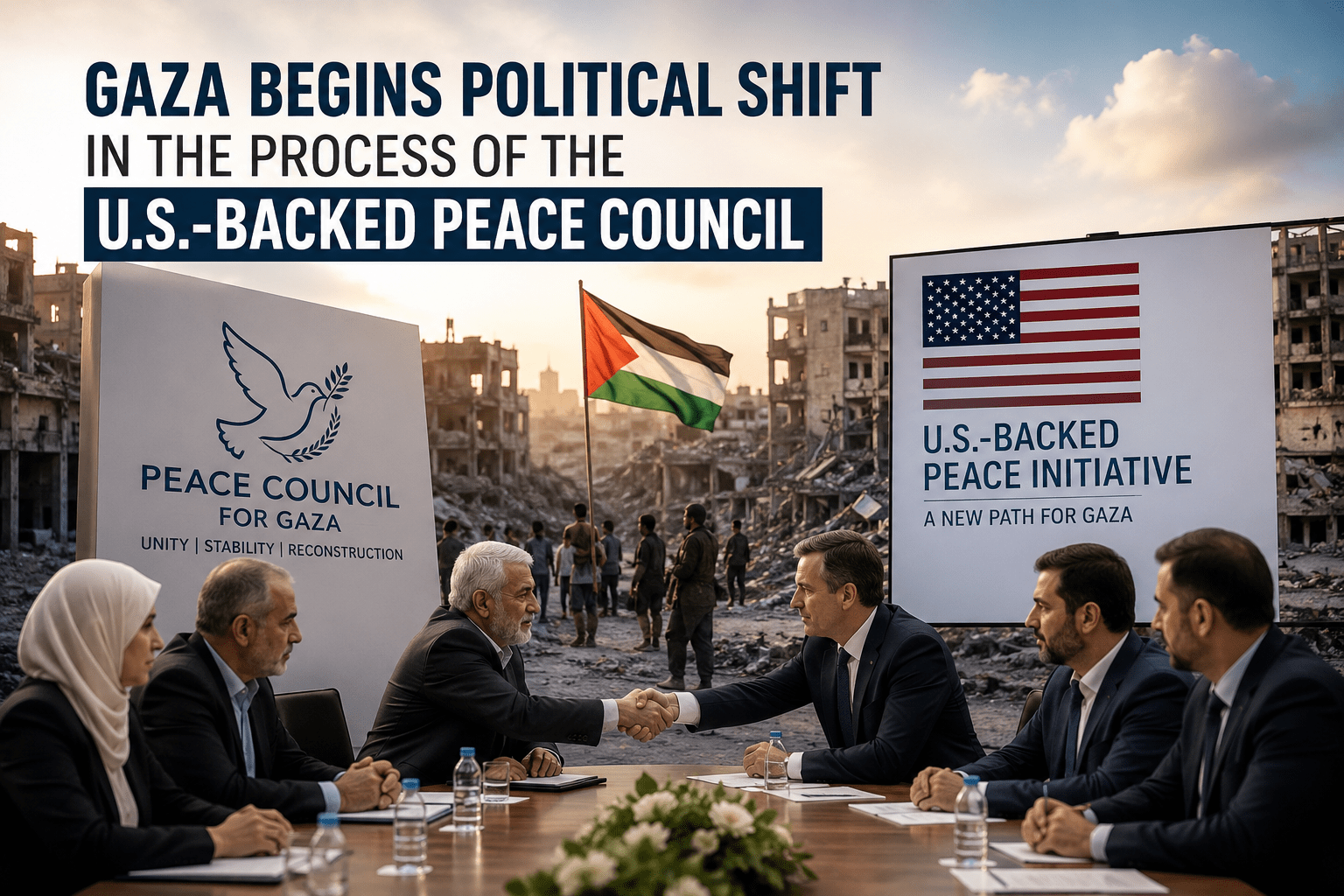
Hamas has announced the dissolution of its governing administration, while a U.S.-supported Peace Council is advancing plans for a technocratic Palestinian administration backed by an international stabilization force.
Together, these developments represent the clearest indication yet that negotiations have moved beyond ending the war and toward determining who will govern Gaza once the fighting permanently ends.
A Pilot Humanitarian Zone
Senior officials involved in the Peace Council initiative confirmed that preparations are underway for an experimental humanitarian zone in southern Gaza designed to accommodate tens of thousands of Palestinian civilians on a voluntary basis.
The project, which is still under discussion, is expected to become the first operational area administered by the Palestinian National Committee for Gaza Administration—a technocratic body created to oversee civilian governance during Gaza’s post-war transition under President Donald Trump’s 20-point framework.
Officials describe the initiative as a pilot project that would allow civilian institutions to begin functioning independently while providing humanitarian assistance, municipal services, and local administration in a secure environment.
The proposed site is expected to be located in Rafah, although planners say the exact location has not yet been finalized and construction has not begun.
International Security Instead of Israeli Control
Unlike previous proposals discussed during the war, security inside the humanitarian zone would reportedly be handled by a multinational International Stabilization Force operating under the Peace Council.
Palestinian technocrats serving on the National Committee would oversee civilian registration and security screening, while the multinational force would secure the area.
Officials insist Israeli forces would not manage civilian affairs or conduct security screening inside the humanitarian zone.
Instead, the international force would establish a buffer separating Israeli military positions from Palestinian civilian communities.
Entry and exit would remain open to all unarmed civilians, while security screening would seek to prevent armed groups from entering the designated safe areas.
Legal and Humanitarian Debate
The proposal has already generated significant concern among diplomats and humanitarian organizations working in Gaza.
Several officials familiar with humanitarian operations argue that concentrating civilians inside designated areas with controlled access raises serious legal questions under international humanitarian law.
Critics warn that such arrangements could amount to de facto forced displacement, restrict civilian freedom of movement, and undermine humanitarian neutrality.
Supporters counter that the zones could provide badly needed security, humanitarian access, and a functioning civilian administration while broader political negotiations continue.
Hamas Announces End of Its Civilian Government
In one of the most consequential political announcements since the war began, Hamas formally dissolved its governing administration in Gaza.
During a press conference, Government Media Office Director General Ismail Al-Thawabta confirmed that Mohammad Al-Farra, who headed both the Government Follow-up Committee and the Government Emergency Committee, had officially resigned.
The decision clears the way for transferring civilian administration to the Palestinian National Committee for Gaza Administration.
Officials stated that existing government institutions will temporarily remain operational under professional civil servants until the transition is completed.
According to Hamas, every administrative and legal arrangement necessary for the transfer of authority has already been finalized following consultations involving Palestinian political factions, tribal leaders, civil society organizations, and a United Nations observer.
The movement described the decision as an effort to alleviate civilian suffering amid continuing war, delayed reconstruction, border closures, and the ongoing humanitarian crisis.
A Technocratic Administration Ready to Govern
Ali Shaath, head of the Palestinian National Committee, announced that the committee is fully prepared to assume responsibility for governing Gaza once conditions allow its deployment inside the territory.
According to Shaath, successful administration requires three fundamental principles:
– A single governing authority.
– One unified legal framework.
– One security structure operating under civilian authority.
The committee has remained in Cairo for months awaiting authorization to enter Gaza.
Hamas Signals Political Flexibility
Hamas spokesman Hazem Qassem described dissolving the movement’s government as an effort to remove what he characterized as Israeli justifications for continuing military operations.
He confirmed Hamas has formally informed regional mediators of its decision and reiterated the movement’s commitment to transferring governmental responsibilities to the National Committee.
The movement has called upon the Peace Council, international guarantors, and regional mediators to pressure Israel into permitting the committee’s immediate entry into Gaza.
Negotiations Continue Behind Closed Doors
Diplomatic activity has intensified in Cairo, where Hamas recently completed another round of negotiations before its delegation departed for Istanbul.
Sources involved in the talks say Hamas submitted its response to the latest revised Peace Council proposal and expects Israel to deliver its formal reply within days.
Officials involved in the mediation process report that discussions have made significant progress, with agreement reportedly reached on most provisions contained in the latest negotiating framework.
Weapons and Security
Perhaps the most politically sensitive issue remains Gaza’s future security structure.
According to senior Hamas political adviser Taher Al-Nono, Palestinian factions support transferring heavy weapons—including rockets, launchers, and weapons manufacturing facilities—to a Palestinian authority under protocols drafted by the National Committee, provided Israeli forces play no role in the process.
However, Hamas maintains that complete transfer of all weapons would occur only within the framework of an internationally recognized Palestinian state.
The movement also proposes that disarmament proceed gradually alongside phased Israeli military withdrawals and remain separate from reconstruction efforts.
Reconstruction Becomes the Next Battleground
As negotiations continue, reconstruction planning has quietly begun. The first tender for debris removal in Rafah has already been published, reopening discussion over one of the largest reconstruction efforts in modern Middle Eastern history.
Israeli researcher Oded Bukhter has proposed using millions of tons of war rubble to reclaim approximately ten square kilometers of land from the Mediterranean Sea, arguing that the project could reduce Gaza’s population density while creating space for future urban development.
The proposal would require carefully processing debris, removing explosives, separating metals and glass, and implementing major environmental safeguards. Critics have questioned both its environmental impact and its political implications.
Washington’s Emerging Reconstruction Vision
Israeli media report that Washington has submitted a comprehensive reconstruction framework that would allow rebuilding efforts to begin even before Hamas fully disarms.
According to the reported proposal, Israel would permit critical infrastructure projects involving electricity, water systems, hospitals, communications networks, and construction materials.
The framework also envisions gradually relocating civilians into Peace Council-administered areas by the end of 2026, establishing permanent headquarters for the technocratic administration, transferring tax revenues, introducing fourth-generation mobile communications, rebuilding the European Hospital, and deploying an International Stabilization Force supported by an unarmed Palestinian civilian security service.
The proposal reportedly includes conditional amnesty for individuals voluntarily surrendering weapons while preserving Israel’s right to undertake future security operations if disarmament commitments are not fulfilled.
An Uncertain Road Ahead
Despite growing diplomatic momentum, the major obstacle remains Israel, and their policies against the Palestinian people.
Israel continues to insist that Hamas ultimately surrender its military capabilities before fully implementing reconstruction and long-term political arrangements. Hamas, meanwhile, argues that reconstruction should not be conditioned on immediate disarmament and continues to seek guarantees regarding Israeli military withdrawal and the establishment of a unified Palestinian governing authority.
Whether the current negotiations produce a lasting settlement remains uncertain.
What is becoming increasingly clear, however, is that discussions surrounding Gaza have evolved beyond ceasefire negotiations. They now encompass the territory’s future political system, civilian governance, international security arrangements, economic reconstruction, and the broader question of who will ultimately govern Gaza after the war.
The coming weeks may determine not only whether the ceasefire endures, but also whether Gaza enters a new political era unlike any in its modern history.
Steven Sahiounie is a two-time award-winning journalist.
https://www.aljazeera.com/news/2026/7/9/israeli-attacks-on-gaza-kill-10-people-in-24-hours-despite-ceasefi

