


Steven Sahiounie, journalist and political commentator
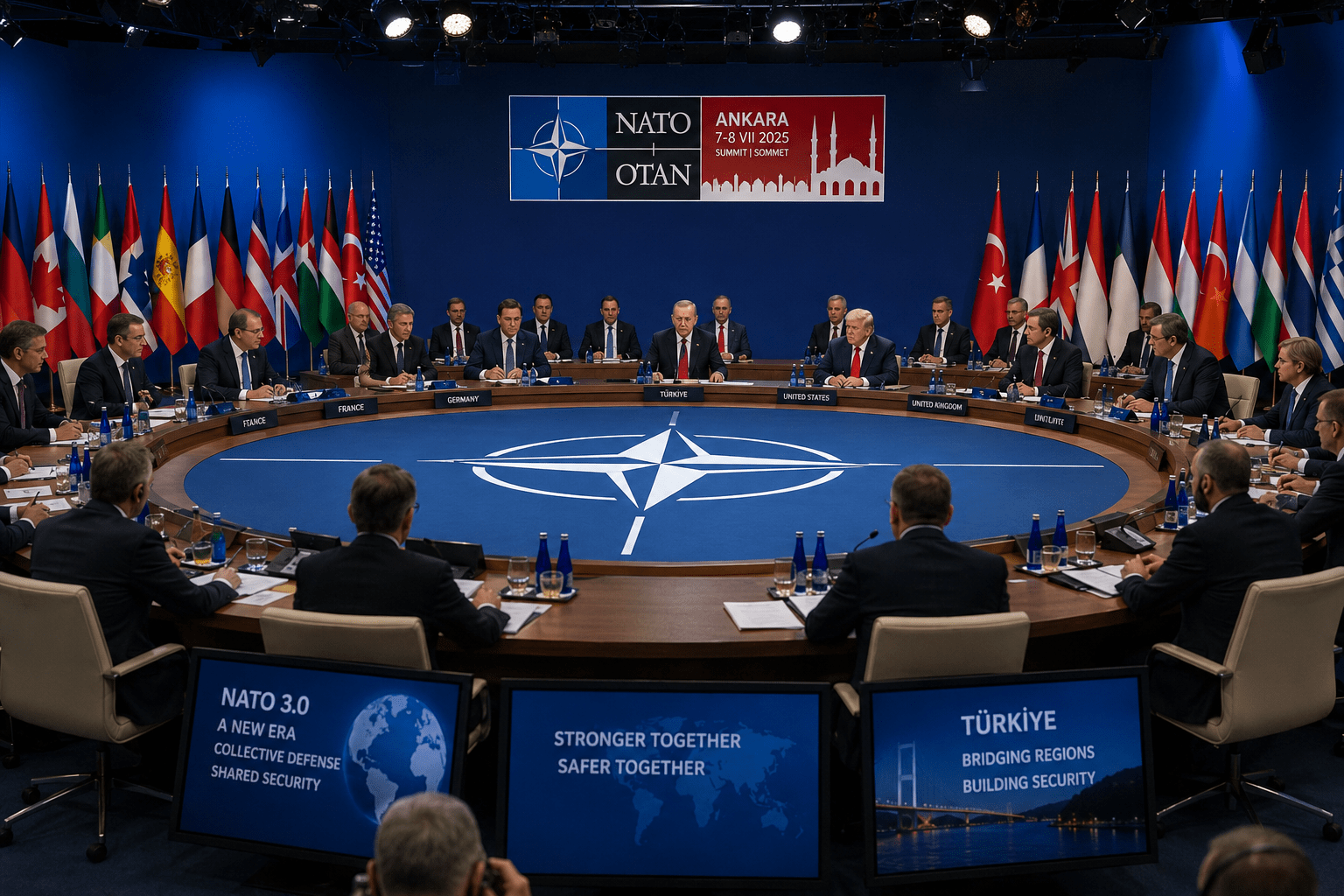
Türkiye hosted the NATO Summit on July 7–8, at one of the most consequential moments in NATO’s modern history, with member states facing mounting pressure to increase defense spending, strengthen military capabilities, and redefine the Alliance’s strategic priorities amid escalating geopolitical tensions.
Many analysts said the summit exposed the deep fractures within the members of NATO, with the Alliance seemingly unaligned on many issues. Each member of NATO is pulling in separate directions.
Türkiye is hoping to emerge as one of the Alliance’s most influential strategic actors. But, this has been met with Israeli concern that their position as the region’s premier U.S. ally may be threatened.
Trump Signals Major Shift in U.S.–Türkiye Relations
One of the summit’s most closely watched developments was President Donald Trump’s meeting with Turkish President Recep Tayyip Erdoğan. Trump described Türkiye as “a great ally” and stated that U.S.–Turkish relations are now “better than ever.”
He announced that Washington is considering approving the sale of F-35 fifth-generation fighter aircraft to Türkiye and indicated he had no concerns regarding Ankara’s acquisition of the advanced aircraft.
The Trump administration is preparing to reintegrate Türkiye into the F-35 program after its suspension in 2019 following Ankara’s purchase of the Russian S-400 air defense system.
Trump also praised Türkiye’s role during the recent conflict involving Iran, describing Ankara as a valuable partner that contributed to diplomatic efforts aimed at ending hostilities and preventing Iran from acquiring nuclear weapons.
Netanyahu Warns Against F-35 Transfer
Israeli Prime Minister Benjamin Netanyahu is strongly opposed to the potential sale of F-35 aircraft to Türkiye.
Netanyahu argued that such a deal would “destroy the balance of power” in the Middle East.
Erdogan’s stance in support of the Palestinian people, and against the genocidal policies of Israel, has caused some Israeli politicians to call Turkey “the new Iran”.
NATO describes itself as a defense organization. However, historically it has always been an offense organization. The US-NATO attack on Yugoslavia, Iraq, Libya, Yemen and Syria were carried out on orders from Washington and enriching the Western military-industrial complex.
Turkiye played a major role in the US-NATO invasion and attack on Syria for regime change by hosting the mercenaries used to fight the Syrian people.
The European members of NATO recall that it was Turkiye who opened the flood-gates of migrants from Syria to Europe in beginning in 2015, which has destabilized Europe and drained it of funds.
Türkiye’s Path into NATO
NATO was founded in Washington on April 4, 1949, by twelve member states based on the principle of collective defense established under Article 5 of the North Atlantic Treaty, which declares that an attack against one member is considered an attack against all.
Incirlik Air Base began operations in February 1955 and it evolved into one of NATO’s most strategically important military facilities, supporting operations across the Middle East.
From Friction to Strategic Partnership
Although Türkiye has experienced numerous disagreements with several NATO allies over regional conflicts, defense procurement, and foreign policy, it has consistently maintained a central role within the Alliance.
Its strategic geography—bridging Europe, the Middle East, the Black Sea, and the Caucasus—combined with the Alliance’s second-largest military force after the United States, has made Türkiye indispensable to NATO’s southern flank.
Today, Türkiye seeks not merely to remain a NATO member but to help shape the Alliance’s future security architecture while promoting its rapidly expanding domestic defense industry.
NATO Secretary General Mark Rutte argues that Europe must assume greater responsibility for its own security while maintaining NATO’s transatlantic character. Under the new framework, member states have committed to increasing defense expenditures to 5 percent of GDP by 2035.
Rutte emphasized that financial commitments alone are insufficient, stressing that increased spending must translate into deployable military capabilities, stronger defense industries, and accelerated production of advanced weapons systems. This position reflects U.S. President Donald Trump’s criticism of NATO and past threats to pull the U.S. out of the organization.
Türkiye’s Defense Industry Takes Center Stage
Türkiye’s defense sector has undergone remarkable expansion in recent years, with military exports exceeding $10 billion last year. Turkish manufacturers now produce a wide range of defense systems—including drones, artillery munitions, armored vehicles, and electronic warfare technologies—often delivering products faster and at lower cost than many Western competitors.
Massive Defense Contracts Announced
The Ankara summit also showcased NATO’s growing investment in defense modernization.
Diplomats confirmed that new defense contracts announced during the summit exceed $50 billion.
Major agreements were signed involving Canada, Germany, Sweden, France, UK and Poland.
Türkiye’s Expanding Strategic Role
American and Turkish observers increasingly agree that Türkiye has undergone a transformation within NATO.
Once frequently portrayed as the Alliance’s most controversial member, Ankara is now widely viewed as one of its most indispensable strategic partners.
Türkiye controls access to the Black Sea, commands NATO’s second-largest military, possesses a rapidly expanding defense industry, and occupies a pivotal geographic position connecting Europe, Asia, and the Middle East.
The Ankara Summit may ultimately be remembered not simply as another NATO meeting, but as the one in which Türkiye plays a leading role in shaping NATO’s future. However, NATO’s future remains uncertain due to the lack of unity among its members.
Steven Sahiounie is a two-time award-winning journalist.

