


By Steven Sahiounie, journalist and political commentator
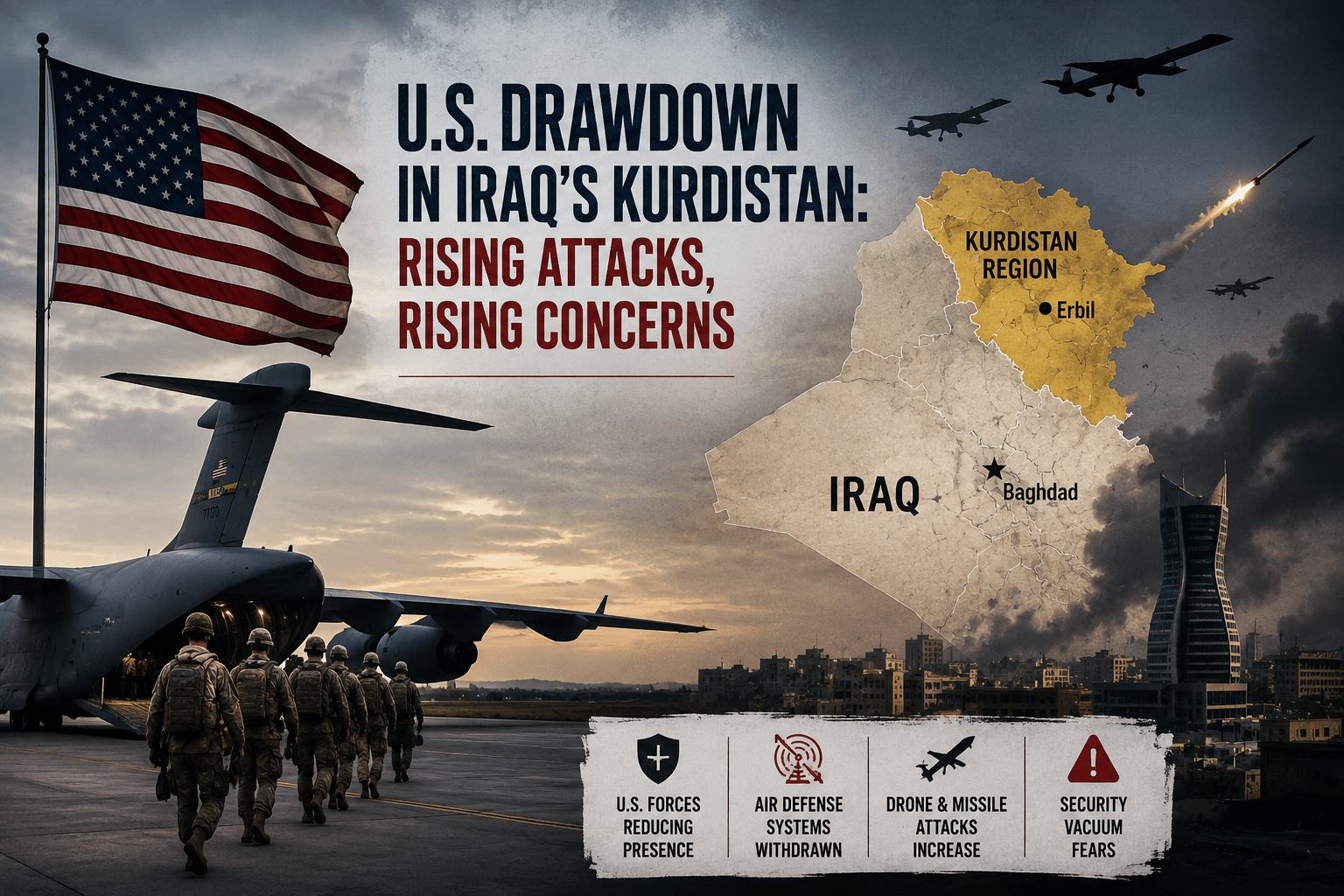
The United States has begun a gradual reduction of its military presence in Iraq’s Kurdistan Region, including the reported withdrawal of some Patriot air-defense systems, troops, and heavy equipment, according to Kurdish officials and multiple media reports.
The move comes amid a sharp increase in drone and missile attacks across the autonomous region and growing concerns that the reduction of American military capabilities could leave U.S. facilities and strategic sites more vulnerable to attack.
The reported drawdown is believed to be part of broader security arrangements between Washington, Baghdad, and the Kurdistan Regional Government aimed at restructuring the U.S. military presence in Iraq.
Kifah Mahmoud, media adviser to the leader of the Kurdistan Democratic Party, confirmed that a withdrawal process was underway but said it had been planned for months and should not be viewed as a sudden development.
“Yes, a withdrawal process is taking place, but this is not surprising. U.S. forces have been preparing for these arrangements for months,” Mahmoud said.
He rejected reports that the United States had completely removed its air-defense capabilities from the Kurdistan Region, saying that some systems remained in place to protect American interests and strategic facilities.
According to reports cited by The Jerusalem Post, Patriot air-defense systems have been removed from the Harir military facility near Erbil. The systems are designed to detect and intercept incoming missiles and drones.
Other reports said the withdrawal began last week and remains ongoing, with significant numbers of U.S. troops and heavy equipment reportedly being redeployed outside Iraq. The exact destination of the redeployed systems and forces has not been publicly disclosed.
Mahmoud said U.S. troops previously stationed at Al Asad Air Base and other locations in Anbar Province had moved to Harir Air Base in Erbil in accordance with arrangements between Baghdad and the Kurdistan Regional Government. He said those forces were now preparing for a final redeployment to bases outside Iraq.
The United States has maintained a military presence in Iraq for years, supporting Iraqi security forces, conducting training and intelligence operations, and contributing to the international coalition against Islamic State.
The reported reduction in forces comes as the Kurdistan Region faces an escalating security threat.
According to Kurdish media statistics, Erbil Province experienced 66 drone attacks and two missile attacks during July, while Sulaymaniyah recorded 10 missile attacks and nine drone attacks. Missile debris was also reportedly found in Halabja Province.
A separate tally cited by Rudaw reported 88 attacks across the Kurdistan Region during July, resulting in 10 deaths and 15 injuries.
Since regional tensions intensified on February 28, local media have reported more than 950 missile and drone attacks across the region, causing dozens of deaths and injuries.
The attacks have reportedly targeted U.S. military facilities, Kurdish political sites, and Iranian Kurdish opposition groups based in the region. In several cases, coalition air defenses reportedly intercepted drones before they reached their intended targets.
The latest reported attack involved two drones targeting the vicinity of Kijena village in Sulaymaniyah Province. No official casualty figures were immediately available.
The escalation has raised concerns over the ability of the Kurdistan Region and the federal government in Baghdad to defend their territory independently.
Iraq lacks a comprehensive air-defense network capable of effectively countering sophisticated missile and drone threats. The country also has limited early-warning radar capabilities to detect incoming projectiles and violations of its airspace.
The reported U.S. drawdown has also revived longstanding Kurdish concerns about Washington’s commitment to the region.
Kurdish leaders have historically relied on American military and political support, particularly during the fight against Islamic State. However, previous shifts in U.S. policy have left Kurdish officials concerned that Washington could once again prioritize broader strategic interests over its partnership with the Kurds.
The situation has become more complicated amid tensions between the United States, Israel, and Iran.
Kurdish groups have reportedly faced pressure to play a greater role in efforts against Tehran, while Iran has repeatedly warned against the use of Iraqi territory for activities it considers threats to its national security.
The Kurdistan Regional Government is therefore facing a difficult balancing act: maintaining close relations with Washington while avoiding direct involvement in a wider confrontation with Iran.
The U.S. military drawdown is also unfolding amid tensions between Iraq and Saudi Arabia.
Saudi authorities have accused armed groups operating from Iraqi territory of launching drone attacks against critical infrastructure and targets in Riyadh. Baghdad has rejected the allegations.
Sabah Al-Numan, spokesman for Iraqi Prime Minister Ali Faleh Al-Zaidi, said no evidence had been presented proving that Iraqi territory was used to launch the attacks.
“No party has provided any evidence proving the validity of these allegations so far,” Al-Numan told the Iraqi News Agency.
The dispute threatens to strain years of improving relations between Baghdad and Riyadh. A planned visit by Prime Minister Al-Zaidi to Saudi Arabia was reportedly postponed amid the latest regional developments.
A Saudi government source said Riyadh remained committed to its relationship with Iraq and insisted that recent military action was directed at militia capabilities rather than the Iraqi state or its people.
The source said Saudi Arabia did not seek escalation but would respond to attacks originating from Iraqi territory.
The developments have placed Iraq at the center of an increasingly complex regional security environment.
For Washington, the challenge is to reduce its military exposure while protecting its diplomatic and strategic interests. For Baghdad, the priority is to prevent Iraqi territory from becoming a launchpad for attacks against neighboring countries. For Kurdistan, the immediate concern is whether the region can maintain security as American forces and air-defense systems are gradually reduced.
The coming months will determine whether the U.S. drawdown represents a carefully managed transition toward a smaller security partnership—or the beginning of a broader American disengagement from Iraq.
With drone and missile attacks continuing to rise, the most pressing question may be whether the reduction of American military capabilities will create a security vacuum at precisely the moment when the region can least afford one.
Journalist Steven Sahiounie Interviewed Iraqi political researcher Mohamed Salah Turki
1- Media reports have been speaking of the withdrawal of several U.S. military bases from Iraq in general, and from the Kurdistan Region in particular. In your opinion, if these reports are accurate, how would this affect Iraq?
The final withdrawal of the international coalition forces from Iraqi territory represents an important milestone in Iraq’s efforts to fully restore its sovereignty over its territory and manage its security affairs through its own national capabilities. The Iraqi government and the United States have reached an agreement to completely end the presence of international coalition forces in Iraq according to an agreed-upon timetable.
In September 2025, the first phase of the agreement was implemented, with part of the U.S. and international coalition forces withdrawing. The final phase is scheduled to be completed by September 2026, when the remaining forces are expected to withdraw from all their positions and military bases across the various Iraqi provinces, including the Kurdistan Region.
The security situation in Iraq today is fundamentally different from what it was in previous years. The Iraqi armed forces and security agencies have made significant progress in training, armament, and operational experience. They now possess advanced capabilities that enable them to protect national sovereignty, secure the country’s land, air, and maritime borders, and confront various security threats and challenges with efficiency and competence.
The state of security and stability currently prevailing in Iraq also reflects the high level of readiness of the country’s military and security institutions and their ability to fulfill their constitutional responsibilities in maintaining security and protecting citizens. This has strengthened the government’s confidence in the ability of its security agencies to manage the security file independently, without the need for foreign troops to remain on Iraqi soil.
The responsibility for protecting Iraq and safeguarding its sovereignty rests with its military and security institutions, which have demonstrated in recent years their ability to confront various challenges, drawing on accumulated experience and the continuous development of their combat and intelligence capabilities. From this perspective, the completion of the international coalition’s withdrawal represents a natural step that is consistent with the development of Iraq’s security capabilities. It also confirms that Iraq now possesses the necessary means to protect its territory and borders and preserve its security and stability within the framework of state sovereignty and the rule of law, through its official institutions alone.
2- Saudi Arabia was targeted several days ago, and Iraqi factions allied with Iran were immediately accused. In your opinion, is it possible that Israel was behind the attack on the Kingdom in order to fuel Arab-Arab conflict in general and Sunni-Shia sectarian tensions in particular?
In light of the accusations directed at certain Iraqi factions regarding the attacks that targeted the Kingdom of Saudi Arabia, the Iraqi government called for evidence to establish the source of those attacks, emphasizing the need to rely on diplomatic channels and official investigations before making accusations. Supporters of this view argue that the developments that followed, including attacks on sites belonging to Iraq’s Popular Mobilization Forces (PMF) and the resulting casualties, contributed to an escalation of tensions and cast a shadow over Iraqi-Saudi relations.
This perspective also suggests that these developments could be linked to attempts to justify the continuation of the U.S. military presence in Iraq, despite the announced agreement to end it. It warns that continued escalation could negatively affect relations between Baghdad and Riyadh.
Those who hold this view call on the Iraqi government to take effective diplomatic and legal measures to safeguard Iraq’s sovereignty and protect its national interests in accordance with international frameworks.
At the same time, the possibility that Israel could be involved in such an attack in an attempt to deepen Arab-Arab divisions or inflame Sunni-Shia tensions remains a hypothesis that would require credible evidence and an official investigation before it could be established as fact. Any assessment of responsibility should therefore be based on verifiable evidence rather than assumptions, particularly given the potential regional consequences of such accusations.If you want, I can also turn this into a more powerful, professional English interview format with sharper political analysis and language suitable for publication in an international news outlet.

