


Steven Sahiounie, journalist and political commentator
Behind the armed conflict between Riyadh and Yemen’s Houthi movement lies a much broader strategic struggle: the rivalry between Saudi Arabia and Iran, two regional powers whose competing interests have influenced the political and security landscape of the Middle East for years.
Escalating tensions between Washington and Tehran threaten to push the region toward another major confrontation. The conflict in Yemen is increasingly intertwined with broader regional security calculations, maritime competition, energy infrastructure protection, and the strategic interests of the US and Israel.
An attack on King Khalid International Airport in Riyadh on Saturday had killed 12 people and injured 309 others, including several in critical condition.
Saudi Arabia Launches a Major Military Operation in Yemen
As the confrontation intensifies, the Saudi-led coalition has announced a broad military operation targeting Houthi personnel and capabilities.
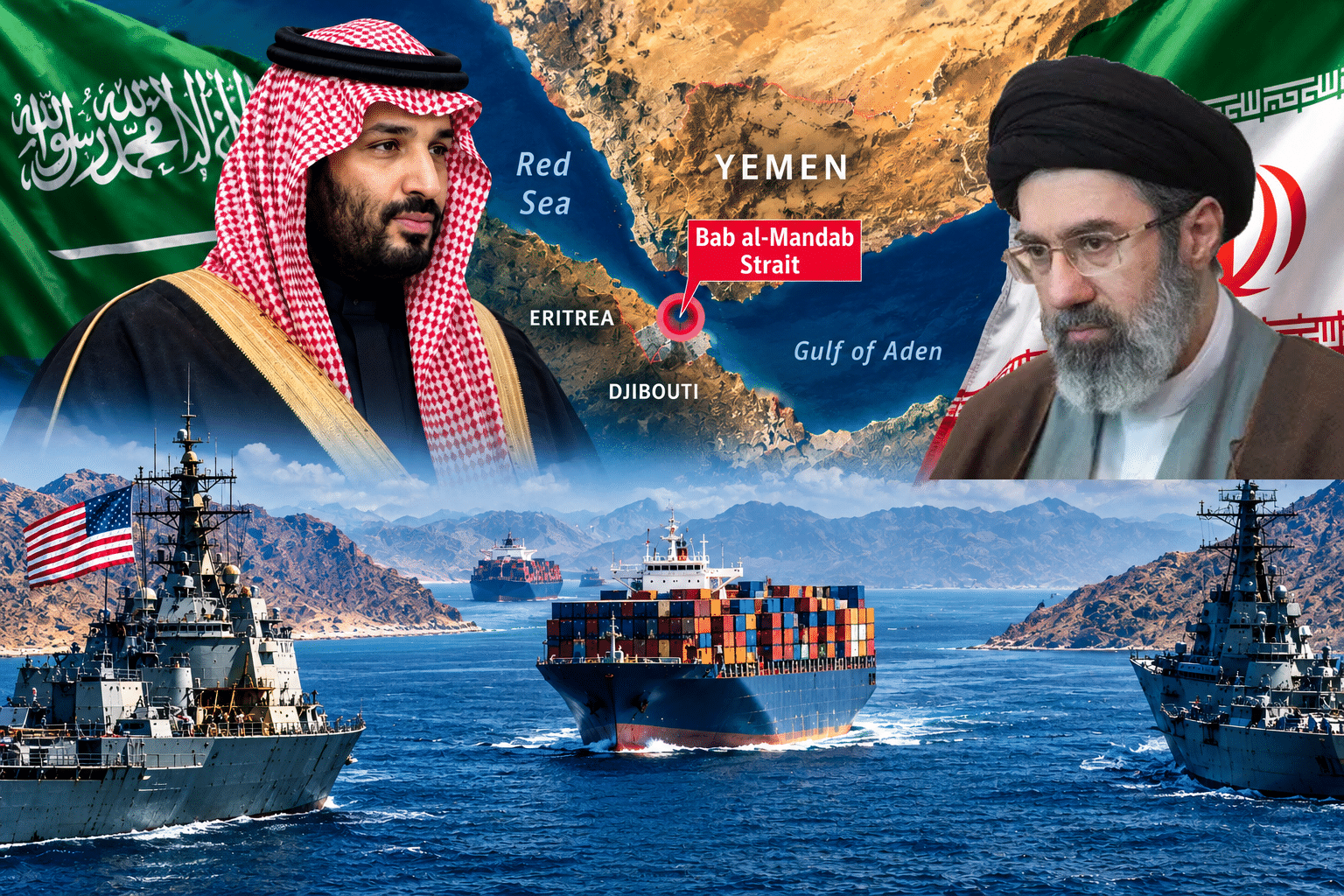
One of the most strategically significant areas is the Bab al-Mandab Strait, a narrow maritime passage connecting the Red Sea with the Gulf of Aden and the wider Indian Ocean.
The Limits of American Support and the Search for New Partners
Despite its close strategic relationship with Washington, Saudi Arabia has sought greater American assistance than it has received so far. The Trump administration has not yet delivered the level of support that Riyadh and its allies in Yemen’s internationally recognized government had hoped to obtain.
The Saudis, and the entire Gulf, had previously relied on the US military for security. The unprovoked attack by the US and Israel on Iran revealed that the US cannot protect the Oil Rich countries from retaliation, and cannot keep the Strait of Hormuz open.
America allowing an armed non-state actor, such as the Houthis, to exercise control over Bab al-Mandab, would previously have been difficult to imagine.
For Riyadh, the issue extends beyond the immediate military confrontation. It concerns the long-term security of maritime trade, the protection of energy exports, and the regional balance of power.
Journalist Steven Sahiounie interviewed Egyptian Army Brigadier General Hatem Atef, a political and military analyst. His insight gives a rare glance into the military aspect on the military conflict between Saudi Arabia and the Houthis.
#1. Steven Sahiounie (SS): Will the Yemen issue remain tied to the security of international maritime navigation and regional confrontation, or can it be separated from these issues to reach understandings that guarantee regional security and the stability of global trade?
Brigadier General Hatem Atef (HA): Absolutely, the Yemen issue cannot be separated from the broader context of regional security and international maritime navigation. What is happening in Yemen today is no longer a local matter confined to the rival Yemeni factions; rather, it has become a strategic focal point where the lines of confrontation between regional and international powers intersect.
Yemen’s unique geographical position overlooking the Bab al-Mandab Strait makes it a key gateway for global trade and energy security. Any attempt to address the Yemeni crisis in isolation from maritime supply routes and freedom of navigation would therefore represent a limited assessment that fails to account for the geopolitical realities on the ground.
Consequently, the continued linkage between the Yemeni front and broader regional conflicts makes it extremely difficult to achieve an isolated settlement. The Yemen card has become a major instrument of leverage used by multiple parties to strengthen their negotiating positions in other matters, including the Iranian nuclear file and the balance of power in the Middle East.
This means that any future understandings aimed at safeguarding global trade and regional stability must address the underlying causes of the crisis and provide comprehensive security and economic guarantees. Such arrangements must restore stability not only to Yemen but also to the entire Red Sea and Bab al-Mandab maritime system.
#2. SS: Can we say that the key to ending the war in Yemen lies neither in Sana’a nor Riyadh alone, but rather in the nature of regional understandings between Riyadh and Tehran, alongside the strategic calculations of Washington and Tel Aviv?
HA: Yes, absolutely. The key to ending the war in Yemen does not lie solely in the hands of Sana’a or Riyadh. Instead, it extends beyond Yemen’s domestic political and geographical boundaries, with the outcome heavily influenced by the interplay between regional powers and major international actors.
The nature of broader regional understandings between Riyadh and Tehran represents the political and diplomatic foundation for any potential stability. De-escalation or heightened tensions between these two regional powers have a direct impact on developments on the ground in Yemen.
Furthermore, the strategic calculations of Washington and Tel Aviv play a decisive role in shaping the limits of military operations and the trajectory of negotiations. This is due to the connection between Israeli security, freedom of navigation in the Red Sea, and the broader American vision for the Middle East.
Therefore, any genuine and sustainable solution must be built on regional and international understandings that bring together military deterrence and diplomatic settlement. The objective must be to prevent Yemen from becoming a permanent proxy battleground driven by the calculations of major powers.
Instead, all parties must be directed toward a comprehensive political settlement that rebuilds the Yemeni state, restores stability, and prevents vital maritime corridors from being used as bargaining chips in ways that threaten the economies of the region and the wider world.
Journalist Steven Sahiounie of interviewed Brigadier General Mounir Chahada, former Lebanese Government Coordinator to UNIFIL, to get his unique analysis on Lebanon at the crossroads.
# 1. SS: In light of the interconnected Yemeni, Saudi, and Iranian issues, as well as tensions involving the United States and Israel, what scenarios lie ahead for the region? Could a Saudi-Iranian agreement become a gateway to ending the conflict in Yemen?
Brigadier General Mounir Chahada (MC): The greatest strategic mistake is to treat Yemen as an isolated issue. Developments on the ground since 2023 indicate that four separate files have effectively become one:
– The internal Yemeni conflict.
– The Saudi-Iranian relationship.
– The US-Iranian confrontation.
– The Israeli conflict with the Axis of Resistance.
Any movement in one of these files automatically affects the other three.
Possible Scenarios and the Future of the Saudi-Iranian Agreement.
There are three realistic scenarios, not just one.
Firstly, a settlement through the Saudi-Iranian channel (the preferred scenario for Riyadh and Beijing).
The agreement reached between Riyadh and Tehran in Beijing in March 2023 was publicly aimed at reducing tensions. However, its unstated objective was to separate the Yemeni track from the nuclear negotiations.
Saudi Arabia’s strategic calculation was straightforward: if Tehran could guarantee that the Saudi heartland would not be targeted, Riyadh would be prepared to accept a Yemeni government in which the Houthis held substantial influence.
Could this agreement end the war? Yes, but only under certain conditions:
– Iran would have to move from being a backer of the Houthis to becoming a guarantor of their commitments, using its influence to push them toward accepting a roadmap that would not give them an absolute victory.
– Riyadh would have to accept that Yemen cannot return to the status quo that existed before 2014.
– An economic framework would be needed: Saudi Arabia would finance reconstruction, while Iran would help preserve the standing and credibility of its ally.
This scenario was derailed following the recent attack on King Khalid International Airport. Tehran maintains that it does not control the Houthis’ decisions, while Riyadh considers this denial unconvincing.
Secondly, conflict management and armed de-escalation (the current scenario). This scenario means neither a full-scale war nor a comprehensive peace. Front lines remain active in Taiz, Marib, and the Bab al-Mandab
Strait, with reciprocal strikes targeting airports, but without a major ground offensive.
Washington currently favors this scenario: keeping the Houthis tied down in Yemen while maintaining Saudi Arabia’s security concerns, thereby justifying arms deals and the continued American military presence.
Thirdly, regional escalation. Any Saudi-Iranian agreement could collapse if Israel directly intensifies its strikes against Houthi targets, as has occurred in Hodeidah and Sanaa. Tehran would regard such attacks as an assault on its regional axis and could retaliate through Yemen.
The Saudi-Iranian agreement is therefore necessary but insufficient to end the war in Yemen. It opens the door, but it does not take the parties into the room.
The Yemeni political landscape itself remains divided among the internationally recognized government, the Southern Transitional Council, and the Houthis. Without an intra-Yemeni consensus under Omani mediation, any externally brokered agreement will remain fragile.
#2. SS: Could an escalation between Washington and Tehran reignite the Yemeni front and expand the confrontation across the region, or will economic and security interests push the parties to avoid escalation?
MC: Here, we must distinguish between two types of escalation.
Firstly, a limited maritime and nuclear escalation. If the escalation remains limited to maritime tensions and the nuclear issue, as is currently unfolding around the Strait of Hormuz and the Red Sea, Yemen will be used as a calculated Iranian pressure card.
The Houthis would intensify attacks on Saudi and Emirati airports and commercial shipping to send Washington a message: ‘the cost of squeezing Tehran will be disruption to your trade and oil supplies.’
This is what we witnessed in the October 10 attack.
Secondly, a direct US military strike against Iran. All indications suggest that the Yemeni front would erupt immediately and with unprecedented intensity.
The Houthis have explicitly declared that any attack on Iran would trigger the closure of the Bab al-Mandab Strait and strikes against all American military bases in the Gulf.
Why might the parties nevertheless avoid a full-scale confrontation?
Three economic and security calculations could restrain them:
1. Oil market considerations
A full-scale war could push oil prices above $150 per barrel. This would damage the US economy ahead of the midterm elections and hurt China, which is a major buyer of oil from both the Gulf states and Iran.
2. Maritime trade considerations
Approximately 12% of global trade passes through the Bab al-Mandab Strait. Neither Washington, Beijing, nor the European Union wants this vital shipping route to be closed.
3. The cost of prolonged conflict
Iran understands that fully activating the Yemeni front would give Washington a pretext for striking Iran directly. Saudi Arabia, meanwhile, knows that another war in Yemen would impose heavy costs on its Vision 2030 economic transformation program.
The most likely strategic outcome, therefore, is controlled escalation: reciprocal strikes, threats, and attacks on airports and ships, but with implicit red lines designed to prevent the situation from spiraling into a full-scale regional war.
Every party wants to hurt its adversary without destroying it, because doing so could amount to collective economic suicide.
The future of the region will not be determined solely by negotiations in Muscat or Beijing. It will depend on Riyadh and Tehran’s ability to separate the Yemeni conflict from the broader geopolitical rivalry among the major powers.
Achieving that separation is arguably the most difficult strategic challenge facing the Middle East today.
Steven Sahiounie is a two-time award-winning journalist.

