

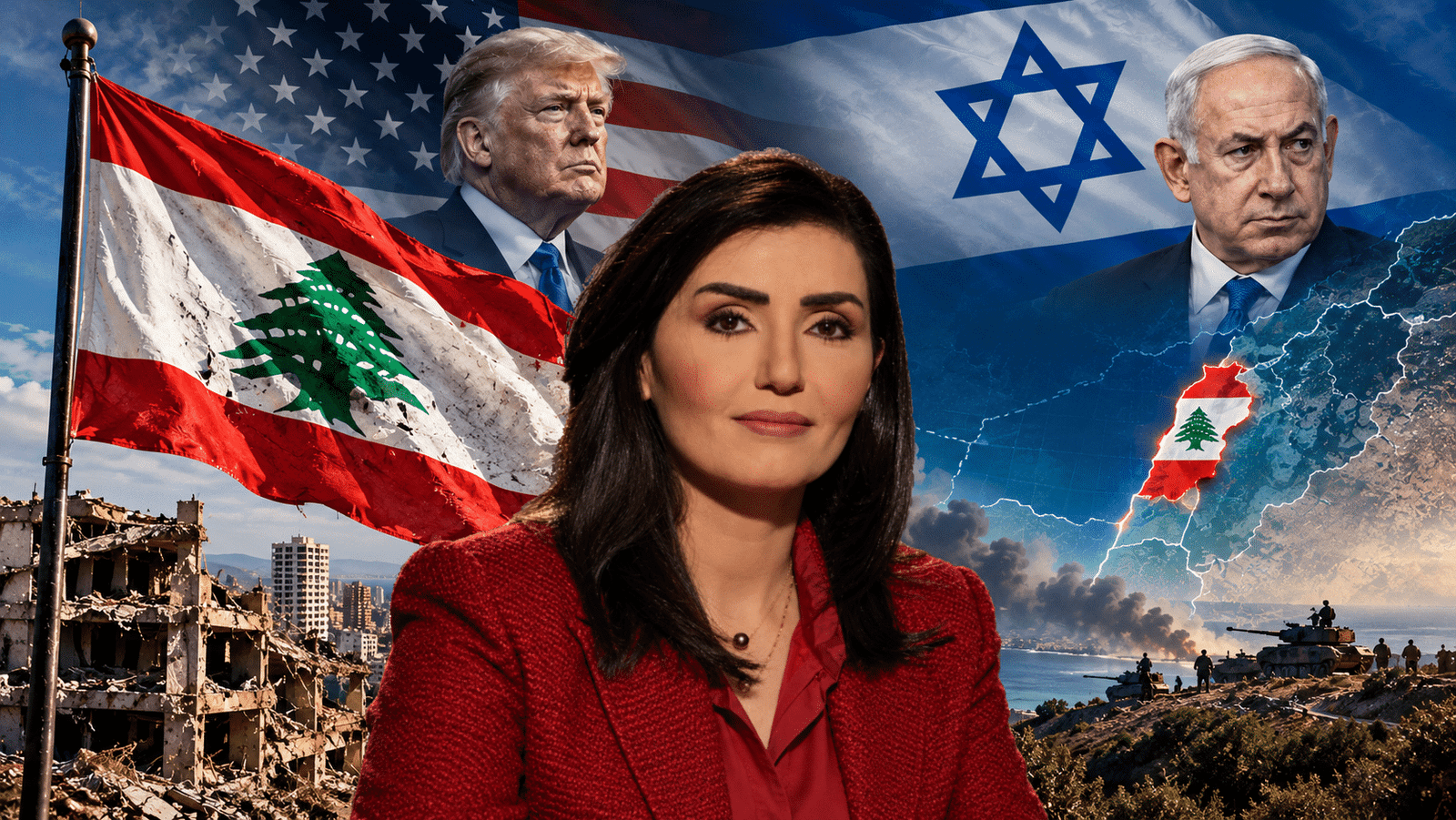

By: Steven Sahiounie, journalist and political commentator
The unprovoked attack on Iran by Israel and the US on February 28 has been a disaster for Lebanon. While the world is watching the Trump war with Iran unfold in the Persian Gulf, far away Lebanon is under almost daily attacks and further occupation by the Israel Defense Forces.
Between 4,057 and 4,386 fatalities have been recorded from Israeli airstrikes and invasions in Lebanon, while over 12,100 people have been wounded. More than 1.2 million people have been displaced across Lebanon.
In an interview with journalist Steven Sahiounie, Ogarite Dandash, Lebanese writer, media figure, and Head of Media for the Syrian Social Nationalist Party, discusses Lebanon’s sovereignty, border security, the return of displaced Syrians, international reconstruction assistance, regional escalation, the role of resistance, and the future of UNIFIL in southern Lebanon.
#1. Steven Sahiounie (SS): Controlling Lebanon’s land and maritime borders, combating smuggling, and resolving the issue of displaced Syrians are among the principal demands of both the international community and the Lebanese public. What practical steps can be taken to implement these understandings without compromising national sovereignty?
Ougarit Dandash (OD): We must first move away from an approach that treats these issues primarily as responses to the demands of the international community. Border control, combating smuggling, and regulating cross-border movement are, above all, responsibilities of the state and matters of national interest.
There is, however, a fundamental difference between a state managing its borders in accordance with its sovereignty and economic and security interests, and those borders becoming an instrument for implementing policies imposed by external parties in pursuit of foreign agendas. Some actors want the Lebanese state to serve as a border guard for their own interests.
Lebanon and Syria share geographical, economic, social, and historical ties that cannot be reduced to a line on a map. This does not mean that border regulation is unnecessary. On the contrary, the current circumstances make institutional cooperation between the two countries even more urgent.
In practical terms, we need direct official coordination, the development of legitimate border crossings, stronger customs oversight, and effective action against smuggling networks that exploit corruption and institutional weakness.
However, the current governing establishment in Damascus complicates matters. On the one hand, we hear Western calls, particularly from the United States, urging the Syrian government to enter Lebanon and fight a Lebanese political faction. On the other hand, the Syrian side has not articulated a sufficiently clear position regarding these demands.
As for the issue of displaced Syrians, it cannot be treated merely as a security or demographic problem. It is a humanitarian, political, and economic issue.
Resolving it requires examining why such large numbers of Syrians remain in Lebanon, having initially arrived under the stated justification of fleeing the former Syrian regime. It also requires coordination among the countries concerned and the creation of conditions conducive to their return, rather than simply managing the consequences of their continued presence.
Most importantly, we must ask a fundamental question: Who benefits?
Who benefits politically and economically from their continued presence? Who benefits from the funds allocated to this issue? And who has profited from the corruption and alleged theft associated with its management?
These questions deserve serious investigation if Lebanon is to develop a sustainable and effective policy.
#2. SS: Lebanon faces major challenges in rebuilding damaged areas and restructuring its banking and financial sectors. Do the Lebanese have a genuine opportunity to obtain Arab and international support for reconstruction, or will such assistance remain conditional on difficult political and security concessions?
OD: We must distinguish between economic assistance as a necessity for rebuilding what wars have destroyed and the use of that need as leverage to impose political and security choices. The imposition of impossible conditions in exchange for financial support is no longer something that can be concealed from the public.
Lebanon needs reconstruction, but it also needs to rebuild its economic and financial institutions and address the banking crisis. That crisis was not caused by war alone; it resulted from a long accumulation of policies and structural imbalances.
International financing, however, is never driven exclusively by humanitarian or economic considerations. Political and strategic interests also influence the decisions of donor countries and institutions.
This brings us to the central question: Does Lebanon possess a unified national vision on the basis of which it can negotiate, or will it approach negotiations from a position of economic vulnerability and internal division?
I do not believe that all conditional assistance should be rejected outright. Conditions relating to transparency, accountability, economic reform, and the management of public funds are legitimate concerns. Indeed, these are demands that Lebanese citizens themselves have long raised, not merely requirements imposed by international institutions.
However, in my view, those setting the conditions also seek to target the Resistance camp and subject it to financial pressure. The standards used to evaluate compliance are not sufficiently clear and are applied selectively.
It is therefore essential to distinguish between conditions that genuinely promote economic reform and those that go beyond financial governance to impose political choices concerning sovereignty, security, and foreign policy.
Ultimately, these issues concern Lebanon’s identity and its place in the region, as well as the right of a segment of its population to determine its own future.
#3. SS: Attention is increasingly focused on the interconnected regional escalation between Washington and Tehran, alongside developments in Yemen and their implications for maritime navigation in the Red Sea and the Bab al-Mandab Strait. How does this open-ended regional confrontation affect Lebanon? Is it realistic to expect Lebanon to remain outside this conflict?
OD: I believe the fundamental mistake in analyzing this conflict is treating Lebanon as though it were a separate arena, disconnected from its regional environment.
Any conflict in any part of the world affects its geographical surroundings and can have repercussions across the international system. This is particularly true when the conflict unfolds in such a strategically important region and involves a political actor that occupies a prominent position on the regional stage.
We are witnessing a confrontation in which American, Iranian, and Israeli interests intersect with maritime security, energy resources, regional alliances, and the balance of military and economic power.
The Red Sea and the Bab al-Mandab Strait are not merely shipping routes. They form part of a strategic network connecting the Levant to global trade. Any disruption in these waterways can have consequences for regional security and the international economy.
Lebanon is inevitably affected by these developments because of its geographical position and the interconnected nature of its political, security, and economic relationships with the surrounding region.
Nevertheless, we must distinguish between two separate questions: whether Lebanon is affected by the regional conflict and whether it chooses to become a central participant in it.
The first is a geographical and political reality that is difficult to escape. The second is a strategic choice that requires serious national debate.
It is equally impossible to discuss keeping Lebanon out of regional conflicts without addressing the continuing Israeli threats against the country. Any vision of Lebanese security that ignores this reality is incomplete.
The question, therefore, is not simply how to keep Lebanon neutral, but how to build a national capacity to protect its interests in a region where the security of one state cannot easily be separated from that of its neighbors.
Neutrality cannot be achieved through wishful thinking or external dictates. Lebanon is not an island in the middle of the ocean.
Parts of southern Lebanon remain occupied, and massacres and attacks have continued over many decades. In my assessment, this reality has persisted in various forms since the 1940s.
Under these circumstances, talk of neutrality risks becoming a romanticized and unrealistic concept. In practice, I believe it could translate into Lebanon submitting to the American agenda and, consequently, to its adversary—one that occupies its territory, violates its sovereignty, and kills its people.
#4. SS: With growing domestic and international pressure to place all weapons under the exclusive control of official military and security institutions, and to ensure that decisions of war and peace rest with the Lebanese government and constitutional institutions, can Lebanon implement this approach without triggering serious internal divisions?
OD: This issue requires a high degree of political responsibility because it concerns two matters that cannot be considered in isolation: state sovereignty and society’s right to defend itself.
The history of conflict cannot be understood solely through the lens of positive law or international law. If it were, all rebellion and resistance movements would be classified as unlawful, regardless of the circumstances that gave rise to them.
Historically, liberation has not always been achieved by states and governments acting alone. Liberation movements and resistance forces have played decisive roles in freeing occupied territories. Vietnam and Cuba in more recent history, as well as Simón Bolívar and José de San Martín in earlier periods, offer examples worthy of study.
In principle, the modern state is founded on the authority of legitimate institutions to exercise force within the framework of the law. Decisions of exceptional national importance, including those concerning war and peace, should also fall within the constitutional framework.
However, translating this principle into practice in Lebanon cannot be separated from the circumstances that produced the reality of weapons outside official state institutions.
Lebanon has a long history of occupation and Israeli attacks, alongside a profound crisis of trust between different components of Lebanese society and the state.
Treating this issue as a purely security-related measure could therefore deepen existing divisions rather than resolve them.
What is needed is a serious national dialogue on a comprehensive defense strategy. Such a strategy must define the nature of the threats facing Lebanon, the role and capabilities of the army, the resources required to protect the country, and the constitutional mechanisms through which critical decisions are made.
This discussion must also address the need to build a capable, properly equipped army and reaffirm the state’s responsibility to protect all its citizens and territories.
Yet a difficult question remains: How can we expect an army armed by the United States—which I regard as the principal ally of our enemies—to confront the adversary effectively?
And is the Lebanese army being equipped with the capabilities it actually needs?
Lebanon is not a country living in peacetime with nothing more than an armed group operating outside the law. Lebanon has experienced a state of ongoing conflict for decades. Parts of its territory remain occupied, and the occupying power is demolishing homes, hospitals, schools, and even cemeteries.
Under these circumstances, people are being asked not to defend their land, their dignity, or their children’s future.
At the same time, exceptional circumstances must not become permanent arrangements that obstruct the development of state institutions. In my view, once the occupation ends, the process of building and consolidating those institutions can take its proper course.
The challenge is not simply to determine which entity carries weapons. It is to build a national defense system in which all Lebanese can have confidence and which they believe is capable of protecting them.
Any sustainable solution must be grounded in domestic consensus and constitutional institutions, rather than imposed outcomes shaped by external conflicts.
#5. SS: As critical decisions approach concerning the mandate of the United Nations Interim Force in Lebanon (UNIFIL) and arrangements for the period following its presence in the south, what is Lebanon’s vision for preventing a security vacuum along the border? How can Lebanon reconcile its commitment to UN Security Council Resolution 1701 with international demands for broader surveying and security measures
OD: Any discussion of the future of southern Lebanon must begin with a fundamental question: What will guarantee the security of the population, protect the land, prevent the recurrence of war, and restore occupied territory?
The presence of international forces has been linked to specific security and political circumstances, as well as resolutions issued by the United Nations Security Council. However, these forces cannot be viewed as a permanent substitute for the responsibilities of the Lebanese state.
These same international forces have repeatedly faced Israeli attacks. In 1996, Israel committed the Qana massacre at a UNIFIL compound, killing international personnel and residents of southern Lebanon. In my view, accountability for this tragedy has remained inadequate.
Any change to the nature of the international presence or its mandate must therefore be based on a clear and credible vision that prevents the emergence of a security vacuum.
This requires strengthening the deployment and capabilities of the Lebanese army, providing it with the resources necessary to perform its duties, and ensuring effective coordination between official Lebanese institutions and the relevant international bodies.
However, under the current circumstances, this approach is difficult to reconcile with realities on the ground. Reports of attacks on Lebanese army positions in the south emerge regularly. More troubling still, the army sometimes appears to require permission from the adversary to enter areas of Lebanese territory.
As for UN Security Council Resolution 1701, it should not be treated as a set of obligations imposed exclusively on Lebanon. The resolution concerns the cessation of hostilities and security arrangements that require respect from all parties, including respect for Lebanon’s sovereignty and territorial integrity.
Regarding international demands to expand security measures, inspections, or surveying operations, a distinction must be made between measures that fall within the existing legal mandate and approved agreements, and new measures that would require the consent of the Lebanese state.
The region’s experience with United Nations resolutions does not inspire confidence that international decisions alone can guarantee lasting stability.
Stability cannot be achieved by imposing dictates on Lebanese institutions. Nor can it be established without clear, reciprocal, and verifiable commitments from all parties involved.
Southern Lebanon is not merely a security zone on a map of international power dynamics. It is a homeland inhabited by people who have repeatedly paid the price of war.
Any security arrangement that fails to place the safety of these residents, their rights, and their ability to continue living on their land at the center of its priorities will remain a theoretical framework, incapable of delivering lasting results.
Steven Sahiounie is a two-time award-winning journalist.

