


Steven Sahiounie, journalist and political commentator
Libya’s parliamentary approval of its 2019 maritime agreement with Türkiye has reignited tensions across the Eastern Mediterranean, raising questions about maritime sovereignty, energy resources, alliances, and the future of relations between Ankara, Cairo, Athens, and Tel Aviv.
The decision, adopted unanimously by Libya’s House of Representatives on October 20, 2026, reverses the legislature’s previous opposition to the agreement. Türkiye has welcomed the development, while Egypt and Israel have expressed objections, highlighting strategic divisions surrounding maritime boundaries in the region.
President Recep Tayyip Erdoğan’s “Blue Homeland” doctrine is viewed as an aggressive, revisionist, and expansionist strategy that destabilizes the Eastern Mediterranean and escalates friction with neighbors and international bodies. Greece, Cyprus, the EU, and NATO have criticized Ankara’s unilateral maritime claims as risking military escalation and permanent crisis zones in a strategically vital corridor. Some domestic political figures have criticized the doctrine in parliament as unrealistic.
The 2019 Türkiye–Libya Maritime Agreement
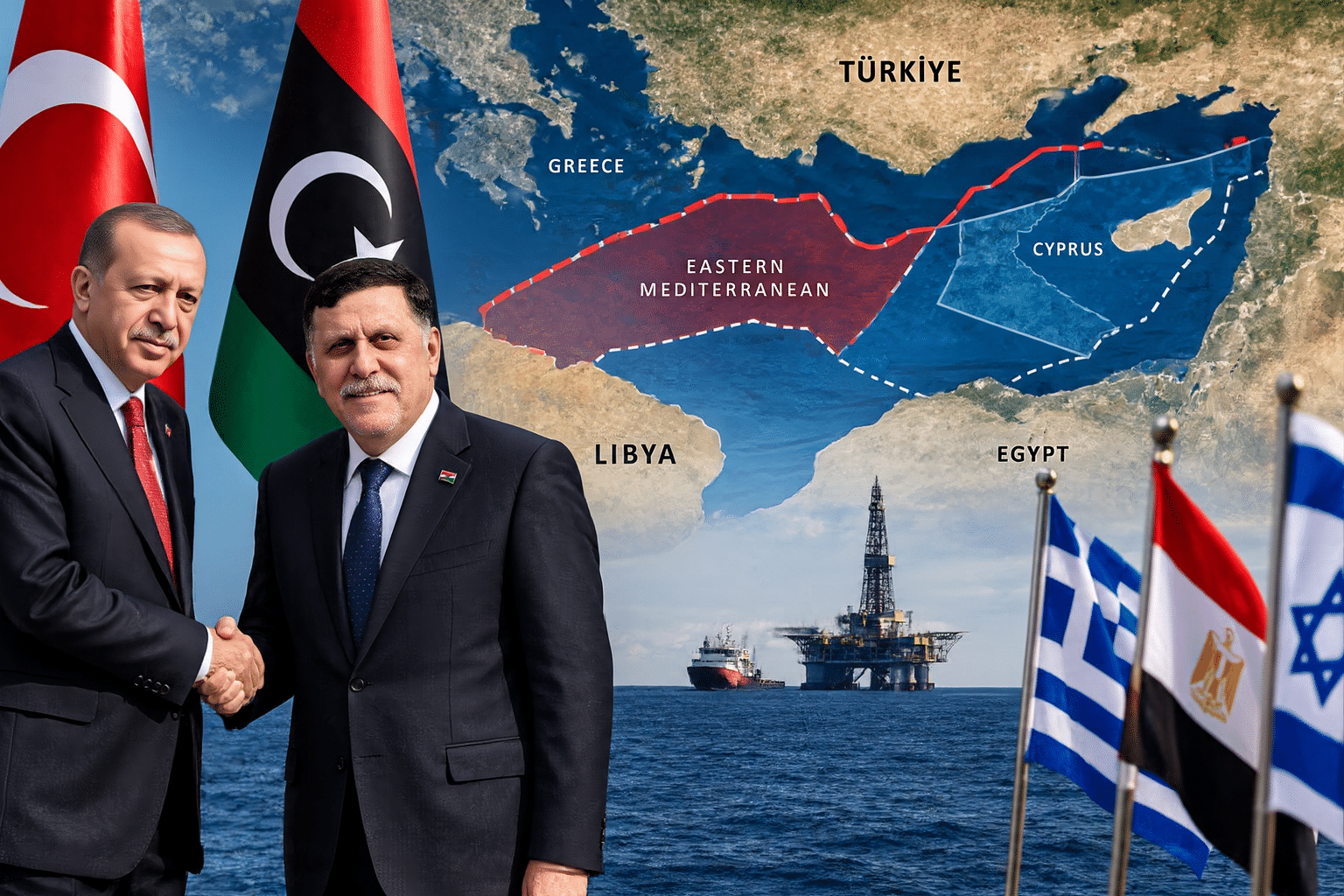
The memorandum of understanding was signed in Istanbul on November 27, 2019, by Turkish President Recep Tayyip Erdoğan and Fayez al-Sarraj, then head of Libya’s internationally recognized Government of National Accord. It formed part of a broader package of agreements that also included security and military cooperation.
The Turkish parliament approved the maritime memorandum on December 5, 2019, and it subsequently entered into force. The agreement establishes a framework for delimiting the continental shelf and exclusive economic zones between Türkiye and Libya through specified geographical coordinates. It provides a basis for exercising sovereign rights over natural resources, including oil and natural gas, within the areas covered by the arrangement.
The memorandum also provides for consultation and diplomatic mechanisms to address disagreements over its interpretation and implementation. Its central principle is equitable maritime delimitation, taking account of geographical circumstances and relevant coastlines. Türkiye argues that islands should not automatically receive full effect when determining maritime boundaries, particularly where this would substantially restrict the maritime entitlements of mainland states.
Greece, Cyprus, and Egypt dispute aspects of this interpretation, arguing that the agreement disregards their maritime interests. The resulting disagreement remains part of the broader regional dispute over maritime boundaries and international law.
Libya Reverses Its Previous Position
The reversal is politically significant because eastern Libyan political and military actors previously opposed the agreement during the conflict between rival Libyan factions. Türkiye had supported the Tripoli-based Government of National Accord, while forces associated with Khalifa Haftar fought against it.
The vote could strengthen Ankara’s position by broadening political support for cooperation with Libya. Supporters say it offers economic opportunities, although approval does not settle competing international claims.
Egypt Rejects the Agreement
Egypt has strongly rejected the decision, describing the memorandum as “absolutely null and void and without legal effect,” according to the Egyptian Foreign Ministry statement.
Cairo argues that the agreement conflicts with international law of the sea and infringes upon Egyptian sovereign rights in its exclusive economic zone and continental shelf. Egypt has reaffirmed its opposition to any measures based on the memorandum that conflict with its declared maritime boundaries.
The dispute is particularly sensitive because Egypt and Greece signed a maritime delimitation agreement in August 2020, establishing part of their respective exclusive economic zones in the Eastern Mediterranean. Meanwhile, Greece’s Foreign Ministry has announced that Athens and Cairo agreed to continue consultations aimed at expanding the geographical scope of their maritime agreement.
Türkiye Seeks to Preserve Relations with Egypt
Despite welcoming Libya’s reported decision, Ankara has sought to prevent the issue from becoming a diplomatic crisis with Cairo.
Turkish Ambassador to Egypt Salih Mutlu Şen said that Türkiye did not believe the Libyan parliamentary decision was intended to harm Egyptian interests. He emphasized the historical relationship between the two countries and expressed confidence that the issue would not trigger a major bilateral crisis.
Nevertheless, the two countries remain divided over the maritime agreement. Ankara considers it a legitimate arrangement protecting Turkish and Libyan interests, while Cairo maintains that it cannot prejudice Egyptian maritime rights.
Hamza Tekin: A Strategic Instrument for Türkiye
In an exclusive interview with journalist Steven Sahiounie, Turkish writer and journalist Hamza Tekin, author of *The Nightmare and the Spy*, argued that the maritime agreement is far more than an ordinary bilateral arrangement.
Tekin identified several strategic objectives behind the agreement. First, he said, Türkiye seeks to establish a strong and durable strategic partnership with Libya. Second, the arrangement could strengthen both countries economically by supporting cooperation over energy resources, particularly oil and natural gas.
Third, Tekin argued that the agreement protects what Ankara considers its legitimate continental shelf rights in the Eastern Mediterranean. He accused Greece, Israel, and the Greek Cypriot administration of pursuing policies that seek to restrict Türkiye’s maritime access and diminish its share of the region’s resources.
According to Tekin, the agreement sends a clear political message that Türkiye intends to defend its maritime interests and will not accept arrangements that exclude it from areas it considers rightfully its own.
He linked this position to the Turkish strategic doctrine known as *Mavi Vatan*, or “Blue Homeland,” which emphasizes the importance of maritime jurisdiction, naval power, and surrounding seas to Türkiye’s national security.
Tekin also argued that the agreement challenges Israel’s broader regional ambitions. He claimed that Israel seeks to expand its influence over the Middle East and the Eastern Mediterranean, including energy exploration, gas transportation, and exports to Europe.
In his assessment, the Turkish-Libyan arrangement constrains Israel’s ability to pursue these objectives without taking Türkiye’s interests into account. He described the agreement as a source of substantial geopolitical leverage for Ankara, potentially at the expense of Israel, Greece, Cyprus, and European countries supporting their regional positions, including France.
Why Israel Opposes the Agreement
Asked why Israel opposes the memorandum and how the dispute relates to natural gas and energy transportation, Tekin argued that Israel understands the agreement’s potential economic and geopolitical consequences.
He maintained that closer Turkish-Libyan cooperation could strengthen a strategic partnership between the two countries while complicating Israeli plans for offshore exploration and energy exports to Europe.
Tekin rejected the characterization of the dispute as simply economic competition. In his view, the issue goes beyond competition because Türkiye believes that Israel, Greece, and the Greek Cypriot administration are seeking to deprive it of maritime rights rather than merely compete for energy resources.
He argued that these countries want Türkiye to receive the smallest possible share of the Eastern Mediterranean’s maritime resources while securing advantages for themselves. Tekin described the issue as one of national security and geopolitical strategy, insisting that Türkiye would not retreat from its Blue Homeland doctrine or abandon what it considers its continental shelf rights.
He added that the Turkish navy and armed forces were prepared to defend these interests if circumstances required it. His remarks reflect the more assertive elements of Turkish maritime strategy and illustrate why the dispute carries implications beyond energy exploration and commercial interests.
A Strategic Gain, but No Final Settlement
Libya’s reported approval of the maritime memorandum could strengthen Türkiye’s diplomatic position and deepen cooperation between Ankara and Tripoli. For Egypt, Greece, Cyprus, and Israel, however, the development renews concerns over maritime sovereignty, energy resources, and regional influence.
Tekin’s assessment underscores Türkiye’s determination to defend what it considers its maritime rights and his view that the agreement serves broader national security objectives. He sees it as a means of strengthening Turkish-Libyan ties, advancing shared economic interests, challenging what he regards as efforts to exclude Türkiye, and countering Israel’s regional energy ambitions. He also insists that Ankara will not abandon the Blue Homeland doctrine and that its navy and armed forces are prepared to defend its claims if necessary.
Yet political approval and strategic messaging cannot, by themselves, settle the legal questions surrounding maritime delimitation. The agreement’s implications for third states remain contested, and the rights of the countries concerned must be assessed under applicable international law.
The central challenge is whether the countries of the Eastern Mediterranean can protect their interests through diplomacy without allowing maritime disagreements to escalate into a wider regional confrontation.
Steven Sahiounie is a two-time award-winning journalist.

