

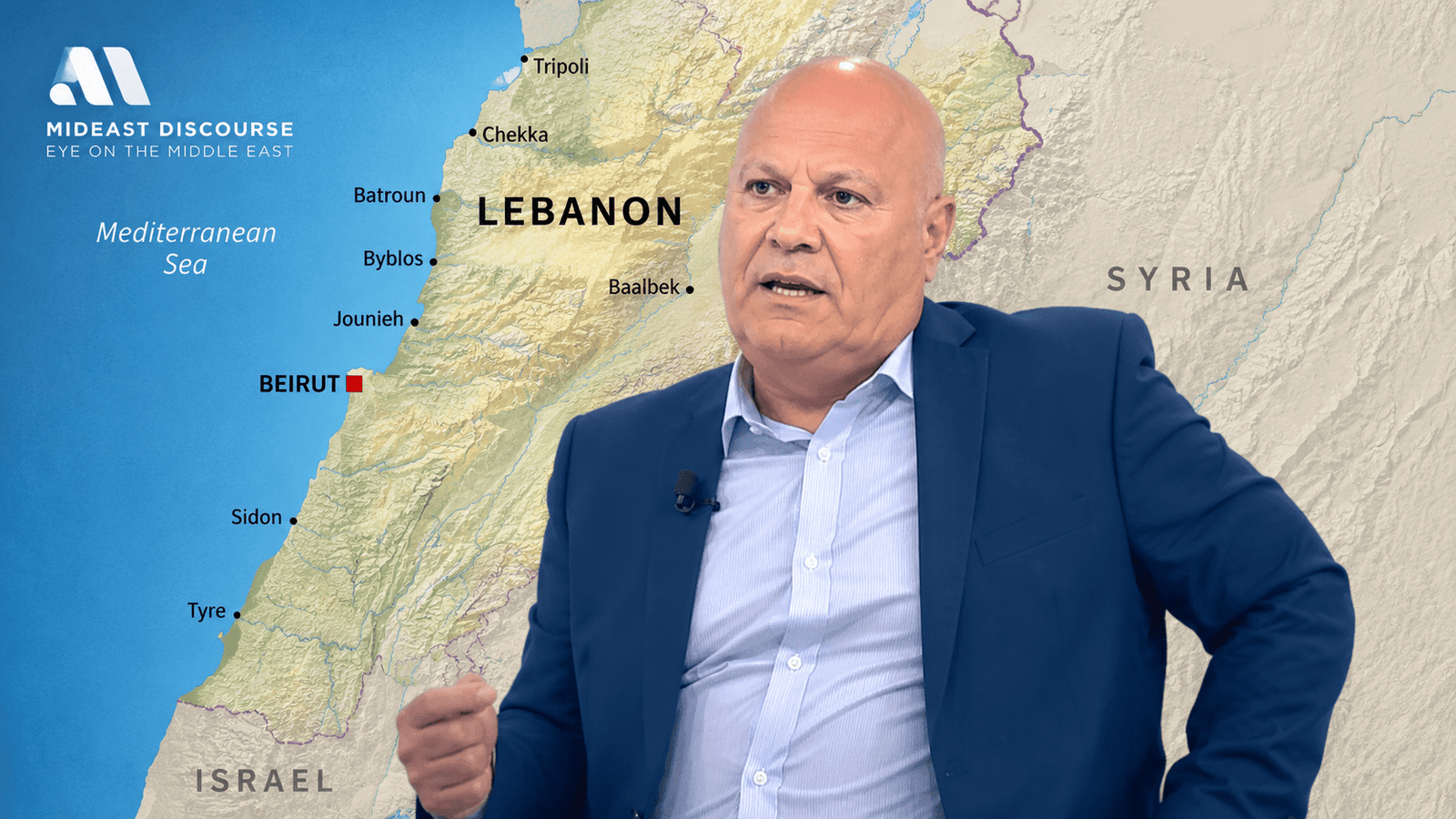

Steven Sahiounie, journalist and political commentator
Lebanese President Joseph Aoun explicitly labeled Hezbollah an “enemy” of Lebanon. In the context of US-brokered talks and a comprehensive ceasefire agreement, the Lebanese government formally designated the militant group as an enemy of the state and agreed to terms calling for the dismantling of its military presence.
Israel has carried out a brutal invasion and occupation of almost one-third of Lebanon, with no intention to ever leave, and conducts continuous airstrikes in the country, including locations far from the south, and which have no connection to Hezbollah.
Many people ask: who is the enemy of Lebanon? If Hezbollah, the resistance group, is blamed by some; what about Israel? How can a foreign military occupation which destroys everything in its path, leaving Lebanon looking like Gaza, not be termed “the enemy”?
Steven Sahiounie of MidEastDiscourse interviewed Ziad Safi, an expert in international politics and US national security.
1. Steven Sahiounie (SS): In the latest ceasefire agreement between Israel and Lebanon, Hezbollah is designated as an enemy of Lebanon. In your opinion, how will Hezbollah, the Lebanese Army, and the Lebanese citizens react to such a statement?
Ziad Safi (ZS): Hezbollah has rejected the terms of this U.S.-brokered framework, with its leader, Naim Qassem, labeling the negotiations “futile” and “humiliating”. Hezbollah framing itself not as an enemy, but as the primary “national resistance”. Because Hezbollah holds an active political party and seats in the Lebanese parliament, and has infiltrated the military and security apparatus, and civil servants in Lebanon, it feels it is untouchable by the Lebanese state, since it holds the upper hand in the Lebanese state…
The Lebanese Armed Forces (LAF) occupies a fragile position, as the agreement mandates that the military take exclusive control of security zones to the exclusion of non-state actors. President Joseph Aoun, the state apparatus views this agreement as a “last chance” to secure a final ceasefire and reassert state sovereignty. The military will accept U.S. and international logistical support to deploy to border areas. Despite the text labeling Hezbollah an enemy, the Lebanese Army does not possess the operational capabilities or the political mandate to disarm Hezbollah by force. Historically, the military seeks to avoid direct domestic confrontation with Hezbollah to prevent a fracture within its own ranks, or a descent into a new civil war. The Lebanese army was built post-Syrian occupation of the free area in 1990. Years of government labeling Hezbollah as resistance has allowed the security apparatus to turn a blind eye to the party spreading within its ranks. The army’s reaction is to prioritize border security, infrastructure management, and patrolling the designated “pilot zones” rather than launching offensive operations against domestic political factions. With Hezbollah refusing to disarm, and LAF refusing to confront it, we are at an impasse.
Anti-Hezbollah Factions: A substantial portion of the population—including many Christian, Sunni, and Druze political blocs—have long argued that Hezbollah acts as a “state within a state”. These citizens feel the militant group has repeatedly dragged Lebanon into destructive, unprovoked conflicts at the behest of foreign backers like Iran. For them, the designation validates their long-held view that true sovereignty is impossible while a parallel armed militia dictates war and peace. The Weary Majority: Beyond political alignments, the overwhelming majority of citizens are exhausted by economic collapse and ongoing warfare. For many, the primary concern is not the precise vocabulary of the text, but whether it can successfully bring an end to airstrikes and allow displaced families to safely return to their homes. Pro-Resistance and Shia Community Support: Broad segments of the population, particularly within the Shia community and allied factions, view the “enemy” label as an outrage. For these citizens, Hezbollah remains a vital shield against foreign occupation.
2. SS: The United States is reportedly mediating between Lebanon and Israel in an effort to end the war. However, can the U.S. truly be regarded as a neutral mediator when it is Israel’s largest military, political, and intelligence supporter?
ZS: Israel receives military aid from the US, political protection specifically at the United Nations security council (Veto power), and intelligence sharing.
On the other hand, the U.S. has unequal leverage over Israel, and there is a historic president like the maritime agreement which was successfully brokered by the U.S. Lebanese government leaders accept U.S. mediation because they view American involvement as the only realistic avenue to stop Israeli bombardment and secure international financial aid for rebuilding.
3. SS: Washington is working to separate the Lebanese front from the Iranian file, while Tehran insists on linking both fronts to the ongoing
negotiations between Iran and the United States. In your view, will Trump succeed in separating these two tracks?
ZS: Achieving a complete separation of these two fronts remains highly difficult. Because Hezbollah’s strategic identity is deeply intertwined with Iran’s foreign policy, a total decoupling of the Lebanese front is unlikely to happen unless Iran faces an existential economic crisis, or a decisive military shifting of the status quo. Historically, Iran has viewed Hezbollah in Lebanon as its primary forward-deterrent and most valuable strategic asset. Consequently, Tehran strongly resists any diplomatic track that isolates Hezbollah, or settles the Lebanese conflict without addressing broader U.S.-Iran issues, such as economic sanctions and the Iranian nuclear program. A Trump administration would likely approach this challenge through three main mechanisms: Maximum Pressure 2.0, Trump is expected to reinstitute an aggressive sanctions campaign against Iran. The goal would be to severely deplete Tehran’s financial resources, thereby limiting its capacity to fund and sustain Hezbollah’s operations in Lebanon. Direct Deal-Making: Trump’s preferred style of transactional diplomacy could lead him to offer Iran economic sanctions relief, but only under the strict condition that Tehran curtails its regional proxies, effectively forcing a separation of the tracks. Empowering Regional Allies: The U.S. may increase strategic coordination and military support for Israel and Gulf Arab states to counter Iranian influence on the ground in Lebanon, altering the balance of power during negotiations.
4. SS: Tel Aviv seeks to maintain a presence in southern Lebanon and preserve its freedom of military action there, but this is being met with popular and political opposition, as well as rejection from Hezbollah. In your opinion, will Israel eventually withdraw from southern Lebanon? If so, will that happen through military pressure or a political settlement?
ZS: In my opinion, Israel will only withdraw from Lebanon if the Lebanese state exercises full sovereignty over its territory. This seem unlikely in the short term, so most likely we are in for an extended occupation of south Lebanon until the Lebanese state assumes full control, or the Israeli public gets tired of occupation like in 2000, after 22 years of occupation, and decides to withdraw.
5. SS: Both Trump and Netanyahu stated months ago that Hezbollah had been defeated militarily and politically. Yet today, we continue to see the group inflicting significant losses on Israeli forces. In your opinion, does this reflect an Israeli miscalculation or an intelligence failure?
ZS: The ongoing clashes and the losses inflicted by Hezbollah—even after declarations of its political and military defeat—reflect the inherent nature of asymmetric warfare, rather than a straightforward intelligence failure. Conventional vs. Guerrilla Metrics: In conventional warfare, losing a centralized command structure, major infrastructure, and top leadership (such as the sweeping Israeli operations that eliminated key figures) equates to defeat. However, for an asymmetric group, survival and the ability to continue launching low-cost, decentralized attacks (like drones and localized ambushes) are framed as a victory.
Steven Sahiounie is a two-time award-winning journalist.

