


Steven Sahiounie, journalist and political commentator
Journalist Steven Sahiounie interviewed Dr. Suheil M. Diab, a Palestinian writer and researcher specializing in Israeli and regional affairs, about Israel’s upcoming elections, the future of its policies toward Gaza and the West Bank, relations with Iran and the Gulf states, and the political prospects surrounding Prime Minister Benjamin Netanyahu.
1. Steven Sahiounie (SS): Could the elections lead to a change in Israeli policy toward Gaza, the West Bank and Iran, or will major security issues continue regardless of the identity of the next government?
Dr. Suheil M. Diab (SMD): If the current government is replaced by a centrist-to-moderate-right government headed by Gadi Eisenkot, we would likely see varying degrees of change on the Gaza, West Bank and Iran fronts.
Gaza: We could see a greater-than-average policy shift in Gaza. This could include greater flexibility in accepting a long-term ceasefire, greater willingness to accept arrangements involving Egypt and the Gulf states, more flexibility in dealing with the Palestinian Authority in Ramallah and potentially giving it a role in administering Gaza, as well as progress on the reconstruction file.
The Gaza issue is essentially an American-led file with Israeli participation and the involvement of a “Board of Peace” chaired by Donald Trump.
The West Bank: The likelihood of a policy change is relatively high. There could be greater flexibility through slowing settlement expansion, curbing settler attacks, improving relations and coordinating positions more closely with the United States, and returning to a policy of “managing” the conflict with the Palestinians rather than pursuing the policy of attempting to
“resolve” or “determine” the conflict associated with Netanyahu’s government. The West Bank Is, above all, an Israeli-led file.
Iran: The possibility of a policy change is below average. A future government would continue seeking to prevent Iran from acquiring nuclear weapons. It would likely continue emphasizing intelligence and cyber operations rather than relying primarily on military action, without fundamentally changing Israel’s security doctrine.
At the same time, there could be greater coordination with Washington and a greater willingness to take American interests into consideration, rather than focusing exclusively on Israeli interests. The Iran issue is, to a significant extent, an American-led file.
There are two additional points to consider. Firstly, if a broad Zionist national unity government involving both major political camps is formed, the indicators for change would decline across these areas.
Secondly, if an Arab political party or list participates in the next government, the prospects for policy changes would increase, particularly regarding the West Bank and the possibility of a political settlement with the Palestinians.
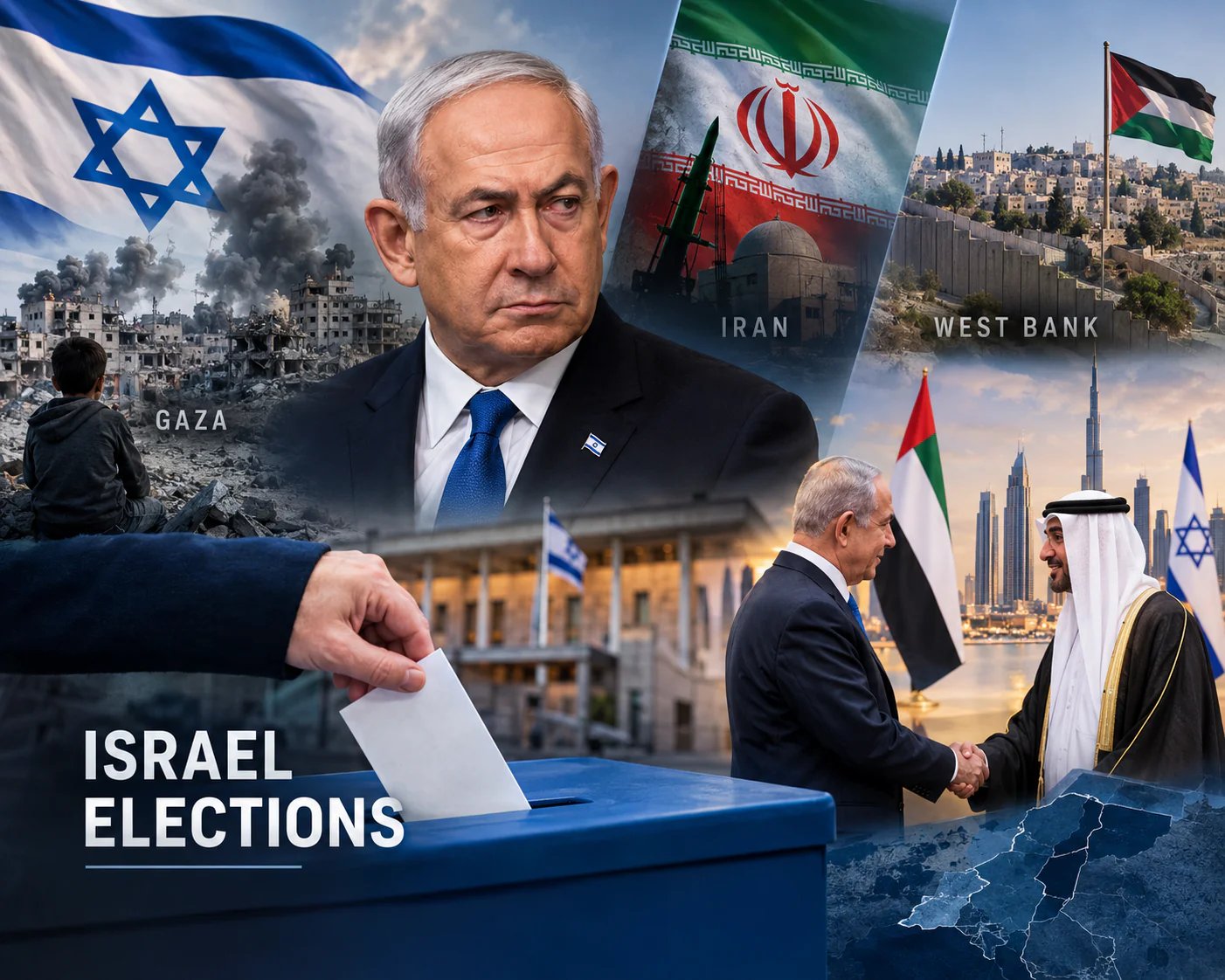
2. SS: Israeli Prime Minister Benjamin Netanyahu recently visited the United Arab Emirates and met with President Sheikh Mohamed bin Zayed. What do you believe were the reasons for this visit? Is there a broader plan being developed between Abu Dhabi and Tel Aviv?
SMD: In my assessment, Netanyahu’s visit to Abu Dhabi—described as both secretive and public—was primarily driven by an Israeli need, and by Netanyahu’s personal political needs in particular. I do not believe it was a carefully planned bilateral visit between the two sides.
The Emirati side reportedly sought to cancel the meeting in the final hours, but the intervention of the United States prevented that from happening.
The meeting took place at the airport rather than inside a government building, and most of the discussion between Netanyahu and Sheikh Mohamed bin Zayed was reportedly held privately.
In my view, the visit was connected to Netanyahu’s electoral needs on two major issues.
Firstly, was Netanyahu’s desire to obtain an Emirati denial of reports concerning an alleged warning call from the UAE president to Netanyahu approximately ten days before the October 7 attack. Reports about such a warning in American and Israeli media have placed Netanyahu in a politically difficult position. Netanyahu reportedly sought to have the UAE publicly deny the account, but that demand was not met.
The second issue involved potential Emirati-Israeli security cooperation concerning a possible Israeli military operation against a regional actor, which could potentially benefit Netanyahu politically during the election campaign. That issue, however, remains open.
3. SS: Many experts and analysts have questioned the official account surrounding the Flydubai aircraft incident. In your view, could it have been an operation orchestrated by the Israeli Mossad, and was Netanyahu’s visit to the UAE connected to it?
SMD: Israeli, Saudi and Emirati analysts and observers broadly agree on several basic facts, although interpretations of the incident differ.
These facts include:
1. A physical altercation occurred between two pilots.
2. The co-pilot allegedly stabbed the captain.
3. The confrontation and resulting turbulence led to the aircraft making an emergency landing at an airport in Saudi Arabia.
4. The co-pilot was arrested and questioned and is expected to be transferred to the UAE for further investigation.
Meanwhile, different scenarios have emerged in Israel, sometimes changing from one hour to the next.
Among the scenarios reported or suggested have been:
– A terrorist operation aimed at bringing down the aircraft.
– An alleged motive involving Iran or one of its regional allies.
– A possible conspiracy by an Arab state seeking to influence the Israeli election and undermine Netanyahu.
However, according to this assessment, none of these scenarios has so far been independently confirmed by another party. This is particularly significant because some of the claims were made by Netanyahu and Defense Minister Israel Katz before the investigation of the co-pilot had even begun.
Saudi Arabia’s refusal to allow Israel to transport the passengers to Tel Aviv aboard military aircraft, in my view, exposed what I consider to be Netanyahu’s political interest in dramatizing the incident.
The episode subsequently allowed Netanyahu to present himself as having successfully “rescued” passengers who had effectively been stranded abroad, followed by a highly publicized reception at Ben Gurion Airport that highlighted his role as the leader who had brought them home.
If we connect the aircraft incident, the Netanyahu–bin Zayed meeting, and Netanyahu’s warnings about an allegedly imminent security threat to Israel, several conclusions emerge from this assessment:
1. Netanyahu needs an urgent political boost ahead of the election.
2. He may be preparing the political and psychological environment for a major military or security operation, either to improve his electoral position or to create circumstances that could potentially delay or prevent the elections.
These remain interpretations and political assessments rather than established facts, and any allegations concerning covert operations would require independent evidence and confirmation.
4. SS: Recent opinion polls show a very close contest between the political blocs, with neither side easily reaching the 61 seats required for a parliamentary majority. What scenarios could emerge for forming a government after the election?
SMD: I see four possible scenarios. Firstly, political deadlock. In my assessment, the most likely scenario would be a failure to form a new government. Netanyahu could remain prime minister at the head of a transitional government, with a new election scheduled after approximately 90 days.
Secondly, a minority government led by Gadi Eisenkot could be formed with fewer than 61 seats, supported from outside the coalition through a confidence-and-supply arrangement or political safety net provided by Arab parties.
Thirdly, a broad national-unity government could be established, potentially involving an agreement under which Netanyahu and Eisenkot share the premiership through a rotation arrangement.
Fourthly, a further possibility is that elections could be postponed or not held as scheduled because of security circumstances.
5. SS: How have the Gaza war, confrontation with Iran and the security situation affected Israeli voters’ priorities and Netanyahu’s political image?
SMD: The upcoming election is unlikely to focus primarily on issues such as the Palestinian question, a two-state solution, the cost of living, unemployment or social justice.
Nor, in my assessment, will the election simply be a contest between the traditional political categories of right and left.
Instead, the central questions are likely to include firstly, what kind of Israel will emerge in the coming decades?
The election could become a debate over whether Israel develops toward a secular and liberal state, or toward what critics describe as a settler-oriented, religiously driven and increasingly authoritarian state.
Secondly, who bears responsibility for the October 7 failure? A central issue will be determining political responsibility for the security failure surrounding October 7 and examining the role of the political leadership.
Thirdly, should Israel adopt a constitution? Another major question will be whether the country should move toward adopting a formal constitution.
Fourthly, restoring Israel’s international image. The election will also address the question of how Israel can repair and restore its international standing following the war and the resulting diplomatic and political repercussions.
The election and its outcome will have significant implications for Israel, the Palestinians and the wider region.
The intensity of the political contest could make this one of the most consequential and fiercely contested elections in Israel’s history, with ramifications extending well beyond Israel’s domestic political arena.
Steven Sahiounie is a two-time award-winning journalist.

