


Steven Sahiounie, journalist and political commentator
Israel is now exposed for genocide and the illegal occupation of Palestine. Social media has caused a huge change in the American and Western view of Israel. In the years prior to the internet, Israel was called an ally of the West, and the only democracy in the Middle East.
After the crushing attack on Gaza, leaving at least 70,000 dead, and hundreds of thousands missing and injured, the images and reports pouring across the screens of Westerners changed their image of Israel.
Now, Israel is humiliated and seen as a corrupt Apartheid regime and colonial power. Social media is flooded with posts by influencers criticizing Israeli crimes and policies.
Ariel Sharon said he didn’t fear an Arab uprising to defeat Israel, but his only fear was a change in the relationship between America and Israel. He feared that should the relationship break, Israel would disappear.
Sharon’s worst fear might be realized, as President Trump told Prime Minister Netanyahu recently, “If you don’t stop, you will be on your own.”
It would seem to be the perfect time for Palestinians to present a single, unified plan for their liberation. But, their leadership is divided by geography and ideologies.
The PLO and Fatah, which dominate the Palestinian Authority (PA), are seeking international recognition and the two-state solution. However, the PA are widely regarded as corrupt and not representing all the people.
Hamas and Islamic Jihad seek to liberate Palestine through armed resistance. Many Palestinians feel Hamas caused the huge Israeli response by including Israeli civilians in the attack of October 7.
The Boycott, Divestment, and Sanction movement (BDS) seek the right of return for refugees, and equal rights for Palestinians through non-violence.
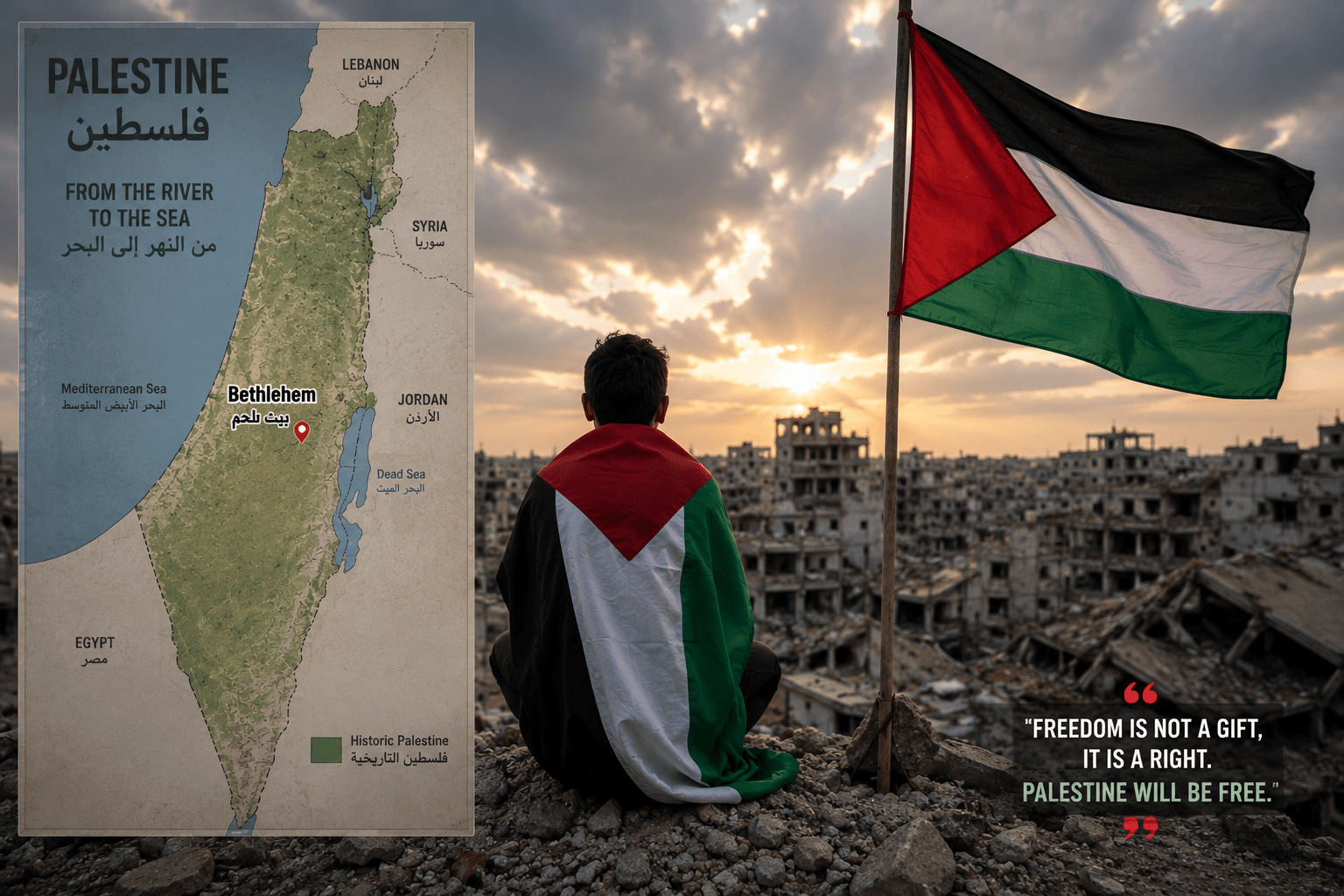
“Israeli-Zionist settler colonialism and Israeli domination over Palestinians can only end with decolonization and liberation of Palestine, from the river to the sea,” according to Lana Tatour is a lecturer in development at the School of Social Sciences at the University of New South Wales Sydney, Australia.
The future of Palestine depends on bringing all Palestinians under a unified plan for freedom and liberation. A totally new leadership body must be instituted.
Israel will continue its project of colonization, occupation, dispossession, and ethnic cleansing as long as America allows it. Public pressure does change things in America: it got the Vietnam war ended.
Journalist and political commentator Steven Sahiounie interviewed Ahmed Miqdad, a Palestinian poet and activist from Gaza.
1. Steven Sahiounie (SS): Israel has issued statements concerning Christian holy sites in the West Bank. Will Western Christians remain silent while their sacred heritage sites are being lost?
Ahmed Miqdad (AM): Israeli violations against Christians in Palestine began long ago and continue to this day. In fact, attacks against Christians and Christian sites have intensified. Despite this, Western governments and decision-makers have largely remained silent regarding what is happening to Christians. While there have been some responses from Christian communities in the West, these efforts have not reached the level necessary to stop or put an end to these violations.
2. SS: The resistance movement has sought to draw attention to the harsh military occupation of Palestine since 1948. Is it not time to end all armed resistance groups in Palestine and the region through the implementation of a two-state solution?
AM: The resistance movement has sought to highlight what it describes as the harsh military occupation of Palestine since 1948.
Since the beginning of the Israeli occupation, Palestinians have sought to obtain their legitimate human rights through all available means, including peaceful efforts and forms of resistance. However, the occupation has completely rejected recognizing the rights of the Palestinian people and, in some cases, has acted as though the Palestinian people do not exist. The occupation has left no meaningful path for peace or a diplomatic solution that would grant Palestinians their rightful rights. I believe the time has come for the Palestinian people to be given the right to live in peace and dignity so that armed Palestinian groups can eventually come to an end. In my view, Israeli governments have categorically rejected the idea of a two-state solution.
3. SS: Israeli Prime Minister Benjamin Netanyahu is facing numerous internal crises, particularly corruption allegations and other challenges, as Israeli elections approach. What is the mood of the Israeli public, and what are Netanyahu’s chances in these elections?
AM: As a Palestinian, I do not pay much attention to Israeli elections or to who wins or loses. Faces may change, but the policies remain the same. I do not believe there is any Israeli politician willing to recognize the Palestinian people’s right to live and obtain their legitimate rights
4. SS: Internal Palestinian divisions continue despite Israeli actions against Palestinians. In your opinion, what is the best way to end these divisions within the Palestinian political system, and are there currently any initiatives aimed at addressing these internal issues?
AM: It is true that significant efforts have been made toward Palestinian reconciliation, but all have failed. Each political faction holds a different ideology, and each believes it is the most deserving of leading the Palestinian people. Furthermore, the occupation fuels this division by every means possible in order to keep Palestinians weak, making the establishment of a Palestinian state nearly impossible.
Therefore, there must be unity of vision in order to achieve liberation from the occupation. I believe this can be accomplished through the election of a single authority that represents the Palestinian people and speaks on their behalf in international forums until their rights are achieved.
5. SS: Israel has not respected the ceasefire and is violating the agreement daily through airstrikes and actions against the people of Gaza, while at the same time the world is calling on the factions operating in Gaza to surrender. In your opinion, where are developments in Gaza heading, and what is the future of the agreement supported by the United States and the international community?
AM: There has never been a genuine ceasefire since the first day the agreement was signed. There have been thousands of violations by the Israeli military. Even the mediators and guarantors of the agreement have not been respected by Israel. Because the world is deeply unjust, it does not view the Palestinian people through the lens of justice, nor does it stop the bloodshed that has continued for years. This has resulted in the destruction of Gaza and the deaths of more than 70,000 Palestinians.
In my opinion, even if Palestinian factions were to surrender, the occupation would not show mercy to the Palestinian people, as it kills without justification. I believe the situation in Gaza will remain extremely difficult and will require years of effort and work to rescue and support what remains of the population. The occupation continues to impose restrictions on the entry of aid into Gaza. Therefore, there must be genuine pressure on Israel from the United States and Western countries to open the crossings, allow urgent humanitarian assistance, and support reconstruction, in addition to establishing a unified authority to govern the Gaza Strip.
Steven Sahiounie is a two-time award-winning journalist.

