


Steven Sahiounie, journalist and political commentator
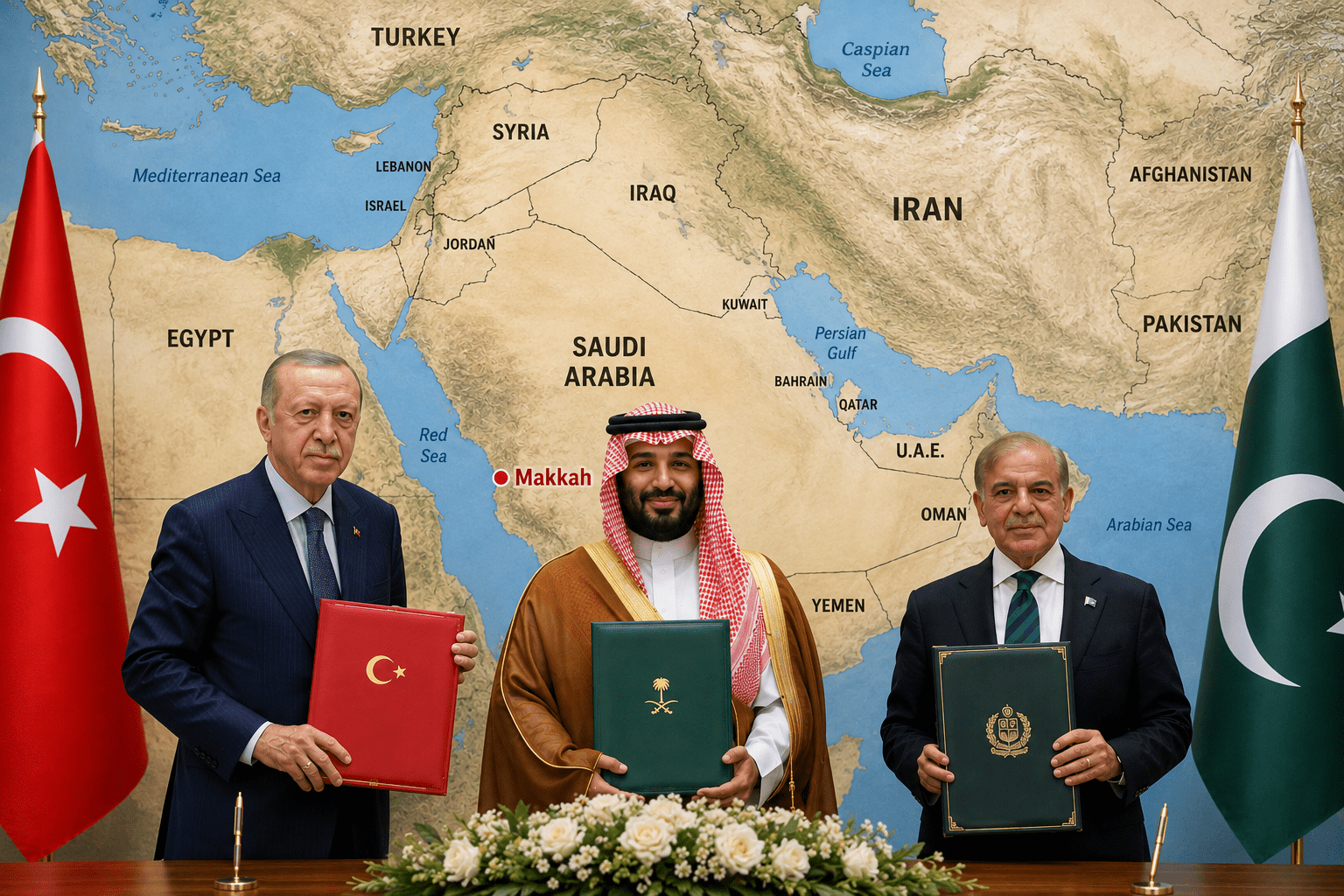
On August 7, Saudi Arabia, Pakistan and Turkey signed a joint defense agreement in Mecca. The Arab Gulf had previously depended on the U.S. military to defend and protect the various oil-rich nations, but that defense was proven a mirage in the desert; a security illusion. The U.S. and Israel launched an unprovoked attack on Iran, which has resulted in damages, deaths and injuries to the Gulf countries, and according to the BBC investigation using satellite imagry, has resulted in the wholesale destruction of American military facilities. Many analysts say the aftermath of the war, should it ever end, will see the U.S. military presence gone from the area, and the Arabs and their neighbors will rely on their own homegrown military and security alliances.
Journalist Steven Sahiounie, of MidEastDiscourse, interviewed experts on Turkey, Pakistan and Egypt to gain insight into the ramifications of the new agreement.
#1. Steven Sahiounie (SS): Turkish President Recep Tayyip Erdoğan said that the agreement is not directed against any country. In your view, can Saudi Arabia, Türkiye, and Pakistan convince regional and international powers of this, or is the political and military message indirectly aimed at specific parties?
Aydin Sezer (AS), former Turkish diplomat: Before commenting on the agreement, it is important to keep in mind that Turkey is a NATO member country, that it has the second-largest military in NATO, and to speak with Article 5 of the NATO Treaty in mind.
The statement that the Mecca Agreement is not directed against any specific country holds no practical significance. The media in Turkey, which is under the control of the ruling party, is promoting the narrative that the agreement is aimed against Israel. Another possible target is, of course, Iran, and this is also being discussed.
This signing is, in fact, entirely aimed at the Turkish domestic audience, and it carries additional significance precisely because it bears the name of a holy city like Mecca. Since such an alliance is being formed, it is very clear that it is being established against someone. For this reason, I do not believe Erdoğan’s words will hold any weight.
2. SS: What are the real motivations behind signing the joint defense agreement between Saudi Arabia, Türkiye, and Pakistan at this particular time? Are we witnessing the emergence of a new defensive alliance that could reshape the security landscape in the Middle East?
AS: Frankly, I don’t think so…
Turkey is seeking financing and markets for its rapidly expanding defense industry. To this end, it is taking political steps while disregarding its other international commitments. As I’ve said before, this also has a domestic political and ideological dimension. Pakistan, in particular, was already seeking allies in its own region, specifically in its relations with India.
Saudi Arabia, too, is seeking to strengthen its own security umbrella in the wake of the recent Gulf crisis and the attack on Iran. However, there is one point we must emphasize here. Not long ago, Saudi Arabia signed a civil nuclear cooperation agreement with the U.S. We know just how deep U.S.-Saudi Arabia relations run.
Trump made the Abraham Accords with Israel a precondition for this agreement. For these reasons, what is at stake here is not so much a new defense alliance as a political partnership and a pragmatic approach
#3. SS: What role can Pakistan, as a nuclear-armed state and a major military power, play in safeguarding the security of the Gulf? Could the agreement eventually extend to arrangements involving strategic deterrence?
Shakeel Ahmed (SA), Journalist Pakistan TV: Pakistan can play a significant role in safeguarding the security of its Gulf partners because of its status as a nuclear-armed state, major military power, and long-standing security partnership of Saudi Arabia. The new Pakistan, Saudi Arabia and Türkiye mutual defense pact significantly strengthens this role by combining Pakistan’s strategic deterrence and battle tested armed forces specially in recent India Pakistan conflict, Saudi Arabia’s economic and energy weight, and Türkiye’s advanced conventional military capabilities and defense industry. The agreement comes at a critical time. The recent Iran Israel conflict, attacks on Gulf states and growing uncertainty surrounding traditional external security guarantees have highlighted the need for stronger regional security mechanisms. In this environment, the alliance can enhance deterrence by making any potential aggressor consider the collective military and strategic consequences of attacking one of its members. The pact should not necessarily be viewed as an Islamic NATO, but rather as a defensive strategic partnership designed to strengthen regional stability. Pakistan can contribute through military cooperation, training, intelligence sharing, defense production and, where necessary, strategic deterrence.
And secondly, the alliance could create a framework for deeper strategic consultations, but such arrangements would require careful political, legal and diplomatic consideration. For now, the greatest strength of the pact is its conventional and collective deterrence. Ultimately, a stronger Pakistan, Saudi and Türkiye alliance can create a credible regional balance of power, protect critical Gulf infrastructure and give diplomacy greater space to succeed.
#4. SS: Are we witnessing the emergence of a new security order in the Middle East led by regional powers such as Saudi Arabia, Türkiye, and Pakistan, or will this agreement remain primarily a political deterrence mechanism without developing into a fully integrated military alliance?
SA: From a Pakistani perspective, the Pakistan Saudi Arabia and Türkiye defence pact should be viewed as the beginning of an emerging regional security architecture, rather than merely a symbolic political agreement. However, it is too early to call it a fully integrated military alliance AS compare to NATO. The strongest indication of a changing order is that the three major Muslim states have formally agreed that an armed attack on one will be regarded as an attack on all, creating a significant collective deterrence effect. The pact reflects a gradual reordering of Gulf security as regional states seek additional mechanisms beyond exclusive dependence on the traditional US security umbrella. The US is stepping back and regional powers are stepping up and the Mecca Defense Agreement is example of that emerging security model. Importantly the agreement is designed around mutual defense planning, intelligence cooperation, joint military exercises, interoperability and coordinated responses, not a permanent integrated command yet. For Pakistan, this is strategically important. Pakistan contributes a large, experienced military, strategic deterrence capabilities and decades of defense cooperation with Saudi Arabia, while Türkiye adds a sophisticated defense industry and major conventional military capabilities. Saudi Arabia provides the alliance with geographical, economic and energy significance. The pact establishes a framework for collective deterrence and expands defense cooperation among the three countries. Pakistan’s own strategic institutions have previously stressed that its defense relationship with Saudi Arabia rests on decades of training, operational cooperation and military expertise.
Therefore, the likely trajectory is gradual institutionalization rather than an immediate NATO style alliance. If joint exercises, intelligence-sharing, defense production, maritime security and interoperability deepen, this pact could evolve into one of the Middle East’s most consequential regional security frameworks while remaining fundamentally defensive and complementary to existing international arrangements
#5. SS: The agreement stipulates that any attack on one of the three countries will be considered an attack on the other two. To what extent can this clause be considered a genuine military commitment rather than merely a political declaration intended for deterrence?
Dr. Hossam Elbakeiey (HE), an Egyptian expert in international relations. Last Friday, at Al-Safa Palace in Mecca, Saudi Crown Prince Mohammed bin Salman, Turkish President Recep Tayyip Erdoğan, and Pakistani Prime Minister Shehbaz Sharif signed the Mecca Mutual Defense Agreement. Article 5 of the agreement states that “the agreement aims to strengthen collective deterrence against any act of aggression” and that “any armed attack against any of the three countries shall be considered an attack against all of them,” in a provision similar to Article 5 of the NATO treaty.
The agreement brings together the largest economy in the Arab world, the only nuclear-armed power in the Muslim world, and the country with the second-largest army in NATO after the United States.
The agreement can be viewed as an extension of the Joint Strategic Defense Agreement signed between Saudi Arabia and Pakistan in September 2025, which contained essentially the same provision, and as the culmination of longstanding military relations between Saudi Arabia and Pakistan. These relations have included joint military exercises, training, and intelligence sharing. Pakistani military personnel have also been stationed in Saudi Arabia for many years, even before the agreement was signed.
Nevertheless, the Pakistani parliament rejected the participation of the Pakistani military in the Saudi-led coalition supporting the Yemeni government against the Houthis in 2015. Pakistani officials have also repeatedly stated that Pakistan’s nuclear weapons are not part of the agreement.
Pakistan also did not participate in responding to repeated Iranian attacks against Saudi Arabia following the U.S.-Israeli aggression against Iran after February 28 and continuing to the present, despite the presence of approximately 8,000 Pakistani soldiers in Saudi Arabia, in addition to fighter aircraft, drones, and air-defense systems deployed across the Kingdom.
Saudi Arabia also purchased a major package of Turkish drones in 2023, reportedly one of Turkey’s largest such export deals.
However, what the text does not mention—and what is fundamental to treaties and ultimately determines their fate—is that the joint statement does not specify any concrete military obligations for the parties. There is no joint command structure, no automatic deployment mechanism, and no decision-making body comparable to NATO.
The initial texts and reports have also not disclosed details regarding what each party would actually be obligated to do if one of the members came under attack.
Following the signing, Ankara stated that the agreement was purely defensive, was not directed against any country, and was open to other countries in the region. More importantly, decisions concerning the use of force remain sovereign national decisions. This significantly limits the practical military meaning of the agreement.
Furthermore, the different rivals and adversaries of each of the three parties make implementation of this provision extremely difficult.
Pakistan’s primary rival and adversary is India, which maintains good relations with Saudi Arabia. It is difficult to imagine Saudi Arabia going to war against India in the event of clashes or hostilities between India and Pakistan, as has happened repeatedly in the past.
Turkey also enjoys strategic relations with India, making it difficult to envision Turkey joining a war against India in defense of Pakistan.
Likewise, Saudi Arabia and Turkey maintain good relations with the Taliban government in Afghanistan, while the Taliban has a history of strained and hostile relations with Pakistan, with recurring clashes between the two sides due to longstanding border disputes dating back to 1892, well before the establishment of Pakistan as an independent state.
Iran, meanwhile, is a rival and adversary of Saudi Arabia but shares a border with Pakistan stretching for approximately 900 kilometers. Pakistan also has one of the world’s largest Shiite populations outside Iran, estimated at around 40 million people. It is highly likely that Pakistan would face internal unrest and instability if it became involved in a war against Iran in defense of one of its alliance partners.
Turkey, for its part, regards the collapse of Iran as a major threat to its national security, particularly if Kurdish forces were involved. Turkey was reportedly among the most important factors behind the failure of a project to establish Kurdish ground forces to overthrow the Iranian government at the beginning of the war.
Turkey’s most prominent regional rival, Greece, also enjoys strategic relations with Saudi Arabia. It is therefore difficult to imagine Saudi Arabia becoming involved in a conflict between Turkey and Greece.
For all these reasons, the agreement is closer to a political declaration of deterrence than to a genuine and binding military alliance.
#6. SS: How could this agreement affect relations between Saudi Arabia and Iran, particularly given that Riyadh and Tehran have recently sought to reduce tensions and rebuild channels of dialogue? Could the agreement be perceived in Tehran as a threat?
HE: One of the most important reasons behind this agreement is the U.S.-Israeli war against Iran and the Iranian attacks that followed against Gulf states, particularly Saudi Arabia, as well as Jordan, Iraq, and Syria during the second phase of the war.
Iran’s reaction to the agreement was negative. Several Iranian officials warned Saudi Arabia that the agreement would not guarantee its security, in an apparent attempt to downplay its significance.
Mahmoud Nobavian, a hardline member of the Iranian Parliament’s National Security and Foreign Policy Committee, stated that Saudi rulers should understand that just as U.S. military bases had failed to provide them with security, “clinging to America’s followers” would not provide them with security either.
The statement came in the same context as remarks by another member of the committee, Ebrahim Rezaei, who said that the Saudis should understand that “a paper agreement with Turkey and Pakistan will not bring them security.” He also called on Riyadh to reconsider its regional policies, arguing that external understandings and agreements do not constitute a guarantee of security.
It is noteworthy that there are reports, most of them originating from American and Israeli sources, promoting the agreement as a Sunni alliance against Shiite Iran, despite assurances from all parties to the agreement that it is not directed against any particular country and that it remains open to all countries in the region in the future.
This could potentially include Iran itself once the war ends, given the realities of regional geopolitics and Iran’s status as a natural part of the region.
#7. SS: What does this agreement mean for relations between Riyadh and Washington? Are we witnessing the beginning of a Saudi shift toward diversifying its security guarantees rather than relying exclusively on the United States?
HE: Regarding the significance of this agreement for Saudi-U.S. relations, the first point to note is that all parties to the agreement are allies of the United States.
Second, the agreement is consistent with Washington’s new policy of placing greater responsibility for regional security on regional states themselves.
Nevertheless, the agreement also reflects Saudi doubts about the ability or willingness of the United States to provide security for the Gulf states. These doubts became particularly evident after the war against Iran.
A number of former U.S. officials have stated that American military bases in the Gulf are primarily intended to protect Israel rather than the Gulf states themselves.
These doubts began to emerge more clearly in 2019 following the Houthi attacks on Saudi Aramco, when the United States did not activate its air-defense systems to protect Saudi Arabia. They were reinforced by the Israeli attacks on Doha in September of last year, despite the presence there of Al Udeid Air Base, one of the largest U.S. military bases abroad.
Nevertheless, Saudi Arabia’s, or the Gulf states’, abandonment of the U.S.-led security architecture is not a realistic prospect in the long term.
Steven Sahiounie is a two-time award-winning journalist.

