


Steven Sahiounie, journalist and political commentator
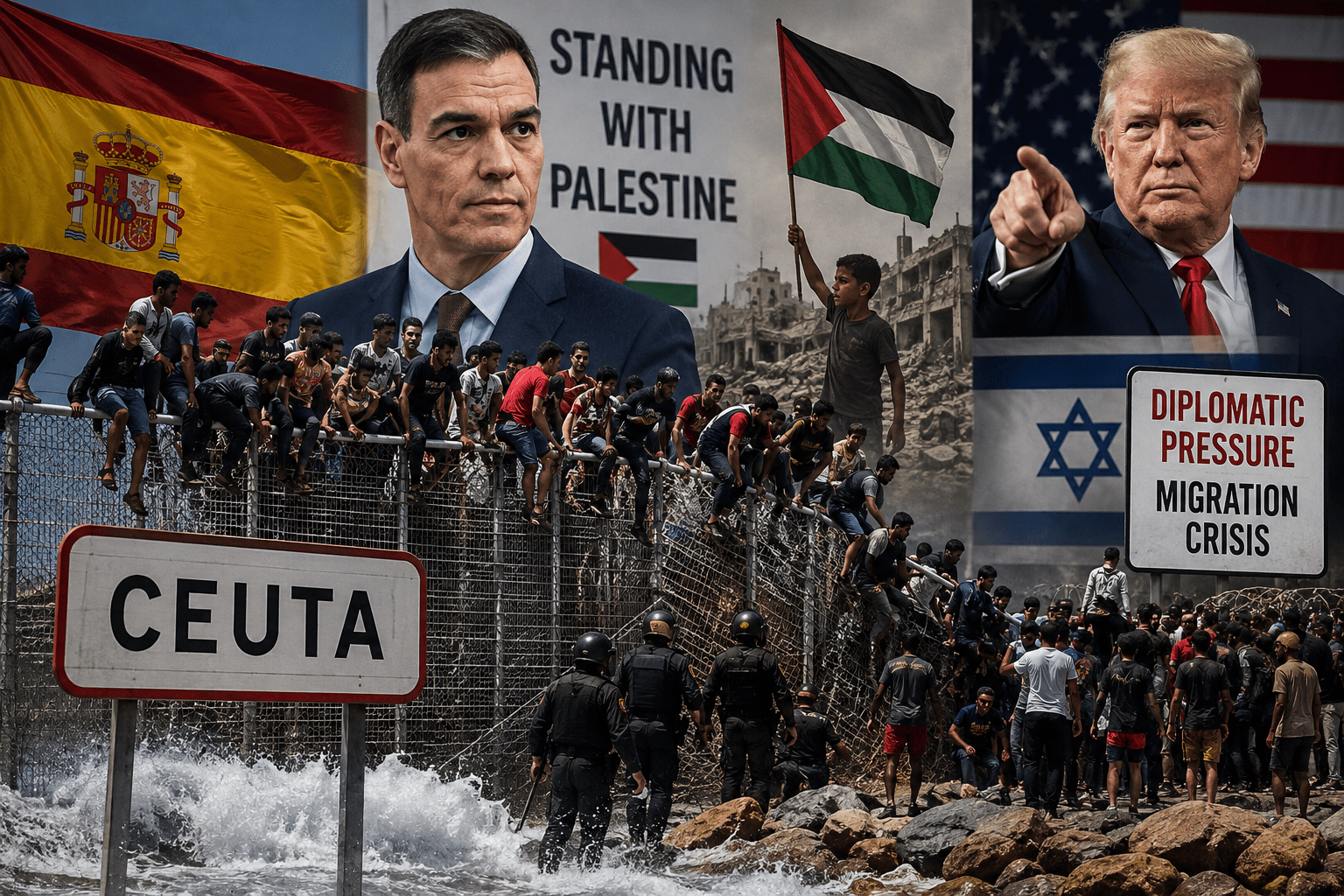
The sudden arrival of more than 50,000 migrants into the Spanish enclave of Ceuta has become one of the largest border crises in Spain’s modern history. While Madrid attributes the mass crossing to misinformation spread by human trafficking networks following a Spanish Supreme Court ruling, the timing of the crisis has fueled political debate throughout Europe and beyond.
The migration emergency unfolded as Spain has emerged as one of Europe’s strongest critics of Israel’s military campaign in Gaza. Madrid has recognized the State of Palestine, suspended military exports to Israel, supported international legal accountability, and repeatedly condemned what Prime Minister Pedro Sánchez has described as the humanitarian catastrophe in Gaza.
The right-wing extremists in Israel, and the Trump administration claim the Spanish government are to blame for the migration crisis.
These developments have prompted some analysts and political commentators to question whether Spain’s increasingly independent foreign policy has exposed it to growing diplomatic and political pressure. Although no public evidence has demonstrated that the migration surge was orchestrated by any foreign government, the convergence of migration, geopolitics, and escalating diplomatic tensions has made the crisis far more than a simple border emergency.
A Historic Migration Surge
Spanish authorities reported that approximately 50,000 migrants crossed into Ceuta by land and sea within two days. Local officials estimated that the figure may have reached nearly 60,000.
The humanitarian consequences were severe. Authorities recovered 57 bodies near the border, with victims reportedly drowning while attempting dangerous sea crossings or being crushed during efforts to climb border barriers. Officials warned that additional casualties may have occurred on the Moroccan side.
On July 31, Spain’s Interior Ministry announced that roughly 48,300 migrants had already returned voluntarily to Morocco after failing to secure accommodation or basic necessities inside the small Spanish territory.
Moroccan security forces deployed large numbers of personnel equipped with batons and tear gas to disperse crowds attempting to enter both Ceuta and the nearby Spanish enclave of Melilla.
Europe Divided
The crisis quickly exposed divisions within the European Union, which include divided opinions concerning support of the US-Ukraine war on Russia
Italy temporarily suspended the application of Schengen travel arrangements with Spain, introducing restrictions on air and sea travel. Finnish officials supported Rome’s criticism, arguing that Spain had failed to adequately secure the European Union’s external border.
France adopted a more balanced approach. President Emmanuel Macron expressed solidarity with Prime Minister Pedro Sánchez while simultaneously ordering increased security checks along the Franco-Spanish border to prevent secondary migration.
Spain rejected accusations that Schengen had been compromised, insisting that migrants could not travel onward to mainland Spain without identity verification.
Washington’s Political Response
The images from Ceuta immediately became part of America’s domestic political debate.
Senior Trump adviser Stephen Miller used the crisis to defend the administration’s strict immigration policies, arguing that similar scenes had occurred during President Joe Biden’s administration and warning that Democratic immigration policies would produce even larger migration waves in the future.
Although these comments reflected American domestic politics, they also illustrated how rapidly Spain’s border crisis became part of a broader international political narrative.
Rising Diplomatic Tensions with Israel
Relations between Madrid and Tel Aviv have deteriorated steadily since the outbreak of the Israeli war on Gaza.
Israeli Ambassador to the United Nations Danny Danon criticized Spain’s handling of the migration crisis, arguing that Madrid had frequently criticized Israel while struggling to secure its own borders. He also questioned Spain’s continued sovereignty over Ceuta and Melilla, describing them as colonial enclaves in Africa.
His remarks generated widespread reactions in both Spain and Morocco. Several Moroccan media outlets argued that Israel was attempting to exploit the migration crisis amid worsening diplomatic relations with Spain over Gaza.
While such interpretations remain political assessments rather than established facts, they demonstrate how the migration emergency quickly became intertwined with broader diplomatic disputes.
Spain’s Foreign Policy Transformation
Spain’s position on Palestine did not emerge overnight.
Since taking office, Prime Minister Pedro Sánchez has gradually shifted Spanish foreign policy toward a more independent approach in the Middle East. Following the outbreak of the Gaza war in October 2023, Madrid departed from the cautious language adopted by many Western governments and repeatedly called for an immediate ceasefire while condemning the high civilian death toll.
Spain later joined Ireland, Belgium, Slovenia, and other European governments advocating stronger humanitarian measures and increased diplomatic pressure on Israel.
The government also suspended military exports to Israel before transforming the suspension into permanent law in 2025, making Spain one of the first European countries to legally prohibit future arms exports to Israel.
Spain’s Parliament simultaneously called for expanded humanitarian assistance to Gaza and greater international legal accountability for alleged violations of international law.
The country’s National Court also opened an investigation into executives of a Spanish steel company accused of complicity in crimes against humanity through commercial dealings involving an Israeli arms manufacturer.
Public Opinion
Spain’s policy reflects significant domestic support.
According to research conducted by the Royal Elcano Institute, nearly four out of every five Spaniards support European recognition of a Palestinian state. Public demonstrations across Spain since 2023 have consistently demanded stronger action to protect Palestinian civilians and uphold international humanitarian law.
Spain’s relationship with the Palestinian cause also has deep historical roots. Madrid established close ties with the Palestine Liberation Organization decades before recognizing Israel in 1986, maintaining a diplomatic tradition that differs from several other Western European countries.
Israel’s Response
Spanish criticism has provoked increasingly sharp responses from Israeli leaders.
Prime Minister Benjamin Netanyahu accused Sánchez of making dangerous remarks after Spain intensified its criticism of Israeli military operations.
Foreign Minister Gideon Sa’ar also attacked Spain, invoking historical references including the Spanish Inquisition in response to Madrid’s position on Gaza.
The exchanges have highlighted one of the deepest diplomatic disagreements between Spain and Israel since formal diplomatic relations were established.
Gaza’s Economic Impact on Israel
The Gaza war has imposed substantial costs on Israel.
Israeli reports estimate that military operations had already cost approximately $40 billion by the end of 2024. Tourism, aviation, construction, investment, and several other sectors have suffered major losses, while diplomatic criticism from traditional allies has become increasingly frequent.
For Spain, these developments have reinforced the government’s argument that a political solution—not an indefinite military campaign—remains the only sustainable path toward regional stability.
Looking Beyond the Border
The Ceuta migration crisis is likely to be remembered as more than a humanitarian emergency. It has become a symbol of the intersection between migration, European security, Middle Eastern diplomacy, and international politics.
Spain’s increasingly assertive position on Gaza has undoubtedly placed it at odds with both Israel and influential political figures in Washington. At the same time, the migration emergency has intensified debates over Europe’s border policies and exposed divisions within the European Union regarding migration management.
What is beyond dispute is that Spain has emerged as one of the most outspoken European defenders of Palestinian rights and international humanitarian law. As the war in Gaza continues and diplomatic tensions deepen, Madrid’s foreign policy is likely to remain under intense international scrutiny, placing Spain at the center of one of the most consequential geopolitical debates of our time.
Steven Sahiounie is a two-time award-winning journalist

