


Muhammad Asif Noor, Journalist and writer
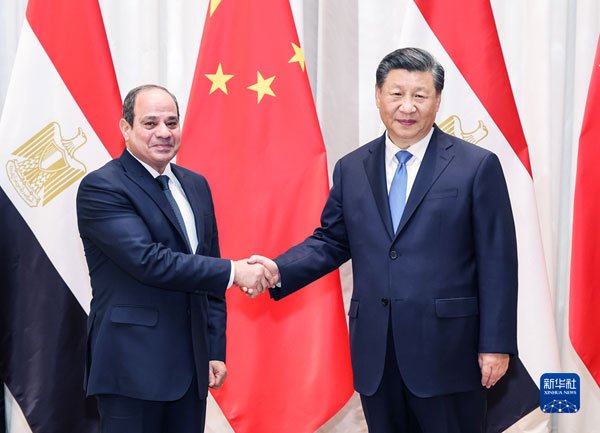
Seventy years ago, Egypt made a decision that helped redraw the diplomatic map of the Global South. By becoming the first Arab and African country to establish relations with the People’s Republic of China, Cairo opened a political bridge between Beijing, the Arab world and Africa. President Xi Jinping’s first state visit to Egypt in a decade now brings that historic choice into a new era. As President Abdel Fattah El-Sisi receives him in Cairo, the central question is no longer how enduring this friendship has been, but how decisively it can help Egypt secure water and energy, strengthen its industries, create opportunities for its youth and preserve its freedom of action in an increasingly uncertain world.
The visit comes at a moment when Egypt’s strategic importance is rising even as its economy absorbs pressures originating far beyond its borders. Conflict in the Red Sea has reduced Suez Canal traffic and weakened a vital source of foreign currency. Regional instability has driven energy costs sharply higher, while water security has become more urgent amid uncertainty surrounding the Grand Ethiopian Renaissance Dam. With external debt at roughly 40.3 percent of GDP, Egypt needs partnerships that do more than provide temporary relief. It needs cooperation that expands its ability to produce, export and withstand future shocks.
What makes China especially relevant is the nature of its engagement. Beijing’s cooperation increasingly connects finance with factories, infrastructure with technology transfer, and investment with local employment. Under the strategic guidance of Presidents El-Sisi and Xi, the relationship has begun to move beyond the traditional exchange of capital and commodities. It is becoming a partnership for building Egyptian capacity, enabling the country to generate more of its own energy, manufacture more of what it consumes, secure new sources of water and prepare its young people for the industries that will define the coming decades.
Energy offers the clearest example. Egypt possesses exceptional solar resources, yet its exposure to imported energy and volatile prices has increased. Chinese finance, technology and equipment are supporting a transition that combines electricity generation with industrial development. The Benban complex in Aswan, Africa’s largest solar park, established Egypt’s ability to develop renewable power at scale. The newly operational Obelisk project adds energy storage, helping make solar power available beyond daylight hours.
The Atum Solar Industrial Park and BodA New Energy’s planned 4-gigawatt photovoltaic manufacturing base take this transition further. Together with the solar and independent storage project agreed in June for the New Administrative Capital, they can help Egypt manufacture renewable-energy equipment rather than remain primarily a purchaser of it. Egypt could become a production and export centre supplying Arab and African markets, with Chinese investment supporting Egyptian engineers, workers and local supply chains.
The China-Egypt TEDA Suez Economic and Trade Cooperation Zone demonstrates how this model can work. Hosting more than 200 companies, it has attracted approximately $4.7 billion in investment and created over 10,000 jobs. Its location has acquired greater significance as the Red Sea crisis has exposed the vulnerability of relying heavily on canal transit revenue.
Egypt cannot control every disruption affecting global shipping, but it can create more value around the Suez Canal. Manufacturing, processing and logistics can ensure that Egypt earns from goods produced near the canal as well as vessels passing through it. China’s zero-tariff treatment for Egyptian exports can reinforce this ambition by improving access to the Chinese market. Egyptian companies will now need support with standards, distribution, packaging and promotion so that formal access becomes actual export growth.
Financial cooperation provides another layer of resilience. The bilateral currency-swap agreement, renewed and expanded in June to 30 billion yuan, can facilitate trade in Egyptian pounds and Chinese yuan, reducing pressure on Egypt’s dollar reserves. The debt-for-development mechanism is equally promising. By converting part of Egypt’s obligations to China into locally implemented projects, it can redirect debt towards infrastructure, industrial capacity and employment. Financial obligations can thereby become investments in Egypt’s future productive strength.
Water cooperation carries even greater national importance. More than 680 desert wells have been drilled with Chinese involvement, expanding agricultural activity and improving farmers’ incomes. Yet Egypt’s long-term security also requires desalination, efficient irrigation and domestic control over essential water technologies.
The contract signed in April to establish a reverse-osmosis membrane plant inside Egypt is therefore a strategic development. Housing Minister Randa El-Manshawy described local membrane production as critical to national water security because it will reduce dependence on external supply chains. The 130,000-tonne-per-day Mersa Matruh desalination plant, half of whose capacity uses Chinese-made membranes, is already providing reliable freshwater to Mediterranean coastal communities. Local production could eventually allow Egypt to export desalination technologies to other water-stressed countries.
The most enduring investment, however, is in people. The Luban Workshop has trained more than 3,000 Egyptian young people by connecting technical education with industrial practice. More than 160 information and communications technology academies have reached over 60,000 students. The next step is to connect this training more consistently with recognised qualifications, apprenticeships, jobs and Egyptian entrepreneurship.
Egypt and China have already established the political trust required for an ambitious partnership. Their 2024–2028 cooperation program identifies industrial localisation and technology transfer as shared priorities. Egypt contributes strategic geography, industrial ambition and access to African, Arab and Mediterranean markets. China contributes capital, technological capability, manufacturing experience and commercial scale.
The principle guiding the next phase should be simple: every project built together should leave Egypt more capable of building for itself. That means producing clean-energy equipment, manufacturing desalination technology, creating greater value around Suez and turning technical education into dignified work.
Egypt gave China its first diplomatic bridge to the Arab and African worlds. Seventy years later, the two countries can build something even more consequential: a partnership that helps Egypt become the industrial, technological and logistical bridge connecting those worlds.
*The writer is Executive Director, Institute of Peace and Diplomatic Studies

