


Steven Sahiounie, Journalist and Political Commentator
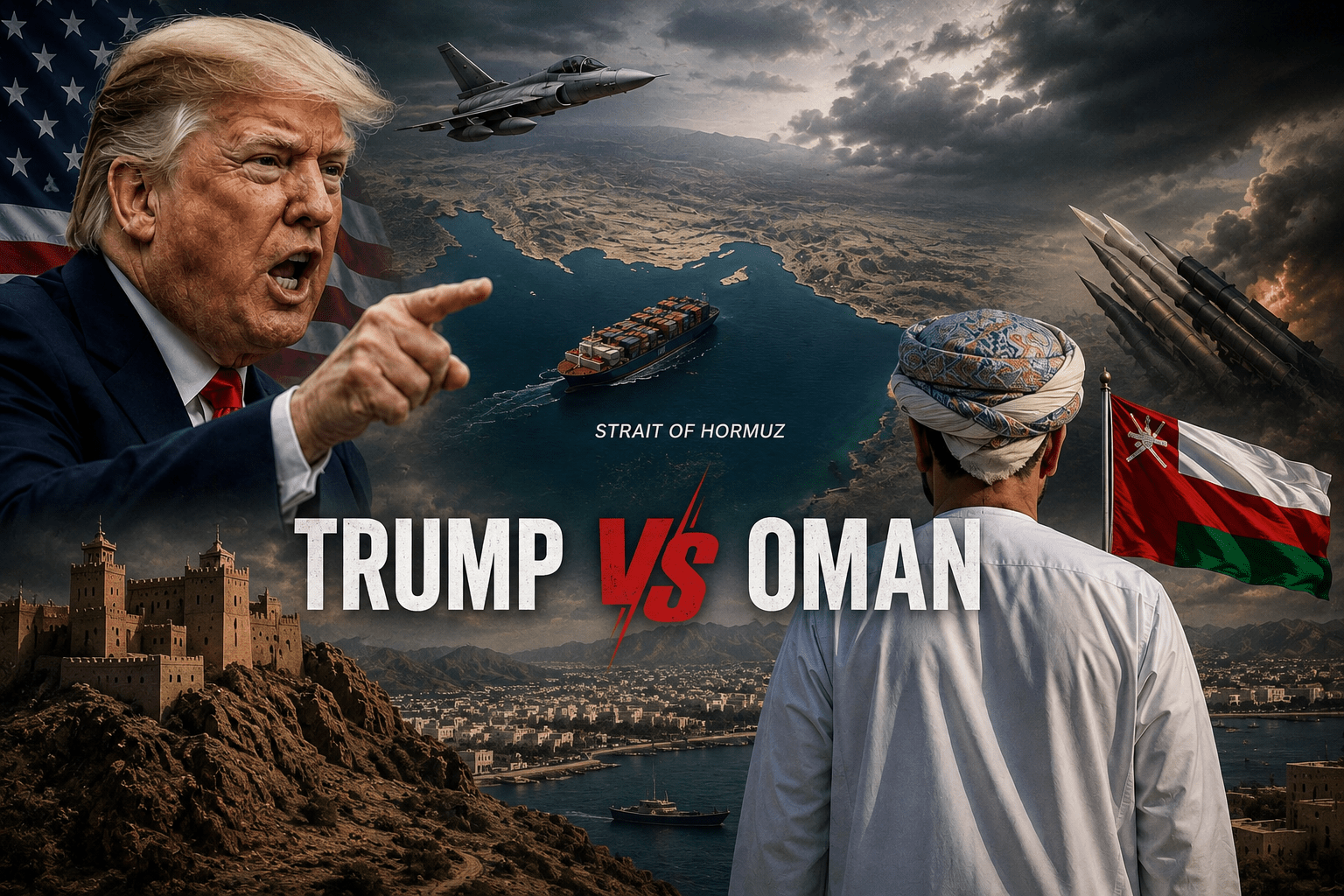
The escalating war between the United States and Iran has entered a potentially dangerous new phase, as US President Donald Trump has threatened to bomb Oman if Muscat interferes with Washington’s negotiations with Tehran. The threat is particularly significant because Oman has long been regarded as one of Washington’s closest partners in the Gulf and has traditionally played the role of a neutral mediator between the United States and Iran.
Trump’s latest warning came as Oman and Iran were reportedly moving toward an understanding over the reopening and management of the Strait of Hormuz, one of the world’s most strategically important maritime passages. According to sources, Iran and Oman had reached an agreement in principle on a new shipping route and were preparing a joint declaration aimed at protecting the interests of both countries while allowing commercial vessels to pass safely.
The development places Oman in an increasingly difficult position. Muscat is attempting to preserve its traditional policy of neutrality while simultaneously protecting its sovereignty, maintaining its relationship with Washington and negotiating with Tehran over the future of the Strait of Hormuz.
A direct threat against a longtime U.S. partner
Trump’s warning was delivered during an interview with Fox News on Monday. He issued an extraordinary threat against Oman, saying that if the country “gets in the way” of US talks with Iran, Washington would bomb it.
The statement was not the first time Trump has threatened Oman during the five-month conflict. On May 27, during a cabinet meeting, Trump was asked whether he would accept an arrangement under which Iran and Oman jointly controlled shipping through the Strait of Hormuz.
His response was unequivocal. Trump said that nobody would control the strait and warned that Oman would have to “behave just like everybody else” or the United States would “have to blow them up.” The US State Department subsequently published the transcript of the remarks, confirming that Trump had specifically referred to Oman.
The United States and Oman have maintained close relations for nearly two centuries and have concluded multiple agreements covering security, trade, science and technology. At the same time, Oman has repeatedly positioned itself as a mediator between the United States and Iran.
The U.S. has a history of betraying partners
A phrase attributed to former Egyptian President Hosni Mubarak — that those who “wrap themselves in America are naked” — has resurfaced amid the current conflict. The expression captures concern that regional states may depend heavily on Washington for security while discovering, during a crisis, that American priorities do not necessarily correspond with their own.
The U.S. betrayed Saddam Hussein during the Kuwait war (the Gulf War). U.S. Ambassador April Glaspie gave Saddam Hussein the “green light” to invade Kuwait in July 1990, after providing economic and intelligence support to Iraq as a strategic buffer against the Iranian Islamic revolution. However, Washington made an abrupt U-turn and attacked Iraq.
Afghanistan withdrawal critics accused Washington of abandoning local partners and damaging American credibility.
The withdrawal from Vietnam remains one of the most controversial examples. Critics argued that Washington abandoned South Vietnam after years of military involvement.
These historical debates are relevant to the current Gulf crisis because regional governments are watching closely how Washington balances military commitments, strategic interests and relationships with its partners.
Trump’s threat creates an extraordinary diplomatic contradiction: Washington is threatening military action against a country that has historically been a partner and mediator for the United States.
It also raises questions about how other Gulf states may interpret Washington’s approach. If an American ally such as Oman can become the target of a public military threat simply because it pursues an independent diplomatic initiative, other regional governments may increasingly question how much strategic autonomy they possess within their relationships with Washington.
A broader question about American commitments
The developments surrounding Oman come at a moment when the United States is already reconsidering its military posture across the Gulf.
The Pentagon is reportedly evaluating whether to reduce or reorganize its military presence in the Persian Gulf following months of Iranian attacks that damaged American facilities. The assessment could involve reconsidering whether existing bases should be rebuilt in their previous form and whether American forces should be positioned farther from vulnerable coastal locations.
The question is therefore no longer simply whether the United States can maintain its military footprint in the Gulf. It is whether the current model of American regional influence remains sustainable.
The debate has expanded among prominent Arab figures, with competing arguments focusing on Iranian influence, Israeli actions and American intervention.
The significance of this debate goes beyond the current war. It reflects a growing question among regional powers: Can Gulf security continue to depend primarily on external military powers, or must Arab states develop more independent mechanisms for protecting their own interests?
The Gulf states are watching
Gulf monarchies have invested heavily in security relationships with Washington, but they also have powerful economic and diplomatic interests that depend upon regional stability.
Can Trump reopen Hormuz?
The central challenge facing Washington is whether military pressure can actually achieve what diplomacy has failed to accomplish.
Can Trump protect Gulf allies?
The emerging Iran-Oman understanding therefore represents more than a dispute over shipping routes. It is a test of whether regional states can establish their own mechanisms for managing strategic waterways and regional security without direct American control.
If Trump chooses confrontation with Oman, the consequences could extend far beyond Muscat and Tehran. Such a move could deepen uncertainty among America’s Gulf partners, further destabilize global energy markets and accelerate discussions about whether the region should reduce its dependence on the United States.
As the U.S.-Israeli war on Iran continues, with no end in sight, the unfolding events could shape the political and security architecture of the Middle East for years to come.
Steven Sahiounie is a two time award winning journalist

