


Steven Sahiounie, journalist and political commentator
Egyptian President Abdel Fattah el-Sisi has reaffirmed that his presidency will end in 2030, declaring that his departure from office is a settled matter and “not open to debate.” The statement comes amid renewed online campaigns calling for constitutional amendments that could allow him to seek another term, placing Egypt’s political future back in the spotlight at a time of growing regional instability.
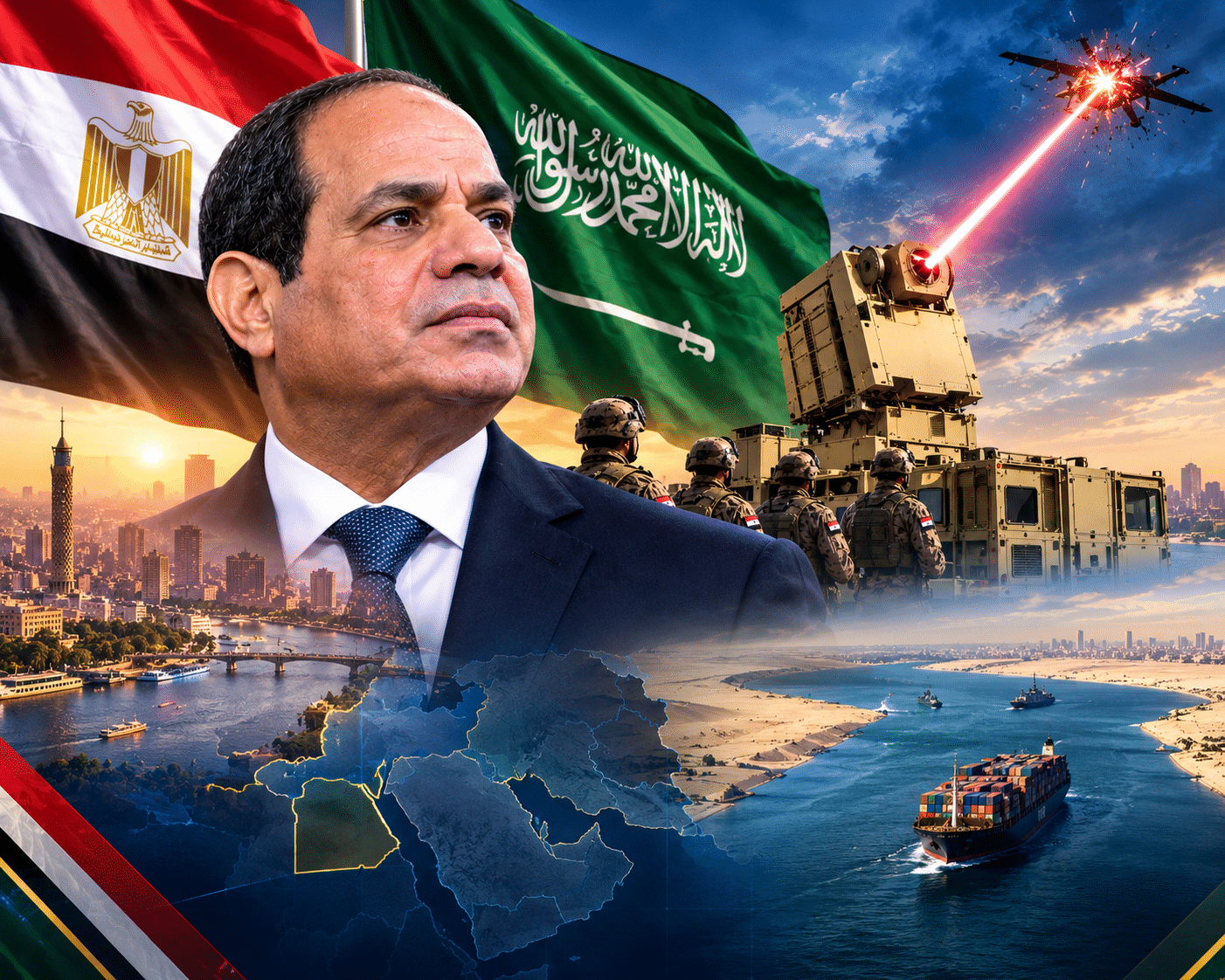
Yet Sisi’s latest remarks extend far beyond the question of presidential succession. His address at the Egyptian Military Academy’s graduation ceremony on Saturday, October 17, brought together three significant messages: a renewed commitment to the constitutional timetable governing his presidency, an unequivocal declaration of support for Saudi Arabia amid the ongoing Gulf conflict, and a warning about the dangers of escalating regional hostilities.
Meanwhile, Egypt’s military has publicly revealed a domestically developed laser defense system designed to counter drones and incoming projectiles, highlighting Cairo’s efforts to adapt its armed forces to the changing character of modern warfare.
These developments reflect the complex challenges facing Egypt as it seeks to preserve domestic stability, maintain strategic relationships with Gulf countries, encourage diplomatic engagement between Washington and Tehran, and strengthen its military capabilities. They also raise important questions about whether Sisi’s commitment to leave office in 2030 will translate into a credible political transition and how far Egypt is prepared to go in defending its regional partners.
The constitutional background is particularly important. Amendments approved in 2019 extended Sisi’s second term and established the legal framework that allows him to remain in office until 2030. Under the current constitutional provisions, he is not eligible to seek another term after completing his third term.
A meaningful transition would require political parties to strengthen their organizations, develop recognizable leadership, communicate clear policy platforms, and establish a stronger connection with voters. It would also depend on the ability of candidates to participate in a competitive electoral environment and on the credibility of the institutions responsible for administering the election.
The road to the 2030 presidential election will be shaped by more than constitutional declarations. Economic conditions, public confidence, institutional arrangements, and the ability of political organizations to mobilize support will all influence the eventual outcome.
Egypt’s opposition faces the challenge of translating public concerns into a coherent political alternative. This requires more than criticizing the government or responding to individual presidential statements. Opposition movements would need to build durable organizational structures, agree on realistic priorities, and demonstrate that they can address the country’s economic and social challenges.
The importance of this process extends beyond Egypt’s borders. As the Arab world’s most populous country and a major regional political and military power, Egypt’s domestic stability has implications for the wider Middle East. A predictable succession process could reinforce confidence in its institutions, while prolonged uncertainty could complicate its regional and economic priorities.
Egypt and Turkey Call for Dialogue Between Washington and Tehran
Cairo is working to prevent regional tensions from escalating into a wider confrontation. Egypt and Turkey have called on the United States and Iran to return to dialogue and resume negotiations, describing diplomacy as the only viable path toward resolving the current crisis and preventing further damage to regional interests.
The appeal emerged from a meeting between Egyptian Foreign Minister Badr Abdelatty and Turkish Foreign Minister Hakan Fidan on the sidelines of the 52nd session of the Council of Foreign Ministers of the Organization of Islamic Cooperation in Baghdad, Iraq
Abdelatty emphasized the importance of maintaining diplomatic efforts, supporting political solutions, and strengthening coordination through the regional quadrilateral mechanism. The objective, according to the Egyptian account, was to reduce tensions and reinforce security and stability across the region.
For Egypt, the security of maritime routes is particularly significant. The country’s strategic position near the Suez Canal and the Red Sea makes the stability of international shipping an important national interest. Any sustained disruption to regional maritime traffic could create additional economic pressures and complicate Cairo’s efforts to strengthen its financial position.
Turkey’s involvement in the diplomatic initiative also highlights the potential for regional cooperation despite differences between Middle Eastern governments. Cairo and Ankara have experienced periods of political tension, but their shared interest in avoiding a broader war provides an incentive to coordinate their positions
Sisi Declares Egypt Will Defend Saudi Arabia
Perhaps the most consequential regional element of Sisi’s speech was his strong declaration of support for Saudi Arabia.
The Egyptian president stated that Cairo would not allow the security of the Kingdom to be threatened without a response. He also announced that he was prepared to seek authorization from the Egyptian Parliament to take measures to protect Saudi Arabia if circumstances required it.
Speaking at the Military Academy graduation ceremony on Saturday, October 17, Sisi stressed that Egypt did not seek war and had no intention of attacking another party. Nevertheless, he maintained that the country was prepared to act in defense of Arab security.
He emphasized that Saudi Arabia’s security and stability represented a priority for Cairo, referring to the Kingdom’s leadership, including King Salman bin Abdulaziz and Crown Prince Mohammed bin Salman.
Egypt and Saudi Arabia share longstanding strategic interests. Both countries have an interest in preserving regional stability, protecting maritime routes, preventing attacks on critical infrastructure, and limiting the spread of armed conflict.
Egypt must balance its commitments to Saudi Arabia with the need to avoid becoming directly involved in a wider war that could impose significant economic and security burdens.
By declaring readiness to defend the Kingdom while simultaneously calling for an end to hostilities, Sisi sought to communicate solidarity without abandoning diplomacy.
Remembering Gulf Assistance After 2013
Sisi also used the ceremony to recall the assistance provided to Egypt by Saudi Arabia, the United Arab Emirates, and Kuwait following the political upheaval of 2013.
He said the three Gulf countries had helped Egypt meet essential needs, including fuel, natural gas, and wheat, during a period of considerable economic difficulty.
These remarks carry both historical and strategic significance. For Cairo, relations with the Gulf states are not merely a matter of diplomatic protocol. They are connected to investment, economic cooperation, energy supplies, and broader efforts to maintain financial stability.
Egypt Unveils Its Egy-Hel-01 Laser Defense System
During a military exercise, the Egyptian Armed Forces publicly displayed a domestically developed laser-based defense system identified as the **Egy-Hel-01**.
The system appeared mounted on a pickup truck in footage of a combat training exercise released by the military spokesperson on Friday. The appearance was reported as the system’s first public unveiling.
Russian media RT described the equipment as a locally manufactured laser weapon designed to counter unmanned aerial vehicles and incoming projectiles.
Drones have become increasingly influential in modern conflicts because they can perform reconnaissance, identify targets, support artillery operations, and conduct attacks at relatively low cost. Their availability has also allowed both state and non-state actors to deploy aerial systems that can challenge conventional defensive arrangements.
The public appearance of the Egy-Hel-01 does not, by itself, establish its operational range, effectiveness, or readiness for deployment. No independently verified performance figures were provided in the reporting describing its unveiling.
Nevertheless, its public presentation signals Cairo’s interest in developing indigenous technologies to address emerging threats. Domestic development could, if successful, strengthen technological expertise, support the local defense industry, and reduce reliance on imported equipment in selected areas.
Changing Security Environment for Egypt
Regional conflicts have demonstrated that relatively inexpensive aerial systems can threaten military facilities, energy infrastructure, and transportation networks. As a result, governments are increasingly seeking defensive systems that can respond to these threats without exhausting their ammunition stocks or imposing unsustainable costs.
For Egypt, this challenge intersects with its broader responsibilities as a major Arab state with interests in the Mediterranean, the Red Sea, and the security of regional trade routes.
Egypt Between Political Transition and Regional Confrontation
Sisi’s latest statements reveal an Egyptian leadership attempting to manage several interconnected challenges at once. Domestically, Sisi is preparing for a transition in 2030, while concerned about the effects on Egypt by the US-Israel war on Iran, and the Houthi attacks on Saudi Arabia, which were a byproduct of the unprovoked war on Iran. Sisi needs to defend the revenues generated in the Suez Canal, which are threatened by the Houthi threat to the fee passage of ships through the Bab al-Mandab.
The Gulf oil producing countries are idle because of the failure to negotiate an end to the US war on Iran. The decisions made in Washington, Tel Aviv and Tehran are impacting the Middle East, and the world.
Steven Sahiounie is a two-time award-winning journalist.

