

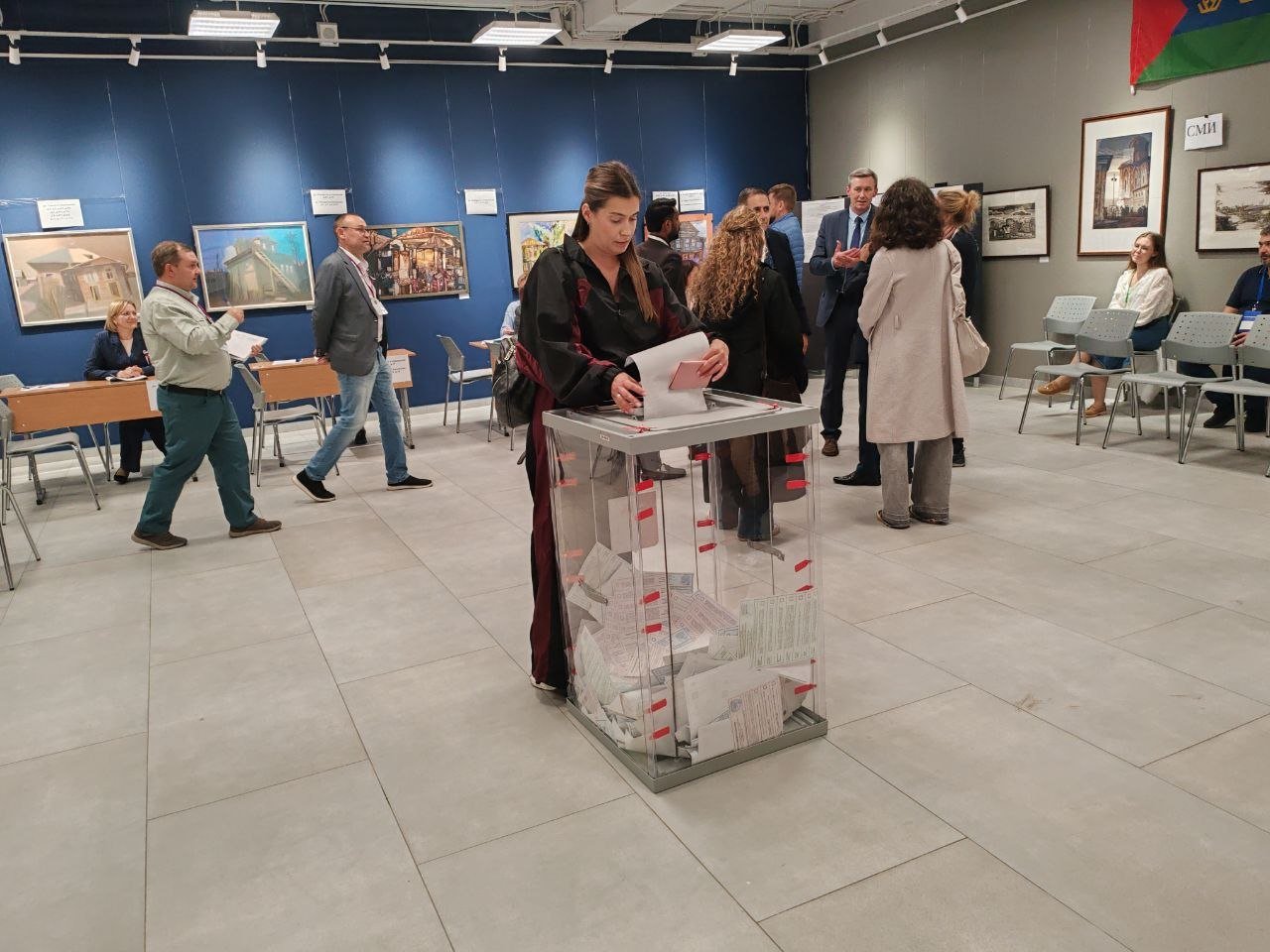

The elections to the ninth convocation of the State Duma of the Russian Federation, held from 18 to 20 September 2026, were marked by high voter turnout and the presence of a large number of domestic and international observers, while taking place amid serious security and cyber threats.
The Center for Geostrategic Studies had the opportunity to monitor the electoral process directly, as the Center’s General Director, Dragana Trifković, participated as an international observer in the Tyumen Region as part of the mission of the International Association for Political and Electoral Experts (IAPEE), following an official invitation from the Central Election Commission of the Russian Federation.
Election observation in Tyumen and the surrounding rural areas provided direct insight into the functioning of polling stations, the work of election commissions, the presence of different categories of observers, and the atmosphere among voters.
Election Results and High Voter Turnout
The elections were held under a mixed electoral system: of the 450 members of the State Duma, 225 are elected from federal party lists and 225 from single-member constituencies. Members of the State Duma serve five-year terms.
On 25 September, the Central Election Commission of the Russian Federation officially certified the final results of the elections to the ninth convocation of the State Duma.
According to the final results of voting on the federal party lists, United Russia received 57.96 percent of the vote. It was followed by the Communist Party of the Russian Federation (CPRF) with 13.67 percent, the LDPR with 8.96 percent, New People with 7.91 percent, and A Just Russia with 5.10 percent.
The remaining parties failed to cross the five-percent electoral threshold. The Party of Pensioners received slightly more than two percent, the Greens slightly more than one percent, Communists of Russia slightly less than one percent, Rodina around 0.7 percent, and the Party of Direct Democracy around 0.3 percent of the vote.
Since half of the State Duma is elected in single-member constituencies, the party-list results alone do not reflect the full composition of the new parliament. According to the final results, United Russia won a total of 349 seats — 140 through the federal party list and 209 in single-member constituencies. The CPRF won 37 seats, the LDPR 23, New People 19, A Just Russia 17, Rodina one, while four seats were won by independent candidates.
United Russia thereby retained its constitutional majority in the State Duma.
One of the notable characteristics of the new State Duma is the increased direct representation of people with combat experience. According to the final data released by the Central Election Commission, 46 participants and veterans of the Special Military Operation were elected as deputies, representing more than ten percent of the total number of members of parliament. Of these, 41 were elected as United Russia candidates, three as LDPR candidates, one as a candidate of A Just Russia, and one as an independent candidate.
This also points to the gradual integration of participants in the ongoing military conflict into Russia’s political and institutional life, which may become one of the distinctive features of the ninth convocation of the State Duma.
Final voter turnout reached 59.8 percent, with 60,448,094 voters participating in the elections. According to the Central Election Commission, this was the highest turnout recorded in the last three parliamentary election campaigns. Turnout in the 2021 elections was 51.72 percent, while in 2016 it stood at 47.88 percent.
The high turnout is particularly significant given the circumstances under which the elections were held: an ongoing military conflict, large-scale drone attacks on Russian territory, cyberattacks, and intense political and information confrontation between Russia and the West.
Following the elections, President of the Russian Federation Vladimir Putin thanked citizens for their participation and stated that the vote demonstrated support for efforts aimed at strengthening the country. He particularly referred to attempts during the elections to penetrate the air defence systems of Moscow and other Russian regions and disrupt the voting process.
What We Observed on the Ground
The international observation mission in the Tyumen Region visited a number of polling stations in the city of Tyumen and surrounding rural areas. Observers were able to speak with members of election commissions, domestic observers, representatives of political parties, and citizens.
One of the strongest impressions concerned the level of training demonstrated by members of the election commissions.
“What I particularly noticed was that the members of the election commissions were exceptionally well acquainted with every detail of the electoral process — from electoral legislation and the rights of voters and observers to specific procedures and organisational matters. We received precise and specific answers to our questions. We were told that commission members undergo continuous training, and this was clearly evident in practice,” Dragana Trifković noted.
Another strong impression concerned the atmosphere at polling stations. Particularly in smaller towns and villages, the elections did not appear to be merely an administrative procedure. Voters arrived in a positive mood, spoke with commission members and observers, and in some locations the election day had an almost festive atmosphere.
From the early morning hours, a high level of public interest was already evident. The atmosphere was calm and positive. What we observed on the ground was later confirmed by the high overall voter turnout,” Trifković stated.
More Than 380,000 Domestic and Over 1,100 International Observers
According to data from the Central Election Commission, more than 380,000 domestic observers were registered, including representatives of political parties and candidates, as well as observers from public chambers. In addition, the elections were monitored by more than 1,100 international observers and electoral experts from a large number of countries around the world.
A particularly interesting feature of the elections was the presence of bloggers and reporting through social media.
“At almost every polling station we visited, there was a blogger filming or reporting via social media. Alongside traditional observers, party representatives, the media, and video surveillance, this provided an additional level of public oversight of the electoral process,” Trifković noted.
International observers also visited the Public Monitoring Center in Tyumen, from which a large number of polling stations could be monitored through the video surveillance system.
Based on her direct observations, Dragana Trifković assessed that the elections at the polling stations visited were highly transparent and very well organised.
Mass Drone Attacks During the Elections
While the atmosphere at polling stations remained calm, the elections took place amid serious security threats. During the election weekend, Russia was subjected to one of the largest waves of drone attacks since the escalation of the conflict in 2022.
Moscow Mayor Sergei Sobyanin stated on 20 September that, since the previous day, Russian air defence systems had destroyed more than 1,600 drones approaching from different directions, including 450 on the approaches to Moscow. Sobyanin described the attack on Moscow as the largest to date and said that it had been planned with the aim of disrupting the elections.
The scale of the attacks was also reported by Western sources. The Associated Press reported on a Ukrainian operation involving more than a thousand drones during the election weekend and described the attack on Moscow as the largest to date.
Following the elections, President Vladimir Putin also linked the attacks to attempts to disrupt the voting process, stating that throughout the election days there had been continuous attempts to penetrate the air defences of Moscow and other Russian regions.
More Than 4,000 Waves of Cyberattacks and Sabotage of Telecommunications Infrastructure
Alongside the drone attacks, Russia’s electoral and telecommunications infrastructure was subjected to cyberattacks and physical attempts to disrupt communication links.
The Central Election Commission reported that more than 4,000 waves of DDoS attacks targeting the electoral system were recorded between 18 and 21 September. CEC member Pavel Andreyev stated that this was an order of magnitude greater than during the 2024 presidential election.
In addition to the cyberattacks, two incidents involving physical damage to major fibre-optic lines in the Russian Far East were recorded on 19 September, the second day of voting. According to Rostelecom and Russia’s Ministry of Digital Development, in one incident in the Sakhalin Region, infrastructure supporting a fibre-optic line was damaged, while in the Khabarovsk Territory a major backbone cable was cut in several places.
The consequences were felt in the Sakhalin and Magadan regions, the Kamchatka Territory, and the Chukotka Autonomous Okrug. Chairwoman of the Central Election Commission Ella Pamfilova characterised the incident as an act of sabotage aimed at disrupting the elections. Rostelecom likewise stated that it regarded the two nearly simultaneous incidents involving damage to backbone communication lines as an organised attempt to interfere with the voting process.
According to the company, traffic was rerouted through backup communication lines, and connectivity was restored in less than an hour. On Sakhalin, online transmission from three polling stations was temporarily interrupted, but recording continued on local storage devices, after which the transmission was restored.
This case is particularly significant because it demonstrates that pressure on the electoral infrastructure was not limited to remote cyberattacks: during the voting itself, key telecommunications lines were also physically damaged.
Despite the cyberattacks and disruptions to communications infrastructure, the electoral process was not interrupted at the national level, and the relevant services were able to restore the affected communications within a short period of time.
Information Warfare: The Picture Presented by Western Media and What We Observed on the Ground
Alongside the military and cyberattacks, the elections were accompanied by an intensive political and media campaign in the West in which the legitimacy of the electoral process was called into question in advance.
Western media outlets, institutions, and think tanks described the elections as undemocratic, politically controlled, and conducted in an authoritarian environment. Following the vote, the European Union stated that the elections demonstrated a “deepening erosion of democracy” and had taken place in an increasingly authoritarian political environment, while the Associated Press reported allegations concerning restrictions on the opposition and electoral irregularities.
These assessments differ significantly from what the observation mission was able to witness directly in the Tyumen Region.
“The picture we observed on the ground was fundamentally different from the image of Russian elections presented by some Western media outlets. At the polling stations we visited, the elections were well organised, procedures were clearly defined, commission members were well trained, different categories of observers were present, and the atmosphere among voters was positive. We were able to speak with whomever we wished and to ask questions about every aspect of the electoral process,” Trifković noted.
Particular emphasis was placed on the absence of an OSCE/ODIHR observation mission. It is true that Russia did not invite the mission to observe the 2026 elections, a decision that the OSCE publicly criticised. However, the absence of one organisation is not the same as the absence of international observation: the elections were monitored by more than 1,100 foreign observers and electoral experts.
Who Determines Who Is a “Legitimate” International Observer?
The issue of international observers also raises the broader question of attempts to monopolise international election observation.
The European Platform for Democratic Elections (EPDE), for example, does not dispute that Russia’s Central Election Commission reported the presence of more than 1,100 international observers. Instead, EPDE published a list of 36 individuals whom it labelled “fake observers” and called for the identification and discrediting of observers it considers biased.
At the same time, it is important to consider the institutional and financial position of the organisation that assigns others the labels of “independent” and “fake” observers.
According to information published by EPDE itself, the organisation receives financial support from the German Federal Foreign Office and the European Union, while it lists among its supporters the European Commission, the German Marshall Fund of the United States, the German Federal Foreign Office, the Norwegian Ministry of Foreign Affairs, as well as other Western organisations and foundations.
EPDE is not a supranational body responsible for accrediting international observers, but a non-governmental organisation with its own methodology, whose activities are funded and supported by institutions of Western states and the European Union.
The Center for Geostrategic Studies therefore considers it problematic when organisations that are themselves institutionally and financially embedded in the Western political sphere effectively claim the authority to determine who may be recognised as an “independent” international observer. This creates a closed system in which Western organisations define the standards and mutually recognise one another’s authority, while observers outside that system whose conclusions differ from prevailing Western assessments may be labelled biased, illegitimate, or “fake.”
“I believe that what we are seeing here is an attempt to monopolise international election observation. It appears that an observer can be recognised as independent only if he or she belongs to a system of organisations that Western institutions regard as legitimate and if the observer’s conclusions conform to their view of Russia. If independent actors go into the field, observe the electoral process, and present different findings, they are labelled biased or even ‘fake observers.’ This is not pluralism in international election observation, but an attempt to establish a monopoly over who has the right to assess elections,” Dragana Trifković stated.
Genuine pluralism in international election observation requires that different organisations and observers, working on the basis of clearly defined methodologies, be able to reach different conclusions.
When certifying the final election results, the Central Election Commission also released data concerning cases in which procedural irregularities had been identified. According to the Central Election Commission, 36,850 ballots at 20 polling stations across 12 regions were invalidated. The relevant decisions were taken by the competent election commissions.
This information is also significant from the perspective of the functioning of the electoral system’s oversight mechanisms, as it indicates that identified procedural irregularities were not disregarded when the final results were determined.
Conclusion: Elections Amid a Broader Geopolitical Confrontation
The 2026 parliamentary elections were the first State Duma elections since the escalation of the conflict in Ukraine in 2022. They took place amid a profound geopolitical confrontation between Russia and the West, sanctions, military hostilities, attacks on Russian territory, cyber threats, and an intense information war.
The Center for Geostrategic Studies assesses that the military attacks during the voting period, large-scale cyberattacks targeting electoral infrastructure, and the information campaign aimed at delegitimising the elections should be viewed within the context of the broader geopolitical confrontation. Their timing in relation to the elections, the scale of the attacks, and the political context provide grounds for the assessment that there was an intention to disrupt the electoral process or, if that proved impossible, to call its legitimacy into question.
“My assessment is that there was a clear intention on the part of the West to disrupt the Russian elections or, if that was not possible, to call their legitimacy into question. At the same time, we witnessed large-scale drone attacks, cyberattacks targeting electoral infrastructure, and an information campaign portraying the elections as undemocratic and non-transparent. What we, as international observers, saw on the ground was contrary to that picture: high voter participation, well-trained election commissions, a large number of different observers, clearly defined procedures, and a calm and positive atmosphere at polling stations,” Trifković stated.
Despite these circumstances, the electoral process was completed without disruptions that would have prevented the system from functioning, while voter turnout was significantly higher than in the previous parliamentary elections. The direct observations of the monitoring mission in the Tyumen Region indicated a well-organised electoral process, a high level of training among election commission members, the presence of different categories of observers, and a positive atmosphere among citizens.
The Center for Geostrategic Studies assesses that the elections were successfully conducted despite exceptional external pressure and attempts to disrupt or delegitimise the electoral process.
In a multipolar world, no single centre of power should have a monopoly over the interpretation of democracy or over determining whose elections are legitimate and whose are not. For decades, Western states and institutions have assumed the role of arbiters of democratic standards in other countries, while today they themselves face increasingly strong domestic criticism concerning the state of their own institutions, human rights violations, and censorship.
Multipolarity therefore also entails reconsidering such a monopoly. Different states, organisations, and international observers must have the right to independently assess electoral processes without being disqualified merely because their conclusions do not conform to the positions of Western institutions.
Democracy cannot be the privilege of a single political bloc, nor can the West simultaneously be the sole interpreter of democratic standards while remaining exempt from critical scrutiny of its own democratic practices.
On 25 September, the Central Election Commission certified the final election results, while the first sitting of the newly elected ninth convocation of the State Duma is scheduled for 30 September 2026 at 10:00 a.m., marking the conclusion of the electoral cycle and the beginning of the work of the new parliamentary convocation.
Report of the Center for Geostrategic Studies

