


Steven Sahiounie, journalist and political commentator
There is no doubt that the events of October 7 fundamentally changed Israel and Palestine. It was the moment that set in motion a transformation across the entire Middle East. Reports are now emerging over whether Israeli Prime Minister Benjamin Netanyahu knew what was going to happen before the attack. According to Israeli media, he received warnings from Egypt and the United Arab Emirates but ignored them. Today, with Israeli elections approaching, the publication of these allegations could potentially mark the beginning of the end of Netanyahu’s political career.
Did Netanyahu know what was coming and deliberately intended to use October 7 as a justification to implement a broader strategy against Gaza, Hezbollah, the former Syrian government, and ultimately Iran?
This question becomes particularly significant when examining the developments that followed October 7. Over the years, Israeli intelligence demonstrated an extraordinary ability to penetrate parts of Iran’s regional network at political, military, technological, and economic levels. Following October 7, the so-called Iranian axis suffered enormous strategic losses. Gaza was devastated, Hezbollah was severely weakened, the Assad government in Syria subsequently collapsed, and Israel eventually confronted Iran directly.
Was October 7 therefore simply a catastrophic intelligence failure—or did it become the justification for implementing a much larger regional plan?
There is currently no conclusive public evidence proving that Netanyahu deliberately allowed the October 7 attack to happen. However, the allegations surrounding warnings allegedly delivered to him personally make the question impossible to dismiss without a serious and independent investigation.
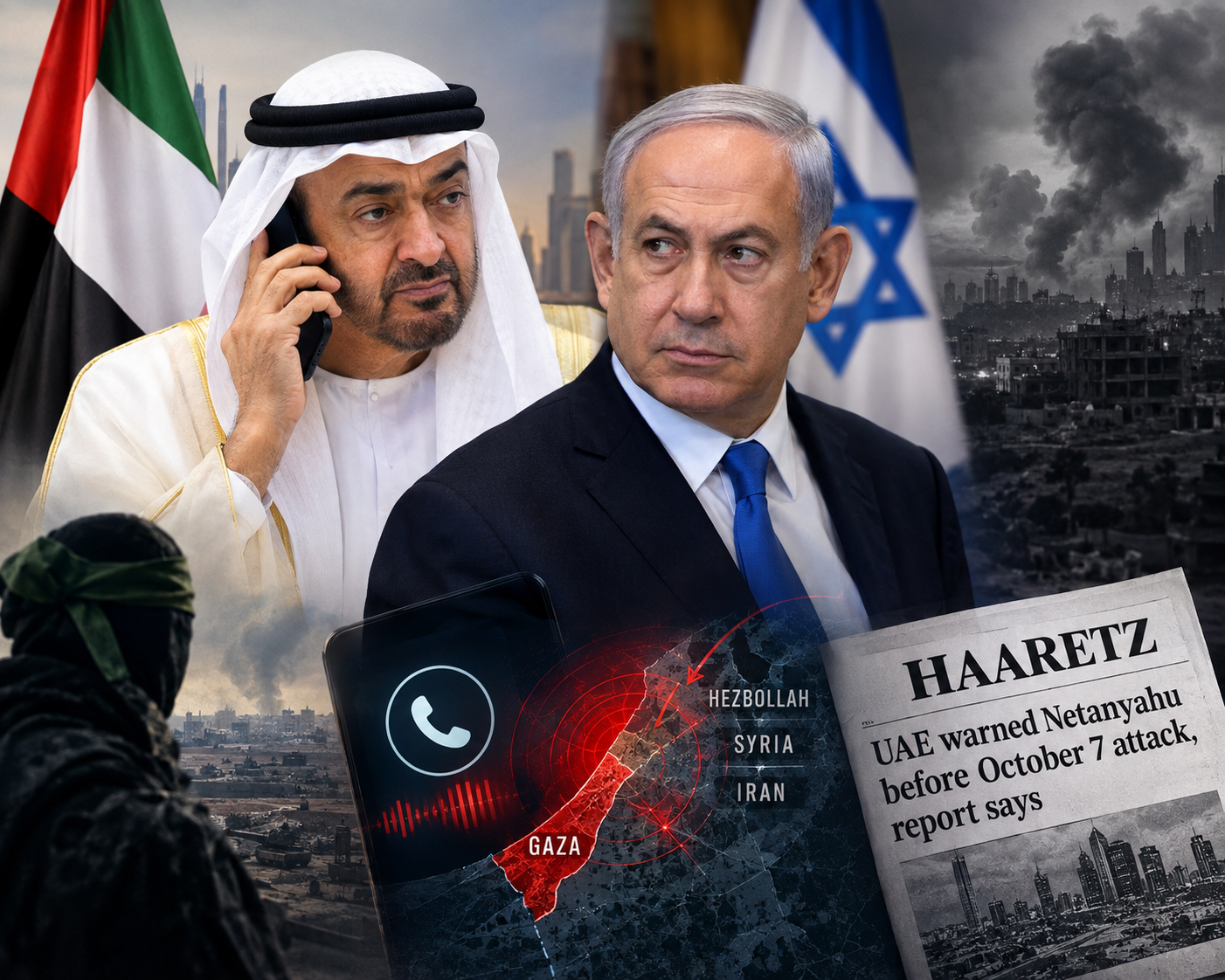
The latest controversy centers on a report by the Israeli newspaper Haaretz, which alleged that UAE President Sheikh Mohamed bin Zayed personally warned Netanyahu before October 7 that Hamas leader Yahya Sinwar was preparing a major operation.
According to the investigation, the warning was based on information originating from Sinwar himself. During secret contacts involving Hamas and Israel in September 2023, Sinwar allegedly told a Palestinian intermediary that he was preparing an extraordinary operation, describing it as an “earthquake” and demanding that his message be conveyed literally.
The information reportedly reached an adviser close to the Emirati president, who sought to verify its seriousness before informing Mohamed bin Zayed.
According to Haaretz, the warning eventually reached Israel’s Shin Bet on September 15. Shin Bet chief Ronen Bar allegedly briefed Netanyahu, while a security meeting was held shortly afterward involving senior defense and intelligence officials.
Yet the initial Israeli assessment reportedly underestimated the threat. Officials allegedly considered the possibility that Sinwar was referring to a limited operation rather than a large-scale assault from Gaza.
The report claims that Mohamed bin Zayed, concerned by Israel’s apparent lack of response, eventually contacted Netanyahu personally. The alleged conversation lasted approximately 45 minutes and was conducted through an exceptionally secure communication mechanism.
The Emirati president reportedly warned Netanyahu that Sinwar was preparing an operation capable of causing massive bloodshed, destabilizing the region, and threatening the Abraham Accords.
Netanyahu allegedly responded that Israel believed Hamas was preparing an operation in the West Bank rather than Gaza and assured the Emirati president that Israel was prepared for all scenarios.
The most serious allegation is that Netanyahu did not subsequently inform senior security officials—including the defense establishment and the heads of Israel’s principal intelligence agencies—about the alleged conversation.
Netanyahu denies this.
His office said that the reports were false and that Netanyahu did not receive any warning from the UAE before October 7. Netanyahu also said that his office, the National Security Council, and his military secretary reviewed their records and found no telephone conversation with Mohamed bin Zayed between September 1 and October 7.
He has instructed his lawyers to pursue a defamation lawsuit against Haaretz.
The UAE, however, has not issued an equally strong denial. Its Foreign Ministry said that Emirati and Israeli authorities have maintained open and direct communication channels since diplomatic relations were established and that, when necessary, relevant intelligence has been exchanged through the appropriate channels.
That carefully worded response has inevitably fueled further speculation.
The allegations also involve Egypt. According to the Haaretz report, then-Egyptian intelligence chief Abbas Kamel also warned Netanyahu about the possibility of a major Hamas operation. Netanyahu allegedly responded that Israel understood the situation in Gaza and had it under control, while identifying the West Bank as the more immediate threat.
Former Israeli leaders have subsequently entered the dispute.
Former Prime Minister Naftali Bennett accused Netanyahu of bearing personal responsibility for the failures that preceded October 7. Former Prime Minister Ehud Barak went further, arguing that if Netanyahu received such warnings and failed to communicate them to the security leadership, his conduct could amount to gross negligence and potentially criminal negligence in the political and legal sense.
Opposition leaders have demanded an official state commission of inquiry capable of examining classified intelligence and establishing exactly what Netanyahu knew, when he knew it, who was informed, and why preventive measures were not taken.
This is crucial because the October 7 failure cannot be examined solely through the question of whether Israeli intelligence “missed” Hamas preparations.
If credible warnings reached the highest political level but were not properly communicated to the military and intelligence leadership, the issue would be fundamentally different. It would become a question of political decision-making rather than merely intelligence failure.
And this is where the larger geopolitical question emerges.
The consequences of October 7 were extraordinary. Israel launched a devastating war in Gaza, Hezbollah became embroiled in a major confrontation with Israel, the regional balance shifted dramatically, the Assad government eventually fell, and Israel and Iran moved from a largely shadow conflict toward direct military confrontation.
Iran’s regional position was significantly weakened.
At the same time, Israel demonstrated that its intelligence capabilities had penetrated deeply into hostile networks. Senior commanders, political figures, weapons infrastructure, communications systems, and other sensitive elements were repeatedly exposed.
For critics of Netanyahu, the sequence of events raises an uncomfortable possibility: that October 7, although not necessarily planned, was subsequently transformed into the strategic justification for dismantling Iran’s regional network.
But there is an essential distinction between using an event strategically after it occurs and deliberately allowing the event to occur.
The first is a political hypothesis supported by the enormous strategic consequences that followed. The second is a much more serious allegation for which publicly available evidence has not yet established proof.
That distinction must remain at the center of any responsible investigation.
One question, however, remains particularly disturbing: If Netanyahu personally received credible warnings and failed to act, how many Israeli lives might have been saved if those warnings had been taken seriously?
More than a thousand Israelis were killed during the October 7 attack, while many others were taken hostage. The consequences extended far beyond Israel, producing a regional war whose effects continue to reshape the Middle East.
If an independent investigation ultimately establishes that Netanyahu knowingly ignored credible warnings, withheld critical information from the security establishment, or deliberately accepted an extraordinary level of risk for political or strategic reasons, the consequences would be historic.
If, on the other hand, the investigation establishes that the warnings were ambiguous, misunderstood, or never reached Netanyahu personally, then the responsibility would lie primarily within the broader intelligence and military failure.
Either way, the truth cannot be determined through political statements, media accusations, or competing narratives.
The only credible answer must come from a genuinely independent investigation with access to classified intelligence, communications records, military assessments, and the decisions made during the critical weeks preceding October 7.
Until that happens, one question will continue to haunt Israeli politics and the wider Middle East:
Was October 7 the greatest intelligence failure in Israel’s history—or was a preventable catastrophe subsequently transformed into the catalyst for a much larger regional strategy?
The answer could determine not only Netanyahu’s political legacy, but also how history ultimately interprets the transformation of the Middle East that began on October 7, 2023.
Steven Sahiounie is a two-time award-winning journalist.

