


Steven Sahiounie, journalist and political commentator specializing in Middle East and US affairs
Britain’s historic role in Palestine created the Palestinian-Israel conflict and shaped the modern Middle East. For more than seven decades, Palestinians have endured displacement, loss of land, military occupation, repeated wars and serious violations of international law. Britain’s role in the origins of the conflict is clear, particularly the 1917 Balfour Declaration and Britain’s subsequent administration of Palestine under the Mandate system.
For decades, Britain was also among Israel’s important Western political allies, alongside the United States and other European powers. Yet today, a striking transformation appears to be taking place. London is increasingly willing to confront the Israeli government over its policies toward the Palestinians, particularly settlement expansion in the occupied West Bank and the humanitarian catastrophe in Gaza.
The question is whether this represents the beginning of a genuine transformation in Western policy toward Israel—or whether governments in London and Washington are responding primarily to growing public pressure and domestic political calculations.
The latest confrontation between London and Tel Aviv provides a revealing example.
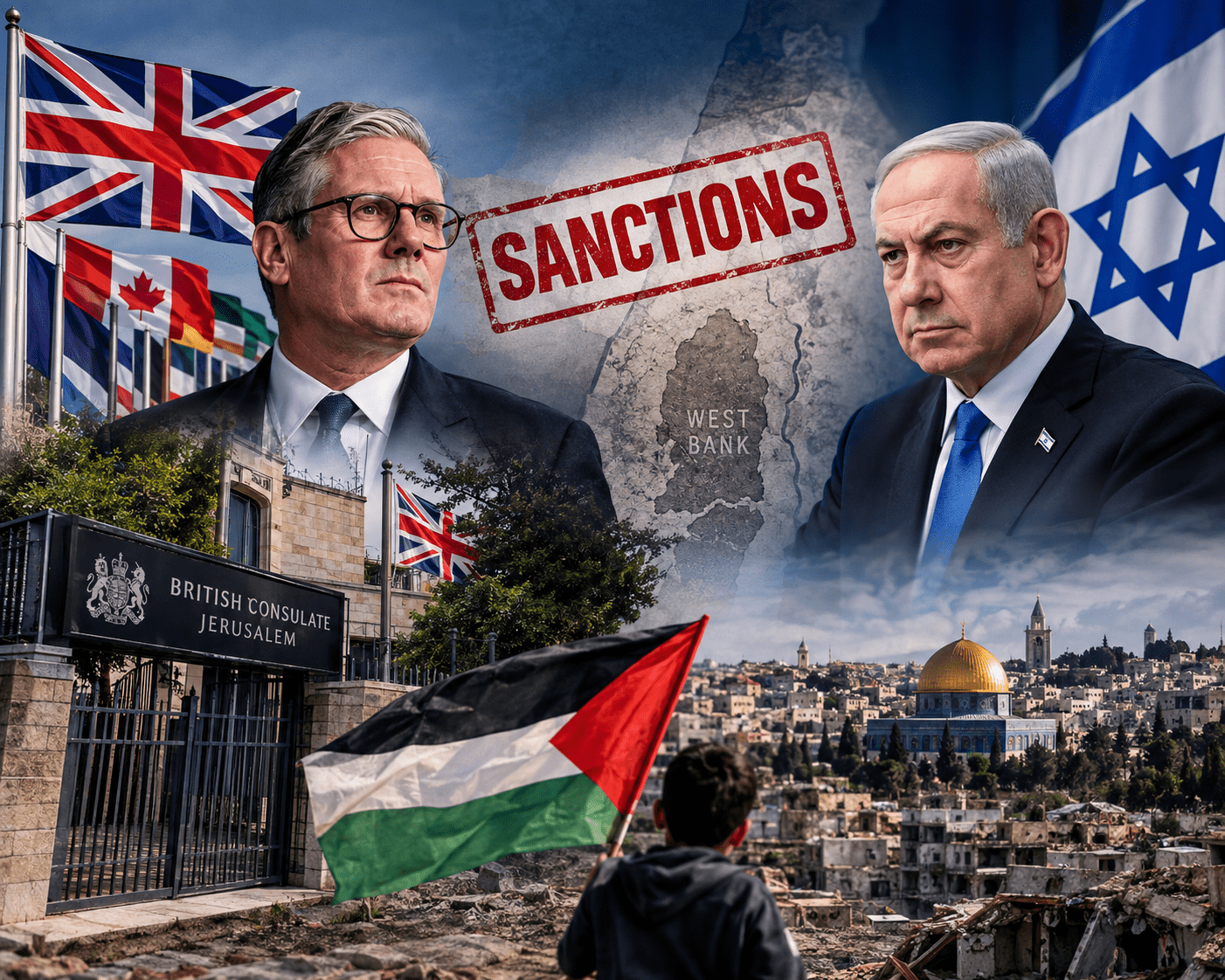
Israel has dramatically escalated its diplomatic response to Britain after Israeli Foreign Minister Gideon Sa’ar announced that Israel would close the British consulate in East Jerusalem and introduce a series of additional measures against British officials and institutions.
According to Sa’ar, the decision was approved by Prime Minister Benjamin Netanyahu and represents Israel’s response to what the Israeli government describes as a series of “anti-Israel” decisions adopted by Britain’s Labour government.
The measures reportedly include the closure of the British consulate in Jerusalem, the removal of British personnel from an international Gaza support center in Kiryat Gat, and the termination of British programs assisting in the training of Palestinian Authority security forces in the West Bank.
Israel also announced restrictions on the entry of a number of British officials and other British citizens, accusing some of them of activities it characterizes as hostile to Israel.
The confrontation reflects a much deeper deterioration in relations between the two governments.
Since Labor returned to power in Britain in July 2024, London has adopted a series of positions increasingly critical of Israeli policies. Britain has recognized the State of Palestine, restored funding to the United Nations Relief and Works Agency for Palestine Refugees (UNRWA), restricted certain defense export licenses to Israel, imposed sanctions on Israeli figures and entities, and taken measures targeting settlement activity.
London has also moved to restrict Israeli participation in certain defense and security-related activities and has frozen or reduced some channels of military cooperation.
The most significant development, however, is Britain’s recent decision to impose a ban on imports from Israeli settlements in the occupied West Bank, accompanied by a broader sanctions framework. The 11 countries who also imposed bans on Israel are: Canada, Denmark, Finland, France, Iceland, Ireland, Norway, Poland, Portugal, Spain and Sweden.
Foreign Secretary Ed Miliband has argued that Israeli settlement expansion threatens the possibility of a viable Palestinian state and has particularly criticized the proposed E1 settlement project, which could prevent a Palestinian state in the future.
The British government has accused extremist settlers of carrying out actions amounting to ethnic cleansing against Palestinians and has criticized the Israeli government for failing to prevent such actions.
If this coalition continues to expand, Israel could face an increasingly difficult diplomatic environment in Europe.
Israel’s decision to target the British consulate is therefore potentially more than a bilateral dispute. The consulate in East Jerusalem has a special diplomatic role because it deals with the Palestinian territories and the Palestinian Authority, rather than serving as Britain’s embassy to Israel.
The escalation also raises concerns that Israel could take similar measures against other European diplomatic missions if their governments continue supporting sanctions related to the settlements.
Washington, however, has made clear that it is not prepared to follow London’s path.
US Secretary of State Marco Rubio criticised the escalating tensions in the West Bank but explicitly rejected the possibility that Washington would adopt the same measures as Britain. The position highlights an important divide within the Western alliance.
While Britain and several European governments appear increasingly prepared to use economic and diplomatic pressure against Israel, the United States continues to provide Israel with significant political and strategic backing.
This divergence raises a broader question: Is the Western consensus on Israel beginning to fracture?
For decades, Israel benefited from strong political support in Washington and considerable diplomatic protection in European capitals. But the scale of civilian suffering in Gaza, combined with the continuing expansion of Israeli settlements in the West Bank, has transformed public opinion in many Western societies.
From Washington and London to Paris, Berlin and Montreal, large demonstrations have brought hundreds of thousands of people into the streets. The protests are significant because they have occurred in countries that historically maintained close political and strategic relationships with Israel.
The pressure on Western governments is therefore no longer coming only from foreign-policy circles. It is increasingly coming from their own populations.
At the same time, political leaders cannot ignore elections.
Both Israel and the United States are approaching politically consequential electoral periods, creating an additional layer of uncertainty. Governments facing elections must consider public opinion, younger voters, opposition parties and the growing political mobilisation surrounding Gaza and Palestine.
This creates two competing interpretations of the current confrontation.
The first is that a genuine transformation is underway. Under this interpretation, Western governments are gradually concluding that unconditional political support for Israeli policies is no longer sustainable. International law, the humanitarian situation in Gaza and settlement expansion are forcing governments to reconsider longstanding policies.
The second interpretation is more cynical: Western governments may be attempting to manage public anger without fundamentally changing their strategic relationship with Israel.
Britain’s actions will therefore be judged not by statements alone, but by whether London is prepared to go further—particularly regarding arms exports, economic relations, sanctions on institutions supporting settlements and diplomatic pressure.
The Palestinian position is already clear. The Palestinian Embassy in Britain welcomed London’s decision, arguing that international law must be applied without fear or favor and that violations must have consequences.
Palestinian Ambassador Husam Zomlot described the move as a potential turning point, while stressing that recognition of a Palestinian state cannot have meaningful value if Palestinian territory continues to be fragmented or confiscated.
The argument touches the heart of the diplomatic dilemma.
If Western governments genuinely support a two-state solution, they must confront the policies that make such a solution increasingly difficult to achieve.
The coming months may therefore prove decisive. Britain’s confrontation with Israel could remain an isolated diplomatic dispute, or it could become part of a broader European realignment.
The answer will depend on whether Western governments are prepared to transform political declarations into concrete policy.
For Israel, the challenge is equally significant. Its traditional Western alliances remain powerful, particularly its relationship with Washington. But diplomatic isolation does not occur overnight. It develops through a gradual accumulation of political disagreements, sanctions, public opposition and changing international perceptions.
The world may therefore be witnessing the beginning of a new phase in the Palestinian-Israeli conflict—one in which Israel can no longer assume that its Western allies will blindly defend every policy pursued by its government.
Ariel Sharon once warned, that he did not fear the Arab world destroying Israel, but a day when the US no longer supported Israel.
Washington is still blindly supporting Israeli genocide, occupation and war crimes. But, 12 of its allies in the international community have bravely stood against Israel.
Steven Sahiounie is a two-time award-winning journalist.

