


By:Dragana Trifković, Journalist and political commentator
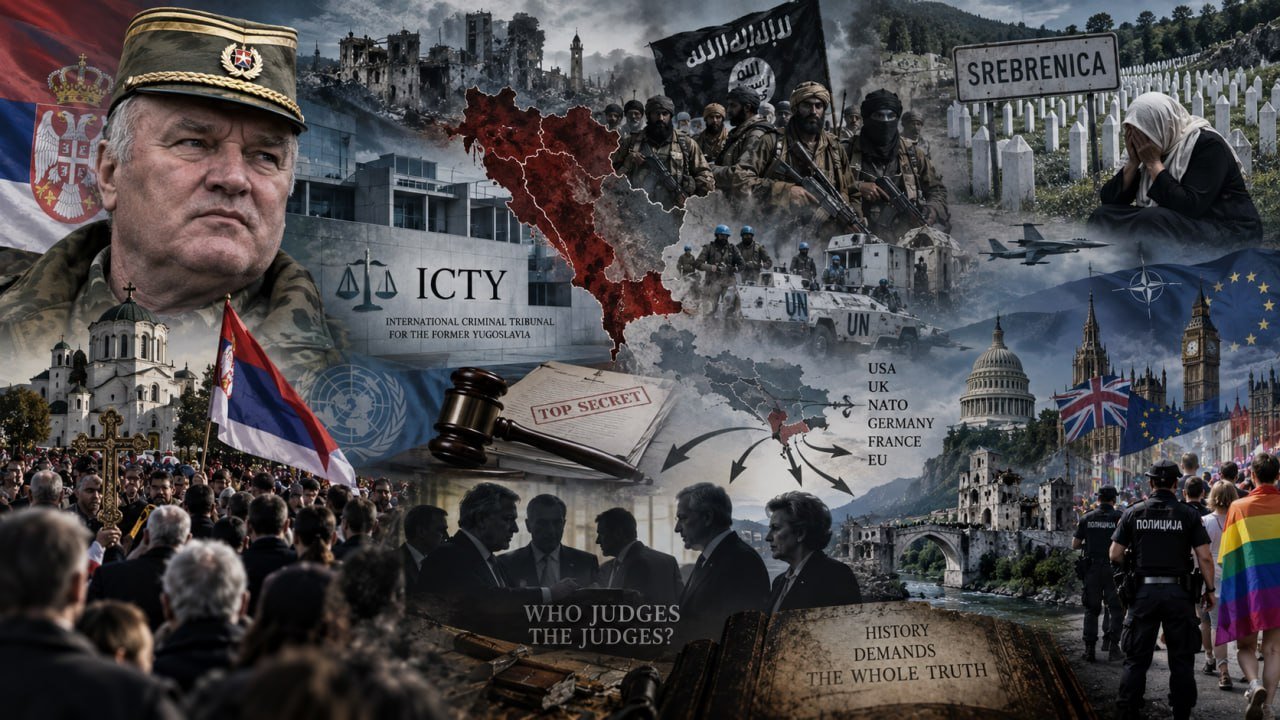
The death of General Ratko Mladić in The Hague on August 27, 2026, did not close the question of responsibility on the part of the institution that had kept him in custody. On the contrary, the circumstances surrounding the final months of his life have once again raised questions about the nature and political role of the Hague judicial system.
Several days before his death, a request for the seriously ill General to be transferred to Serbia for medical treatment was rejected, despite Serbia having offered state guarantees, medical transport, and treatment at the Military Medical Academy in Belgrade. Following his death, his son Darko Mladić and the doctors who had monitored the General’s health made serious allegations: that he had been denied adequate medical care for years and had effectively been killed through inadequate treatment and the refusal to allow him to receive medical care outside the Hague system.
These allegations require an independent investigation, particularly because they cannot be considered separately from the broader question of how the Hague Tribunal operated.
The Hague Tribunal as an Instrument of Political Power
To understand the case of Ratko Mladić, it is necessary to abandon the assumption that the Hague Tribunal operated in a political vacuum. It was established by a decision of the UN Security Council at a time when Western powers were already directly involved in the Yugoslav conflict politically, diplomatically, through intelligence activities, and economically, and later militarily as well.
From the Serbian perspective, its practice demonstrated that it was not a neutral arbiter standing above the conflict, but rather one of the instruments of Western political power through which, following the military and political outcome of the wars, their legal interpretation was also constructed.
The disproportion in the composition of those convicted, together with the outcomes of some of the most significant proceedings against commanders of the other warring parties, created a widespread conviction in Serbia that the Hague judicial system served an additional function: to institutionalize a political interpretation of the war in which the Serbian side was assigned the role of the principal and enduring culprit.
Ratko Mladić was sentenced to life imprisonment by the International Criminal Tribunal for the former Yugoslavia for the alleged genocide in Srebrenica, crimes against humanity, and war crimes. The Trial Chamber delivered its judgment in 2017, and the conviction was upheld on appeal in 2021.
Serbs as the Greatest Losers of the Breakup of Yugoslavia
The war brought suffering and casualties to all the peoples of Yugoslavia, but the consequences of its dissolution were not equal.
The Serbs were a state-forming people who contributed their own statehood, as well as enormous sacrifices made during two world wars, to the creation of both Yugoslav states. With the breakup of Yugoslavia, large segments of the Serbian population found themselves outside Serbia, while hundreds of thousands of people were expelled from lands where their families had lived for centuries.
At the same time, the administrative borders of the Yugoslav republics were transformed into international state borders, while political and national identities were further institutionalized within the newly established states.
This produced a historical paradox: one of the principal peoples behind the creation of Yugoslavia emerged from its dissolution territorially, demographically, economically, and politically weakened, while other political projects acquired independent states through the breakup of the federation.
Yugoslavia as a Laboratory of the New Geopolitical Order
The Yugoslav wars, however, cannot be explained solely in terms of local nationalisms.
The role of the great powers in transforming internal political and national tensions into armed conflict must also be re-examined.
In the early 1990s, Yugoslavia became one of the first major testing grounds of the post-Cold War order. Instead of preserving the multiethnic state and seeking a political compromise, external powers contributed to the internationalization and escalation of the conflicts through the recognition of secessionist republics, support for various local actors, arms supplies, intelligence operations, and selective diplomacy.
In a broader sense, the Balkan wars can also be analyzed through the logic of what Samuel Huntington would formulate as the “clash of civilizations”: political fault lines increasingly overlapped with Orthodox Christian, Roman Catholic, and Muslim identities.
It is therefore necessary to establish whether the West merely “managed the crisis” in the Balkans—or whether, through its own decisions, it actively participated in creating the conditions under which ethnic and religious differences were transformed into geopolitical front lines.
A separate and particularly important issue concerns the arrival of foreign Islamist fighters in Bosnia and Herzegovina. During the war, mujahideen from the Middle East, North Africa, and other regions arrived in central Bosnia, including individuals who were members of or affiliated with radical Islamist structures. In 1993, the “El Mujahid” detachment was formed from foreign fighters and was associated with the Third Corps of the Army of Bosnia and Herzegovina.
The crimes committed by members of these formations are not merely the subject of Serbian testimonies. They were also addressed by the Hague Tribunal. Court proceedings documented killings, torture, and cruel treatment of Serbian and Croatian prisoners and civilians. Among the most horrific documented cases was the killing of the Serb Dragan Popović at the Orašac camp in October 1993: after he was beheaded, other prisoners were forced to kiss his severed head.
This raises a much broader question that has still not been sufficiently investigated: through which channels did foreign mujahideen arrive in Bosnia, who facilitated their movement, supply, and political protection, and what did Western intelligence services know about their presence? There are documents, investigations, and testimonies concerning covert channels used to arm the Bosnian side, as well as the activities of foreign Islamist fighters, which require further investigation into the role of the United States, the United Kingdom, and other external actors.
This is particularly significant from today’s perspective: radical Islamist networks that were regarded during the 1990s as a useful factor in certain geopolitical conflicts later became one of the principal security challenges for the Western states themselves.
Srebrenica: What Did Washington, London and Paris Know?
Nowhere is the need for such a reassessment more evident than in the case of Srebrenica.
International courts have classified the killings of Bosniak men following the fall of the enclave in July 1995 as genocide. However, a judicial classification cannot serve as a prohibition against investigating the political, military, and intelligence circumstances that preceded the fall of Srebrenica, nor against examining the responsibility of external actors who were directly involved in managing the Bosnian war.
Documents produced by Western states themselves and by the United Nations show that there are questions that require further investigation.
Particular attention should be paid to the testimony of Hakija Meholjić, the wartime police chief in Srebrenica and a member of the Srebrenica delegation that met with Alija Izetbegović in Sarajevo in 1993. For years, Meholjić publicly maintained that Izetbegović had told the delegation that U.S. President Bill Clinton had said that NATO might intervene militarily if approximately 5,000 Muslims were killed in Srebrenica.
Clinton later denied that he had ever made such a proposal.
However, the fact that this testimony came from a Bosniak wartime official from Srebrenica itself, rather than from the Serbian side, gives it particular historical significance and requires that it be investigated rather than simply excluded from public debate.
Moreover, the official 1999 report of the UN Secretary-General, The Fall of Srebrenica (A/54/549), records in paragraph 115 that surviving members of the Srebrenica delegation stated that, during their 1993 meeting in Sarajevo, Alija Izetbegović had told them that he had learned that NATO intervention in Bosnia and Herzegovina would only be possible if Serbian forces entered Srebrenica and killed at least 5,000 of its inhabitants. The same report, however, also records that Izetbegović categorically denied having made such a statement.
To this should be added a British Ministry of Defence document dated July 11, 1995. It states that the attack by the Army of Republika Srpska followed months of attacks by the Army of Bosnia and Herzegovina against a Serbian supply route south of the enclave, and offers the assessment that the operation most likely did not begin as a plan by the Pale leadership to capture the entire enclave, but that the advance was extended after encountering weak resistance.
This does not resolve the question of the executions that followed. It does, however, raise important questions concerning the chronology of events, the original intent of the operation, and its subsequent development.
Finally, Srebrenica was a UN-designated “safe area.” If the international community assumed responsibility for its protection, then its own responsibility cannot simply be erased from the historical record.
It is therefore necessary to establish the role played by the intelligence and political apparatuses of the great powers.
Today, following the release of a large volume of documents related to Jeffrey Epstein, questions are once again being raised in public about the nature of his contacts with numerous members of the Western political elite, including Bill Clinton. However, there is currently no public evidence to support the claim that Clinton was blackmailed in connection with decisions concerning Bosnia.
Who Has the Right to Judge History?
The question of Srebrenica also has a broader moral dimension.
Great Britain, which in 2015 sought to have a resolution on Srebrenica adopted by the UN Security Council, was once at the center of one of the largest colonial empires in history. The history of British imperialism encompasses mass violence, repression, concentration camps during the Boer Wars, colonial crimes in Africa and Asia, and policies whose demographic consequences continue to be studied to this day.
The United States is the only country to have used atomic weapons against cities—Hiroshima and Nagasaki—while its modern history encompasses wars and bombing campaigns from Indochina to Iraq and Yugoslavia.
None of this diminishes any crime committed in the Balkans.
It does, however, raise a fundamental question about the universality of international justice: who judges the judges?
Why are the crimes of small nations internationalized as matters of global morality, while the enormous historical violence perpetrated by great powers is largely left to historiography, without international tribunals or political consequences imposed upon entire nations?
In 2015, Russia used its veto to prevent the adoption of the British-sponsored draft resolution in the UN Security Council. Nine years later, the initiative was moved to the General Assembly, where there is no right of veto, and Resolution 78/282 was adopted on May 23, 2024.
Formally, the resolution emphasizes individual responsibility. Politically, however, there is a deeply rooted conviction in Serbia and Republika Srpska that, by institutionalizing only one segment of the Yugoslav wars, an asymmetrical culture of remembrance is being perpetuated in which one people remains permanently associated with the concept of genocide.
Belgrade: A Clash Between Society and an Imported Model
The events in Belgrade on the day of the commemoration for General Mladić presented an almost perfect illustration of the political and cultural pressures under which Serbia finds itself.
On one side was the so-called “Pride Parade,” an event strongly supported by Western diplomatic structures and European institutions, with participants and activists from abroad as well as sections of Serbia’s domestic NGO and political sector that support the LGBT agenda.
On the other side, outside the Church of the Ascension, stood believers, clergy, and citizens who regarded the event as a provocation against the traditional and Orthodox Christian values of Serbian society. Between them stood the police.
At the same time, a commemoration for General Mladić was being held at the Central Military Club in Belgrade.
Such a scene illustrates the profound divide between a significant part of traditional Serbian society and a model of values promoted through the process of European integration, diplomatic pressure, the funding of the NGO sector, and political conditionality as the prescribed path toward “modernization.”
The Battle Yet to Be Fought
The funeral of Ratko Mladić was therefore not merely the funeral of a general.
The large turnout demonstrated that three decades of political pressure and media portrayals of the Yugoslav wars have failed to erase the way in which a significant part of the Serbian people views its own past.
For them, Mladić is not a symbol of the collective guilt being imposed upon them, but a man who, during the war, commanded an army created to defend the Serbian people in Bosnia and Herzegovina.
It is precisely for this reason that his death should open a much broader question than that of his individual biography. The death of Ratko Mladić has also demonstrated that the media language of the 1990s never truly disappeared.
A large part of the Western media landscape has once again reverted to the familiar model in which the complex history of the Yugoslav wars is reduced to one man, one side, and one moral interpretation.
In this way, a process that began in the 1990s continues: the political and media demonization of the Serbs becomes a substitute for a complex analysis of the causes of Yugoslavia’s disintegration, the interests of the great powers, and the responsibility of all actors involved.
For this reason, the time has come for a thorough reassessment of the political history of Yugoslavia’s dissolution—not revision in the sense of erasing the crimes committed or the victims of any nation, but a reopening of the documents, archives, and decisions that shaped the war.
It is necessary to establish the role of the United States, Great Britain, Germany, France, NATO, Western intelligence services, and other external actors in fomenting, escalating, and directing interethnic and interreligious conflicts across the territory of the former Yugoslavia.
If it is established that individuals or institutions deliberately fomented war, obstructed peace agreements, armed the warring parties, organized covert operations, concealed crimes, or manipulated conflicts in pursuit of geopolitical objectives, their responsibility must not remain merely a subject for history books. It must become a matter of legal and political accountability.
For justice that judges only the defeated is not universal justice.
The history of Yugoslavia cannot be permanently reduced to the judgments of institutions created within a political order that was itself actively involved in the conflict.
The ultimate question, therefore, is not simply who Ratko Mladić was.
The question is who broke Yugoslavia apart, who transformed national and religious tensions into war, who decided when the war would continue and when it would end—and why those who wielded the greatest political, intelligence, and military power have, to this day, largely remained beyond the reach of judicial scrutiny.
Without answers to these questions, there can be neither a complete truth about Srebrenica, nor a complete truth about Ratko Mladić, nor a just historical judgment on the tragedy of Yugoslavia.

