


Steven Sahiounie, journalist and political commentator
September 11, 2026 marks the 25th anniversary of the attack on the World Trade Center, the Pentagon, and the downing of a plane in Pennsylvania. Thousands of people were killed or injured in the coordinated attacks carried out that day.
Before September 11, 2001, you could run to catch a flight at the last moment, without security checks, and carrying into the plane a full soft drink. Not anymore. 9/11 changed our daily lives, and changed the world we live in.
One of the most profound changes after 9/11 was the invasion of Afghanistan in October 2001 and in 2003 the invasion of Iraq, which were to reshape American military commitments for the next two decades.
In October 2001, Congress systematically adjusted budget constraints to absorb tens of billions in supplementary, emergency military appropriations that bypassed regular peacetime discretionary spending limits.
The US is now described by analysts as a “permanent war economy” or military-industrial complex, but this functions alongside a standard civilian-led market.
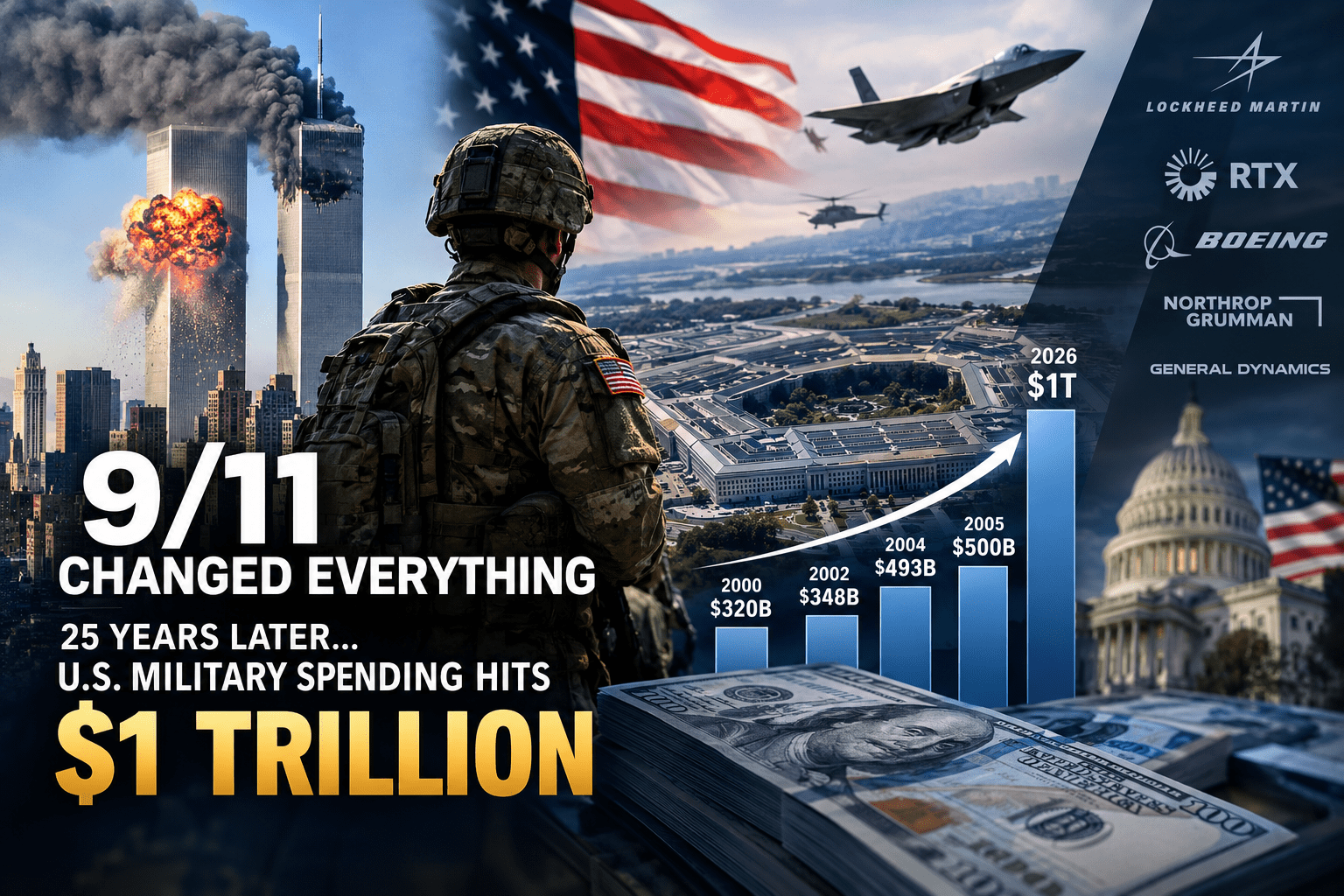
In 2000, the US military budget was $320 billion, in 2001 $304 billion, in 2002 $348 billion, in 2004 $493 billion, in 2005 $500 billion, and now in 2026 $1 trillion.
The systematic monumental yearly increase in the US military spending since 9/11 has been the defining transformation of the post-9/11 era.
The US-NATO war on the Federal Republic of Yugoslavia lasted 78 days from March 24 to June 9, 1999. The International Criminal Tribunal for the former Yugoslavia concluded that roughly 500 civilians died during the 78-day operation. From this conflict, analysts observed that American and European people accepted a bombing campaign on residential neighborhoods, with accompanying deaths and injuries. This was important because the Afghanistan and Iraq war would kill and injure hundreds of thousands of civilians. The US and NATO could be assured that as long as a skillful media propaganda campaign was waged on the western audience, there would be little condemnation from the global citizenry.
The military-industrial complex is a powerful alliance between the US military, the government departments that fund it, and the private defense contractors that supply its weapons and equipment.
The national security establishment is comprised of the arms industry, Congress, the Pentagon, think tanks, lobbyists, and industry-sponsored media outlets.
On January 17, 1961, President Dwight D. Eisenhower warned the American people about the growing power of the military-industrial complex. Eisenhower warned that an alliance between the US military and the private defense industry could gain “unwarranted influence” over government policy. He noted that a permanent, massive armaments industry was new to the American experience. He feared its misplaced power could endanger democratic processes and individual liberties.
He called for an “alert and knowledgeable citizenry” to keep the defense machinery balanced with peaceful goals. Eisenhower cautioned that public policy could become captive to a federally funded scientific and technological elite. He warned against living only for the present and depleting or plundering natural resources and economic assets that belong to future generations.
The United States has the largest military-industrial complex in the world. From 1993 to 2000, the number of major aerospace and defense prime contractors has fallen from 51 to five: Lockheed Martin, RTX (formerly Raytheon), Boeing, Northrop Grumman, and General Dynamics.
Roughly 30% of Defense Department contracts in fiscal year 2024 were awarded exclusively to those five companies. Critics call for an antitrust review of the defense sector, with an aim to break up these defense contractors, to be conducted by Congress and the Justice Department.
The Government Accountability Office has reported in past years that 96 major weapons programs had grown $296 billion above their original cost estimates. According to the office, “The Department of Defense’s most expensive weapon system—the F-35 aircraft — is now more than a decade behind schedule and $183 billion over original cost estimates.”
In 2024, the United States accounted for 37% of world military spending.
Part of the problem sits on Capitol Hill, as many members of Congress benefit from the military-industrial complex through personal stock investments, campaign donations, and pressure to protect local jobs.
Dozens of lawmakers and their spouses own millions of dollars in stock from top defense contractors like Lockheed Martin and RTX. Some members own these shares while sitting on committees that vote on military defense budgets. Lawmakers frequently trade contractor stocks like Honeywell and RTX while shaping military spending bills.
Nearly all federal lawmakers receive campaign donations from arms industry political groups, while defense companies spend tens of millions of dollars each year on lobbying to influence congressional votes on the military budget.
Defense plants and military bases provide jobs inside specific home states and voting districts, while lawmakers often vote to approve expensive or unneeded weapons programs to protect those local jobs and secure their own re-election.
The US economy is harmed by excessive national security spending, by taking resources from more productive industries.
Lowering US spending on weapons would free up billions of dollars for domestic needs and national debt relief, while reducing weapons procurement would lower federal deficits or free up capital to address the national debt.
Funds could be shifted toward domestic investments like healthcare, education, green energy infrastructure, or public transit. Research suggests non-military federal spending often creates more jobs per dollar than military spending.
“Waging peace” means actively applying the same intensity, strategy, organization, and resources used in warfare toward building and sustaining harmony with other nations, international justice and equal human rights. Making friends instead of enemies can avoid conflicts and save lives. The US currently calls China their “enemy #1”, and yet the Chinese leader will soon be visiting Washington.
National security threats can be better addressed by diplomacy rather than military means. It remains to be seen if the US could make a bold move away from war and towards peace and prosperity.
Steven Sahiounie is a two-time award-winning journalist.

