


Steven Sahiounie, journalist and political commentator
Israeli Prime Minister Benjamin Netanyahu’s newly unveiled national security doctrine has intensified political divisions inside Israel while drawing attention to the shifting geopolitical alignments shaping the Middle East. Presented on October 18, 2026, the document calls for preemptive military strikes, expanded buffer zones, and the preservation of Israel’s military superiority. Yet, rather than establishing a broad consensus on national security, it has provoked fierce criticism from opposition leaders who accuse Netanyahu of substituting political slogans for a coherent strategy.
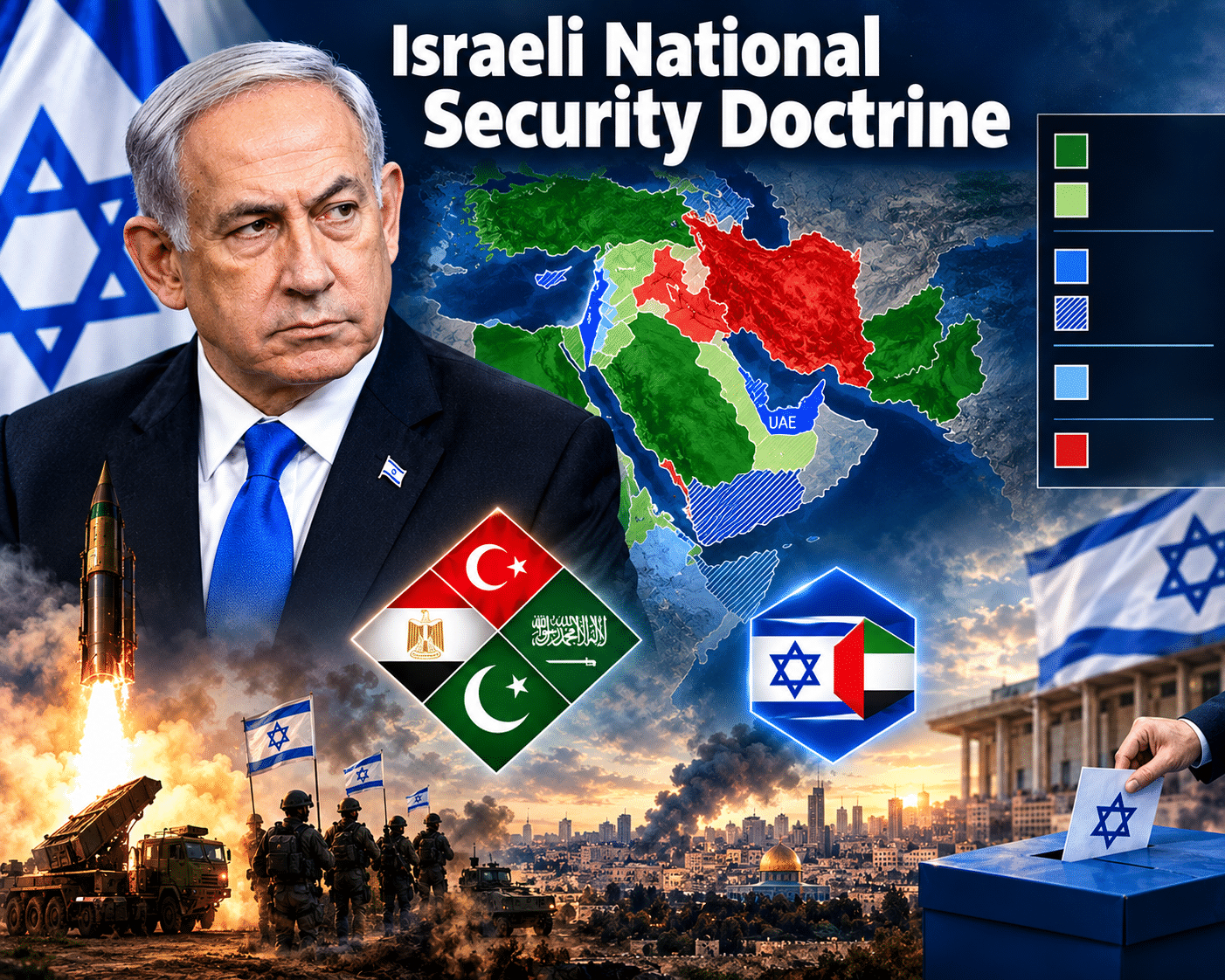
Beyond the domestic controversy, a geopolitical map displayed during Netanyahu’s presentation has raised questions about how Israel views regional alliances and emerging power blocs. The map groups Turkey, Egypt, Saudi Arabia, and Pakistan under the designation “Sunni Diamond,” while placing Israel and the United Arab Emirates within a separate strategic alignment. These classifications highlight the complex relationships among regional powers, where formal diplomatic ties do not necessarily translate into shared security priorities.
The timing of the announcement is equally significant. With Israel’s parliamentary elections scheduled for October 27, opinion polls showing no clear path to a governing majority, and US President Donald Trump publicly endorsing Netanyahu, the prime minister faces mounting pressure to demonstrate that his security policies can deliver lasting results.
A New Security Doctrine Places Iran at the Center
Netanyahu presented his national security vision during a security briefing in Jerusalem, unveiling what Israeli media described as the country’s first such document in approximately a decade. The three-page publication, including its cover, outlines ten central principles and places Iran at the forefront of Israel’s security concerns.
Under the doctrine, Israel must preserve its ability to launch preemptive military operations whenever its leadership considers them necessary. Netanyahu indicated that Israel could strike Iran’s nuclear program independently, even without American support or prior coordination with Washington.
To justify this approach, Netanyahu portrayed the October 7, 2023, Hamas-led attack as a turning point that compelled Israel to confront a wider regional threat. He claimed that military operations extending from Gaza to Yemen and from Lebanon to Iran had weakened the Iranian-led network and reduced what he characterized as an imminent nuclear threat.
The Geopolitical Map Reveals Competing Regional Alignments
The map, attributed to research by Marc Saxer and Markus Schneider and published by Germany’s Friedrich-Ebert-Stiftung on May 19, 2026, divides regional countries and non-state actors into several geopolitical groupings.
Its most striking feature is the separation between the so-called Sunni Diamond and the Israeli-Emirati alignment. Turkey and Egypt, despite maintaining formal diplomatic relations with Israel, appear within a grouping distinct from the countries identified as Israel’s closest strategic partners.
The first grouping, the ‘Sunni Diamond’, is represented in green and comprises Turkey, Egypt, Saudi Arabia, and Pakistan. Lighter green shading identifies countries portrayed as aligned with or close to this grouping, including Sudan, Syria, Jordan, Lebanon, Eritrea, Djibouti, and Somalia.
In contrast, the second grouping, which Netanyahu called the ‘Hexagon Alliance’, is represented in blue. It includes Israel, the United Arab Emirates, Bahrain, Cyprus, Greece, and India.
The map also uses patterned blue shading to identify armed actors and territorial areas portrayed as close to the Israeli-Emirati alignment. These include Sudan’s Rapid Support Forces in parts of Sudan, forces loyal to Khalifa Haftar in Libya, actors in southern Yemen, and entities in Somaliland. Ethiopia appears in lighter blue as a country considered friendly toward Israel and the UAE.
A third grouping, represented in red, encompasses Iran and several armed organizations associated with Tehran, including Hezbollah in Lebanon, Yemen’s Houthi movement, and armed groups operating in Iraq and Syria.
Opposition Leaders Challenge Netanyahu’s Strategic Credibility
The publication immediately triggered criticism from prominent opposition figures Yair Lapid and Gadi Eisenkot, who argued that the document lacked a substantive national security strategy.
Lapid described it in a post on X as superficial and unusual, comparing its apparent quality to something produced by a free version of an artificial intelligence chatbot. He argued that it failed to address Israel’s underlying security challenges and instead attempted to obscure the government’s failures.
He also criticized Netanyahu’s refusal to establish a state commission of inquiry into the October 7 attack, his failure to expand normalization agreements, and policies that Lapid believes have damaged Israel’s international standing and deepened domestic divisions.
Among his other objections was the government’s support for arrangements allowing ultra-Orthodox Jewish men to avoid military service. Lapid argued that this policy contradicts the doctrine’s emphasis on national resilience and military strength.
Eisenkot offered an equally forceful assessment, dismissing the document as little more than empty pages filled with slogans. He argued that releasing it nine days before the election, nearly three years after the October 7 attack, was an attempt to redirect public attention away from the government’s record.
He accused Netanyahu of failing to achieve key wartime objectives, including dismantling Hamas’s military and governing capabilities, weakening Palestinian Islamic Jihad, deterring Hezbollah, maintaining stability in the occupied West Bank, and preserving Israel’s internal unity.
Former defense minister Avigdor Lieberman also criticized the political relationship between Netanyahu and Trump, saying it was convenient for the American president to govern Israel through what he called a “puppet” prime minister.
Taken together, these criticisms suggest that the dispute extends beyond the wording of a security document. It concerns Netanyahu’s leadership, his handling of the October 7 failures, and the extent to which Israel’s military posture has produced lasting security.
With the opposition framing the doctrine as an attempt to deflect accountability, the approaching election has become a crucial test of whether Netanyahu can persuade voters that his leadership remains indispensable.
Trump’s Endorsement Meets an Uncertain Electoral Landscape
Netanyahu’s political challenges have intensified as opinion polls indicate that neither major political camp has secured a clear path to a parliamentary majority.
According to a poll reported by Israel’s public broadcaster, Netanyahu’s bloc fell from 53 seats to 51, while the opposition camp associated with Eisenkot increased from 50 to 52 seats. Neither side would reach the 61 seats required to form a governing majority in the 120-member Knesset.
The same poll placed Eisenkot ahead of Netanyahu as the preferred candidate for prime minister, with 43 percent support compared with 35 percent for the incumbent. Netanyahu’s figure reportedly declined from 38 percent in the previous week’s survey.
Against this backdrop, Trump publicly declared his full support for Netanyahu’s bid for another term. In a message posted on Truth Social, the US president praised the Israeli leader as strong, courageous, and resilient, portraying him as a wartime partner who had withstood substantial domestic opposition.
Trump also credited Netanyahu with cooperating with Washington during military operations against Iran and explicitly appealed to Israeli voters to support his continued leadership.
Public opinion in Israel regarding Trump has become more complicated amid disagreements between Washington and Tel Aviv over Iran. Meanwhile, the war involving the United States and Israel has generated international controversy and economic disruption.
The contrast is striking: while Trump has sought to strengthen Netanyahu’s political position, the Israeli opposition continues to argue that the prime minister’s security policies have failed to deliver the outcomes he promised. That disagreement is particularly consequential because the doctrine’s most ambitious commitments concern Iran, the very issue at the center of the latest regional confrontation.
Tehran Warns Against Another Israeli Attack
Iranian Foreign Minister Abbas Araghchi responded to Netanyahu’s declaration that Israel could act independently of Washington by warning against another military confrontation.
In a post on X, Araghchi argued that Iran had emerged stronger from the previous confrontation and warned that Tehran had unresolved grievances of its own. He accused Netanyahu of attempting to draw the United States into another war to protect his political future, regardless of the consequences for Israel or the American president.
For Israel, Iran’s nuclear program and the capabilities of Tehran-aligned armed groups remain central security concerns. For Iran, the possibility of another Israeli attack presents a direct threat to its national security. These competing positions leave limited room for confidence-building without diplomatic engagement or a broader regional understanding.
The exchange also exposes a potential tension in Netanyahu’s strategy. Seeking freedom of military action may strengthen Israel’s ability to respond to perceived threats, but acting without American coordination could complicate relations with Washington and increase the risk of a wider conflict.
A Doctrine Facing Its First Political Test
Netanyahu’s national security doctrine presents a vision built around military superiority, preemptive action, and the containment of Iran and its regional partners. Yet the controversy surrounding its release demonstrates that Israel’s security debate cannot be separated from questions of political accountability, international legitimacy, and the sustainability of prolonged military confrontation.
Ultimately, the October 27 election may determine whether Netanyahu retains the political authority to implement his vision.
Israel’s security threat is caused by their occupation of Gaza and the West Bank, including the Golan Heights, the south of Syria, and the south of Lebanon. Netanyahu’s new security doctrine does not address the root cause of why the Israeli people can never live in peace without threats to their national security. The only way to insure peace in Israel is to end the occupation and withdraw Israeli troops from Lebanon and Syria. This is needed first to stop Iran and its armed resistance groups. An end to occupation is an end to the resistance.
Peace in the Middle East will only come through justice.
Steven Sahiounie is a two-time award-winning journalist.

