


Steven Sahiounie, journalist and political commentator
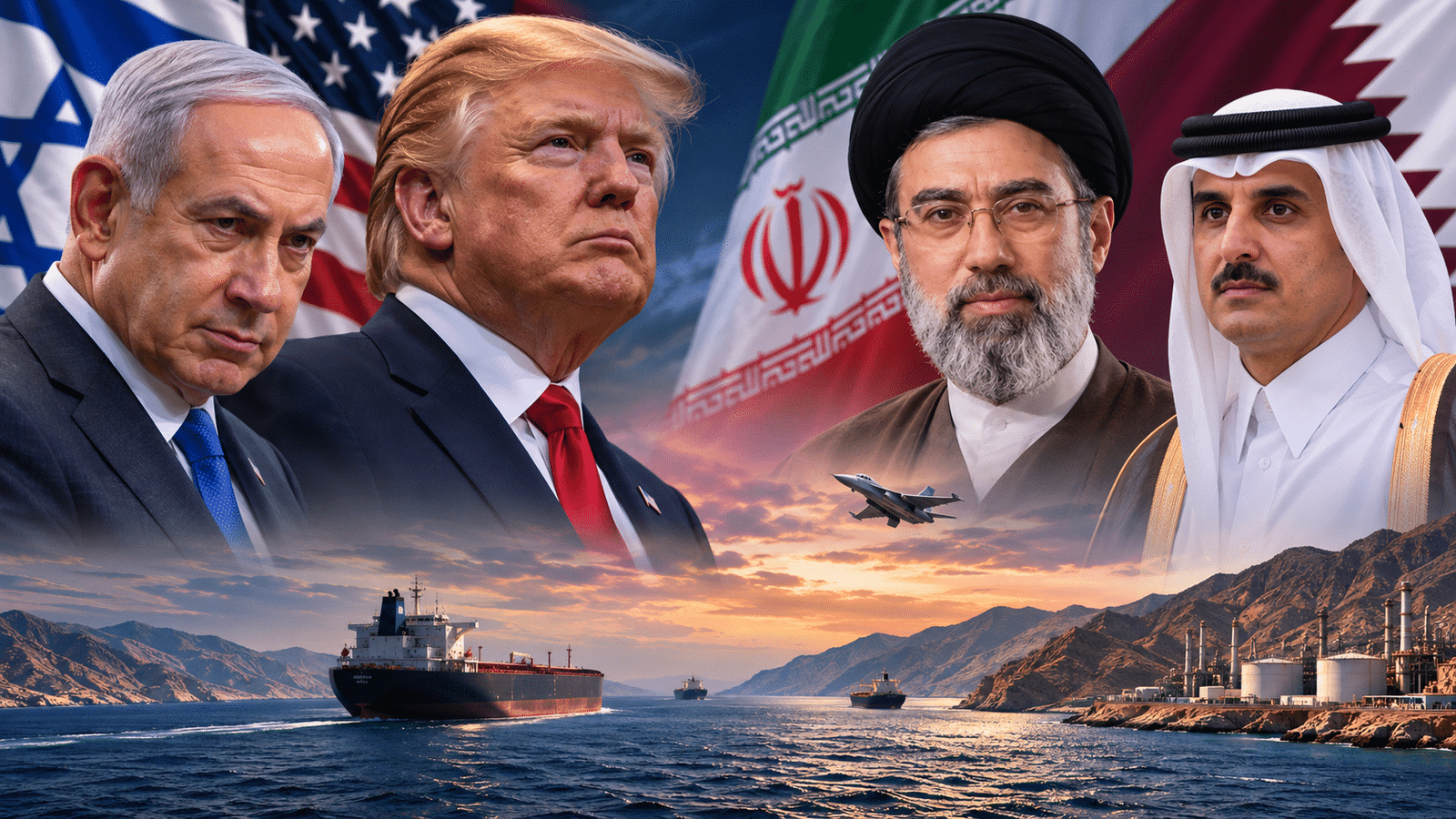
The confrontation between the United States and Iran has entered a decisive phase, one in which diplomacy, economic warfare, and military deterrence are increasingly intertwined. President Donald Trump appears to be searching for an exit from a conflict that carries growing political and economic costs, while Tehran is attempting to transform its military resilience and strategic control over the Strait of Hormuz into political leverage. Meanwhile, Israeli Prime Minister Benjamin Netanyahu appears increasingly concerned that Washington may pursue a diplomatic settlement that does not satisfy Israel’s security objectives.
The latest developments suggest that the disagreement between Washington and Tel Aviv is becoming more significant. Israeli media reports have described an extraordinary confrontation between Trump and Netanyahu over the weekend, reportedly involving a heated exchange concerning Iran and the possibility of resuming military operations. Although the details have not been independently established, the reported disagreement reflects a fundamental question facing both governments: should the confrontation with Iran continue through military means, or has the time come to pursue a political settlement?
Netanyahu’s Calculations and Iran’s Military Deterrence
The Israeli government appears to be closely monitoring Iran’s military preparations. Israel’s media reported that Netanyahu was scheduled to hold a security meeting with Defense Minister Israel Katz and other senior officials, amid continuing concerns over Tehran’s military capabilities.
Iranian military leadership has issued particularly strong warnings to Washington and Tel Aviv. The Chief of Staff of the Iranian Armed Forces declared that previous strikes against Iran were only the beginning of its response capabilities, warning that any further miscalculation would be met with more devastating attacks.
This message is central to Tehran’s deterrence strategy. Iran wants Washington and Israel to understand that military escalation will not necessarily produce the political outcome they seek. Instead, another confrontation could expand across multiple fronts, threatening regional infrastructure, maritime transportation, and international energy supplies.
Tehran Refuses to Negotiate Under American Pressure
While Washington continues to speak about diplomacy, Iranian officials are attempting to establish clear boundaries for any negotiations.
Mohsen Rezaei, identified in the supplied statements as a senior official of Iran’s Supreme National Security Council, said Tehran had requested an explicit and unambiguous American response to its conditions but had received no satisfactory answer.
Iran has further insisted that the Strait of Hormuz will not reopen until its seven conditions are fulfilled. Tehran has also rejected reports suggesting that it would exchange the reopening of the waterway for the release of approximately $8 billion in frozen Iranian assets.
The nuclear issue remains another major obstacle. Rezaei reiterated that Iran would not allow even a single particle of its enriched nuclear material to leave the country. This position directly contradicts Washington’s insistence that nuclear restrictions must form part of any preliminary agreement.
The Iranian position is therefore not simply about ending military operations. Tehran is seeking an arrangement that addresses economic sanctions, maritime restrictions, nuclear sovereignty, and guarantees against renewed military attacks.
The Strait of Hormuz: Iran’s Most Important Strategic Card
One of the most consequential dimensions of the confrontation is the future of the Strait of Hormuz.
The Gulf of Persia Strait Management Authority recently announced legal proceedings against two bulk cargo vessels accused of attempting to reach ports in the southern Persian Gulf using forged documents and without prior coordination.
According to the authority, both vessels subsequently accepted the obligations imposed on them, avoiding placement on a non-compliance list. It also indicated that vessels with previous violations could benefit from less stringent procedures if they formally acknowledged their violations.
The Strait of Hormuz is not merely a geographical passage. It is a strategic artery connecting the Persian Gulf to international markets. Any prolonged disruption would have consequences for global energy supplies, shipping costs, and the economies of countries dependent on oil and gas exports.
For Iran, control over maritime access represents leverage that cannot easily be neutralized through economic sanctions alone. For Washington and its regional allies, the possibility of prolonged disruption creates a serious economic and strategic vulnerability.
Trump Chooses Economic Warfare Over Another Military Campaign
The Trump administration appears to have recognized the difficulties of achieving its objectives through another military confrontation.
According to Axios, citing three individuals who attended a closed-door meeting of G7 foreign ministers in Paris, Secretary of State Marco Rubio explained that Trump had considered two options: returning to military operations or reaching an agreement with Tehran.
However, the president ultimately selected a third approach: maintaining economic pressure and the maritime blockade in an effort to weaken Iran’s economy and force its leadership to negotiate on American terms.
The message from Washington is contradictory. Trump wants Tehran to believe that diplomacy remains possible, but he also wants Iranian leaders to understand that military action has not been removed from the table.
American Domestic Politics Give Tehran Additional Leverage
The Republican Party’s disappointing performance in the midterm elections has increased pressure on the Trump administration to reconsider the political and economic consequences of a prolonged confrontation with Iran.
Trump acknowledged that American voters had not approved of the war.
From the Iranian perspective, Trump’s domestic political difficulties create an opportunity to secure concessions that Washington might otherwise refuse. Washington still wants restrictions on Iran’s nuclear program, the reopening of the Strait of Hormuz, and a reduction in Tehran’s regional influence.
Qatar’s Mediation and the Battle for a Diplomatic Breakthrough
Qatar has emerged as an important intermediary between Washington and Tehran.
Qatari Prime Minister and Foreign Minister Sheikh Mohammed bin Abdulrahman Al Thani met Trump at the White House to discuss de-escalation and possible diplomatic solutions to the confrontation.
The meeting followed intensive consultations between Qatari and Iranian officials, including a recent multi-day visit by Iranian representatives to Doha.
This development places Doha in a particularly sensitive position. Qatar must find a formula that Washington can present as a diplomatic achievement while allowing Tehran to claim that it has defended its strategic interests without capitulating to American pressure.
Lebanon, Israel, and the Wider Regional Equation
The confrontation is also closely connected to developments in Lebanon and the broader regional balance of power.
Critics argue that the American position overlooks Lebanon’s complicated political structure, particularly Hezbollah’s participation in the country’s political system and government.
For Israel, the Lebanese front remains directly connected to its assessment of Iran’s regional influence. This is another reason why Netanyahu may be reluctant to support a diplomatic arrangement that focuses exclusively on the nuclear program and maritime access while leaving other regional issues unresolved.
The disagreement between Washington and Tel Aviv therefore extends beyond the immediate question of whether to resume military operations. It concerns the future regional order and the extent to which American diplomacy will accommodate Israeli security demands.
The Middle East Stands at a Strategic Crossroads
The current confrontation reveals a fundamental difference between the American and Iranian approaches.
Trump believes that economic pressure, combined with the threat of military action, can eventually force Tehran to accept an agreement favorable to Washington. Iran, meanwhile, believes that its military deterrence, nuclear capabilities, and strategic position around the Strait of Hormuz provide sufficient leverage to resist American demands.
Netanyahu faces a different calculation. His government wants to prevent Iran from emerging from the confrontation with its military and strategic capabilities intact, while Trump must consider the consequences of another war for America’s domestic politics and international standing.
A diplomatic breakthrough could prevent another devastating military escalation and open the door to a broader regional understanding. Failure, however, could expose the Middle East to another cycle of military operations, economic disruption, and regional instability.
For now, Trump is betting that economic pressure will bring Iran to the negotiating table, while Tehran is betting that its strategic resilience will prevent Washington from dictating the terms.
The coming weeks will reveal whether diplomacy can overcome these competing calculations or whether Netanyahu will once again dictate the direction of American policy in the Middle East.
Steven Sahiounie is a two-time award-winning journalist.

