


Steven Sahiounie, journalist and political commentator
Moscow’s first major resupply convoy since the August agreement reveals how Damascus and Moscow are redefining a relationship once built around war
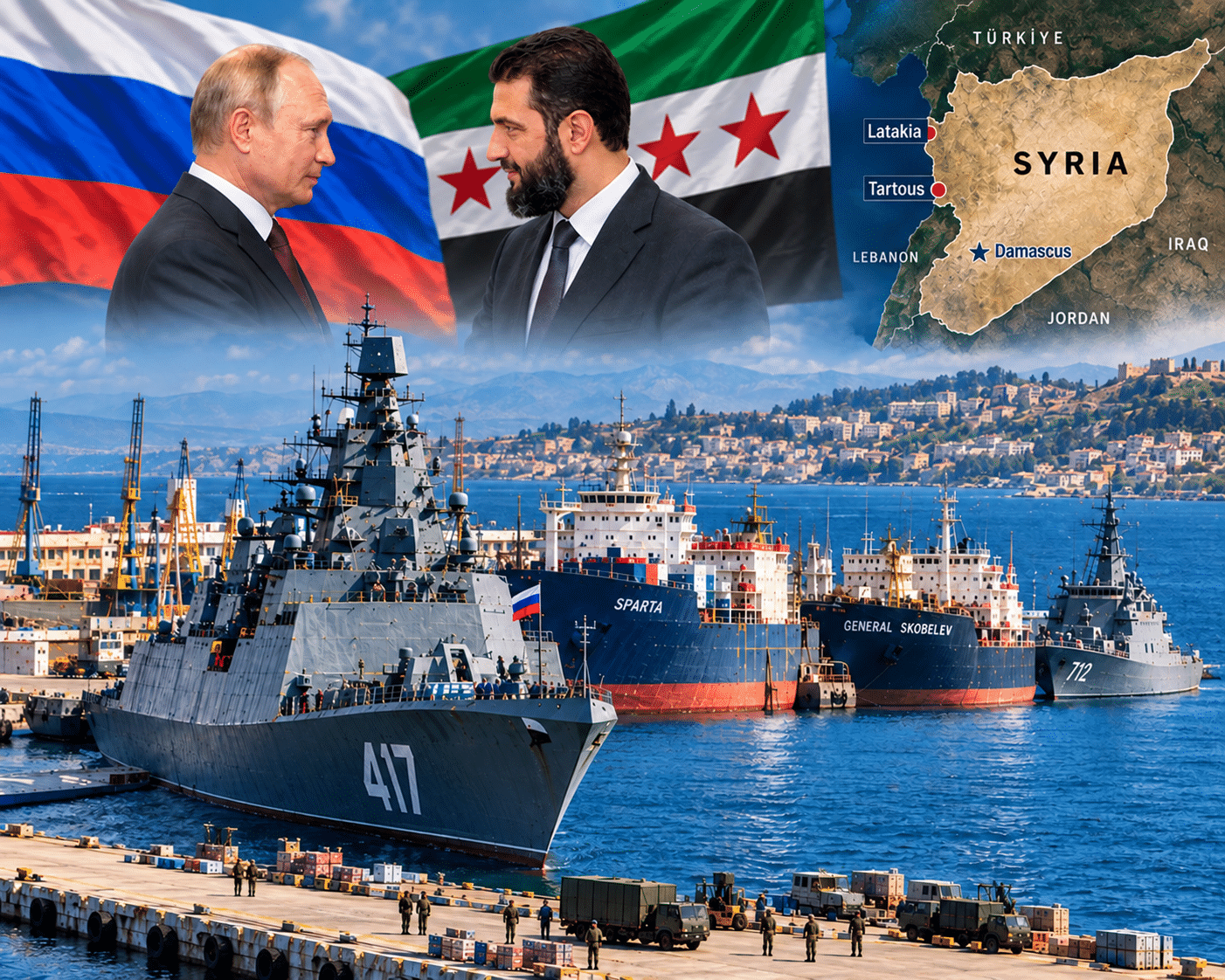
Russia has returned to Syria’s Mediterranean coast with a significant naval and logistical operation, sending a four-vessel convoy to Tartous in the first major resupply mission reported since Moscow and Damascus reached a new agreement on the future of Russia’s military presence in Syria.
The movement is more than a routine logistical operation. It offers an early glimpse into how a relationship once defined by Russia’s military backing of Bashar al-Assad is being reconstructed under Syria’s new political order.
The convoy reached Tartous on September 7, according to vessel movements tracked by Reuters and maritime intelligence company SynMax. It included the Russian Ro-Ro cargo ship Sparta, the naval replenishment vessel Akademik Pashin, the tanker General Skobelev, and the Udaloy-class destroyer Admiral Levchenko. Satellite imagery verified by Reuters showed Sparta and Akademik Pashin docked at Tartous, while General Skobelev remained offshore. A surveillance balloon was also observed over the port during the unloading operation.
According to a Syrian military source and a Russian-Syrian businessman familiar with the operation, Sparta unloaded supplies that included ammunition intended for Hmeimim and Tartous.
It arrived less than a month after Syria and Russia concluded a memorandum of understanding that fundamentally changed the framework governing Moscow’s military presence on Syrian territory.
From Russian Bases to Joint Training Centers
On August 9, Damascus announced that it had reached an agreement with Moscow after approximately 18 months of negotiations over the future of Russia’s facilities on the Syrian coast.
Under the memorandum, Syria would assume management of facilities designated for civilian use, including Hmeimim Airport and the fourth commercial berth at Tartous Port. At the same time, Russian military facilities would be transformed into joint training and qualification centers under a new arrangement designed to accommodate the interests of both countries.
Syria assumes greater responsibility for civilian infrastructure and sovereignty-related functions, while Russia retains a military presence under a revised legal and operational framework.
Hmeimim served as Moscow’s principal air base in Syria, while Tartous provided Russia with its only naval repair and replenishment facility in the Mediterranean. Together, the two locations enabled Moscow to sustain operations and project influence across the Mediterranean, Middle East and Africa.
The new arrangement therefore appears designed to preserve Russia’s strategic interests while giving Damascus a significantly greater role in managing its territory.
A Different Syria-Russia Relationship
The negotiations lasted approximately 18 months. Rather than allowing the relationship to collapse completely, the two sides ultimately negotiated a compromise that appears to recognize the interests of both governments.
For Syria, the agreement provides a pathway toward restoring greater state control over civilian infrastructure along the coast. For Russia, it preserves access to strategically valuable military facilities and allows Moscow to retain a presence in the eastern Mediterranean. The September convoy is therefore an early test of whether this compromise can function in practice.
Damascus Takes Back Civilian Infrastructure
Following the agreement, Syrian Foreign Minister Asaad al-Shaibani toured Latakia International Airport and Tartous Port, accompanied by senior Syrian officials. The visit followed the announcement that civilian facilities previously associated with Russia’s presence would return to Syrian state management.
The distinction between civilian and military functions could become one of the defining characteristics of the new Syrian-Russian relationship. That allows Damascus to emphasize national sovereignty while Moscow maintains a strategic foothold.
Why Tartous Still Matters to Moscow
For Russia, Tartous is not simply another naval facility. Its importance is geographic. The port provides Moscow with access to the Mediterranean without requiring its ships to depend entirely on facilities farther from Russia’s traditional sphere of influence. From Tartous, Russian naval and logistical assets can support operations across the Mediterranean and provide a link to Russia’s wider military presence in the Middle East and Africa.
The airport near Latakia, Hmeimim, serves a complementary function from the air. Together, the two installations form an integrated strategic network.
A New Model of Military-Technical Cooperation
Syria remains connected to Russia through military equipment, technical expertise, energy, grain and other economic sectors.
Russia, meanwhile, retains important interests in Syria, including its strategic military facilities, existing economic relationships and broader geopolitical position. The Russian Foreign Ministry said the August memorandum would strengthen bilateral military cooperation and establish a new legal framework for that cooperation under changed circumstances.
The Strategic Message of the Convoy
The September convoy may therefore carry a message beyond the cargo it delivered. Its arrival demonstrates that Russia continues to possess the logistical capacity to reach Syria’s coast and sustain its military infrastructure. The presence of a Russian naval destroyer alongside logistical and tanker vessels further highlights the military character of the operation.
Yet the most important element is political. The convoy arrived after Damascus and Moscow had publicly agreed on a new framework. The August agreement and September developments is a relationship based less on unilateral military privilege and more on negotiated cooperation.
The Beginning of a New Chapter
The Syrian coast is consequently becoming the testing ground for a new chapter in relations between Damascus and Moscow.
The August memorandum established a framework, while its implementation will require further negotiations over military personnel, logistics, training arrangements, infrastructure, security responsibilities and the precise boundaries between Syrian and Russian authority.
While Syria is reclaiming civilian facilities, such as the civilian use of the airport, Russia is retaining military access to the airport and naval port.
The arrival of the Russian convoy at Tartous therefore represents more than the movement of ships. It is an early physical manifestation of a diplomatic compromise reached after 18 months of negotiations.
For Moscow, it demonstrates that the its Syrian presence remains, and for Damascus, it demonstrates that maintaining relations with Russia does not require the political and military arrangements of the past.
Syria, while opening a new chapter in its international relations, is attempting to ensure that its strategic territory is governed according to arrangements negotiated with the state itself rather than inherited from the previous era.
The Russian ships at Tartous have provided the clearest early signal that Moscow and Damascus are not ending their relationship; they are rebuilding it.
Steven Sahiounie is a two-time award-winning journalist.

