


Steven Sahiounie, journalist and political commentator
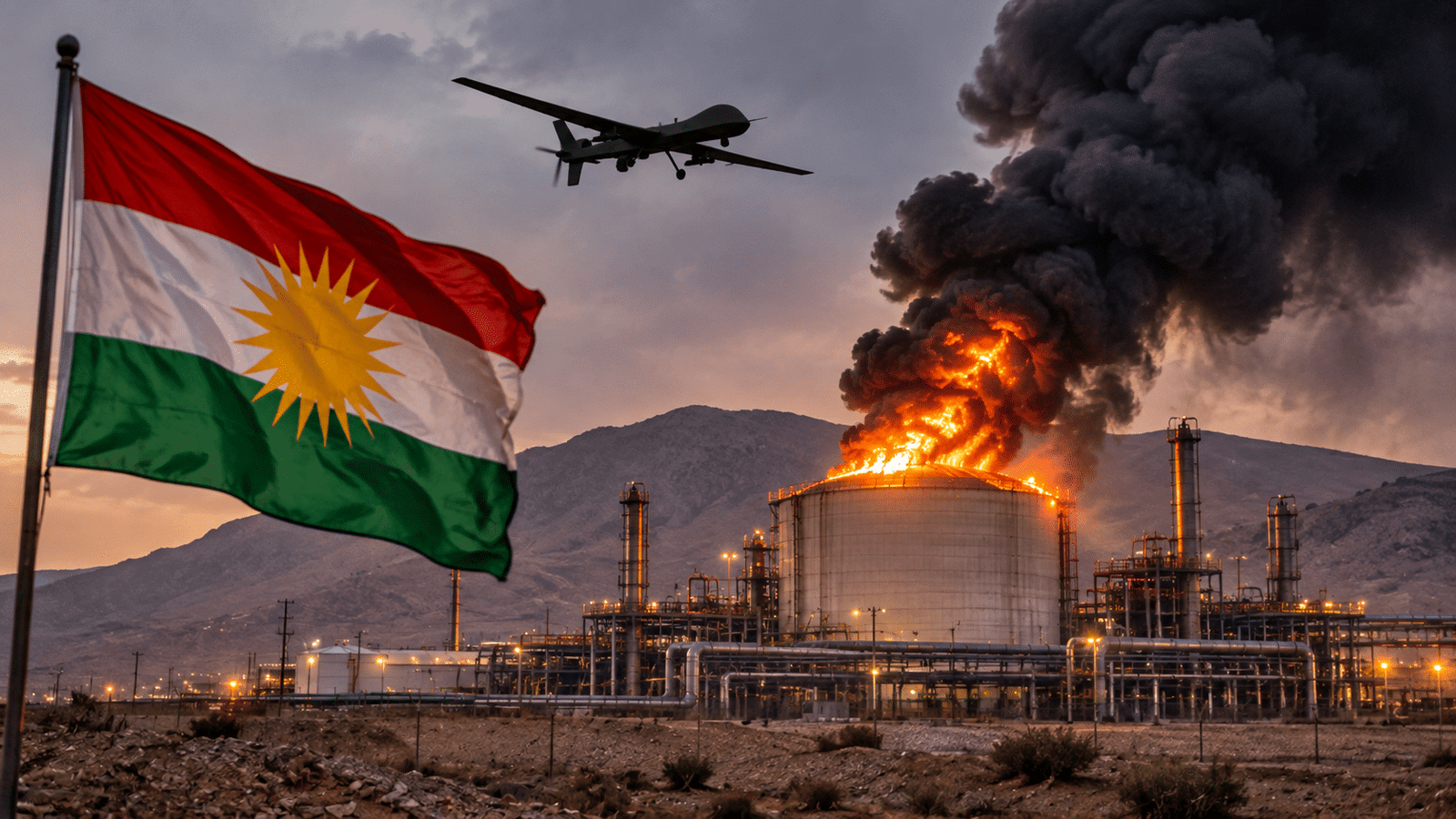
A drone attack on the Khor Mor gas field in Iraq’s Kurdistan Region has forced a suspension of gas supplies to power stations across the region, resulting in an estimated loss of 2,500 to 2,800 megawatts of electricity. The attack reportedly targeted a liquefied petroleum gas (LPG) storage tank, sparking a fire that remains ongoing. Workers were evacuated to safe areas within the facility, with initial assessments indicating no casualties. No group has claimed responsibility for the attack. Khor Mor, one of the region’s largest gas fields, supplies most of its power stations and has been targeted by several drone attacks in recent years.
The future of the relationship between Baghdad and Erbil involves power, economics, and internal political party crises across both federal Iraq and the semi-autonomous Kurdistan Region.
Journalist Steven Sahiounie interviewed Binar Faeq Karim, an Iraqi Kurdish political and security analyst specializing in Middle Eastern affairs, with a particular focus on regional security, geopolitics and conflict dynamics.
1. Steven Sahiounie (SS): Following the Patriotic Union of Kurdistan announcement of its withdrawal from the the Kurdistan Regional Government and its threat to establish a parallel administration in Sulaymaniyah, are we witnessing a temporary political crisis or a deeper political and administrative split?
Binar Faeq Karim (BFK): This crisis has been building for almost two years, reflecting fundamentally different approaches between the two parties to power-sharing and governance in the Kurdistan Region. The Kurdistan Democratic Party considers the recent parliamentary session legitimate, while the the Patriotic Union of Kurdistan rejects it, arguing that it violates political partnership and was conducted unilaterally.
Bafel Talabani’s announcement of the The Patriotic Union of Kurdistan withdrawal from the caretaker government, followed by his stated intention to establish parallel institutions,, marks a significant development. I would not yet conclude that a formal division into two administrations is inevitable, but the possibility can no longer be dismissed. The consequences would extend beyond political appointments, affecting institutional coordination, economic policy, energy management and the delivery of public services. Ultimately, the question is whether both parties can continue to operate within a shared political and administrative framework.
2. SS: Following the withdrawal of US forces from Iraq, and amid escalating regional tensions, how will the reduced American military presence affect the security and political balance in Iraq and the Kurdistan Region? Could Iran benefit from this shift to further expand its influence within Iraqi institutions?
BFK: The conclusion of the US-led coalition’s military mission in Iraq represents an important change in the country’s security environment. Iraqi forces, including the Peshmerga, will now have greater responsibility for countering ISIS remnants and maintaining security, while the nature of US-Iraq security cooperation shifts towards a bilateral framework.
The main concern is whether Iraqi security institutions have sufficient capabilities, coordination and political backing to manage this transition. Iran could benefit from any weakening of the security environment or gaps in state authority, particularly through its established political and security networks in Iraq. However, I would not describe this as an automatic transfer of influence to Iran. Its influence in Iraq predates the US withdrawal and is rooted in longstanding political, economic and security relationships. The extent to which it expands will also depend on the Iraqi government’s ability to strengthen state institutions and maintain control over security decisions.
3. SS: To what extent is Iraq’s political and security decision-making still influenced by Iran? Does the Iraqi government have the ability to make independent strategic decisions, particularly amid the ongoing US-Iranian confrontation and escalating regional tensions?
BFK: Iran continues to have considerable influence over Iraq’s political and security landscape. This influence is exercised through longstanding relationships with political parties, armed groups, economic networks and other actors within the country’s political system. Some armed factions maintain close ties with Tehran, while others are formally integrated into Iraq’s security structures.
However, it would be inaccurate to suggest that all Iraqi political and security decisions are made under Iranian direction. Iraq has its own national interests, institutions and political calculations, and successive governments have attempted to maintain working relationships with both Iran and the United States.
The real challenge is the Iraqi government’s ability to translate its formal authority into effective control over strategic decisions, particularly regarding security and foreign policy. Amid the current US-Iranian confrontation, Baghdad faces a difficult balancing act: preventing Iraqi territory from becoming an arena for regional conflict while protecting its sovereignty and maintaining relations with both sides.
4. SS: Turkey continues to view the the Kurdistan Workers’ Party presence in northern Iraq as a threat to its national security and conducts military operations inside Iraqi territory. Is Ankara pursuing security objectives alone, or are its actions part of a broader strategy to expand its political, military and economic influence in the Kurdistan Region and Mosul?
BFK: Turkey’s military presence and cross-border incursions in northern Iraq should be examined within a broader political and strategic context. While Ankara officially justifies its operations on the grounds of countering the The Kurdistan Workers’ Party, its growing military footprint also has implications for Iraq’s sovereignty and the balance of influence in northern Iraq.
Ankara’s engagement with Iraq extends well beyond security. Over the past decade, Turkey has significantly expanded its economic, diplomatic and political presence through trade, investment, infrastructure, energy and water agreements.
For example, Turkey is one of Iraq’s major trading partners, while its economic and infrastructure interests extend from the Kurdistan Region to Mosul and other parts of northern Iraq. The Development Road project and agreements concerning water management and energy also demonstrate the broader strategic importance Ankara attaches to its relationship with Baghdad.
Water is another important dimension. Iraq depends heavily on the Tigris and Euphrates river systems, and developments in Turkey’s upstream water infrastructure and management have significant implications for Iraq’s water security. This makes water management an important issue in bilateral relations and gives Ankara considerable leverage in negotiations.
Therefore, I would see Turkey’s approach as a combination of stated security priorities and broader economic and geopolitical interests in Iraq. These objectives are not necessarily contradictory; they can reinforce one another.
5. SS: Is the Kurdistan Democratic Party–PUK dispute merely a struggle over political positions and economic resources, or does it reflect a deeper rivalry between two political projects aligned with different regional powers, particularly Turkey and Iran? Could this conflict ultimately weaken the Kurdistan Region’s autonomy?
BFK: The Kurdistan Democratic Party–The Patriotic Union of Kurdistan rivalry is much deeper than a competition over government positions and economic resources. It has historical roots and reflects different political structures, geographical power bases and approaches to governance, relations with Baghdad and engagement with neighboring countries.
Their respective relationships with regional powers are also an important dimension. The Kurdistan Democratic Party has historically maintained close relations with Turkey, while the the Patriotic Union of Kurdistan has longstanding ties with Iran. However, it would be an oversimplification to view the two parties merely as representatives of competing regional powers. Both have their own political interests and maintain relationships with multiple regional and international actors.
The greater concern is the impact of this rivalry on the Kurdistan Region’s political autonomy. A divided Kurdish leadership inevitably has less leverage in negotiations with Baghdad over issues such as budget allocations, oil revenues, disputed territories and constitutional powers. Internal divisions also make it more difficult for the Region to present a unified position on security and foreign policy. In this sense, continued rivalry could strengthen Baghdad’s position in dealing with Erbil and gradually weaken the Region’s ability to exercise its constitutionally recognized authority.
6. SS: Could we witness a political or even military confrontation between Baghdad and Erbil in the coming period, particularly if disagreements over oil, financial resources and the constitutional powers of the Kurdistan Region continue? Or do both sides recognise that any escalation would ultimately serve regional actors at Iraq’s expense?
BFK: At this stage, I do not see a direct military confrontation between Baghdad and Erbil as the most likely scenario. Both sides have political and economic reasons to avoid such an escalation, particularly given the wider instability across the region and Iraq’s existing security and economic challenges.
However, the possibility of further political and financial confrontation remains real. Disagreements over oil exports, federal budget allocations, public-sector salaries and the constitutional division of powers have repeatedly strained relations between Baghdad and Erbil. If these disputes remain unresolved, they could lead to further institutional tensions, legal challenges and unilateral political or economic measures.
The greater risk is that continued confrontation will weaken coordination between the federal government and the Kurdistan Region at a time when both need greater cooperation. Ultimately, ordinary citizens are likely to bear the consequences through economic uncertainty, interruptions in public services and further delays in resolving longstanding issues.
Steven Sahiounie is a two-time award-winning journalist.

