


By: Steven Sahiounie, journalist and political commentator
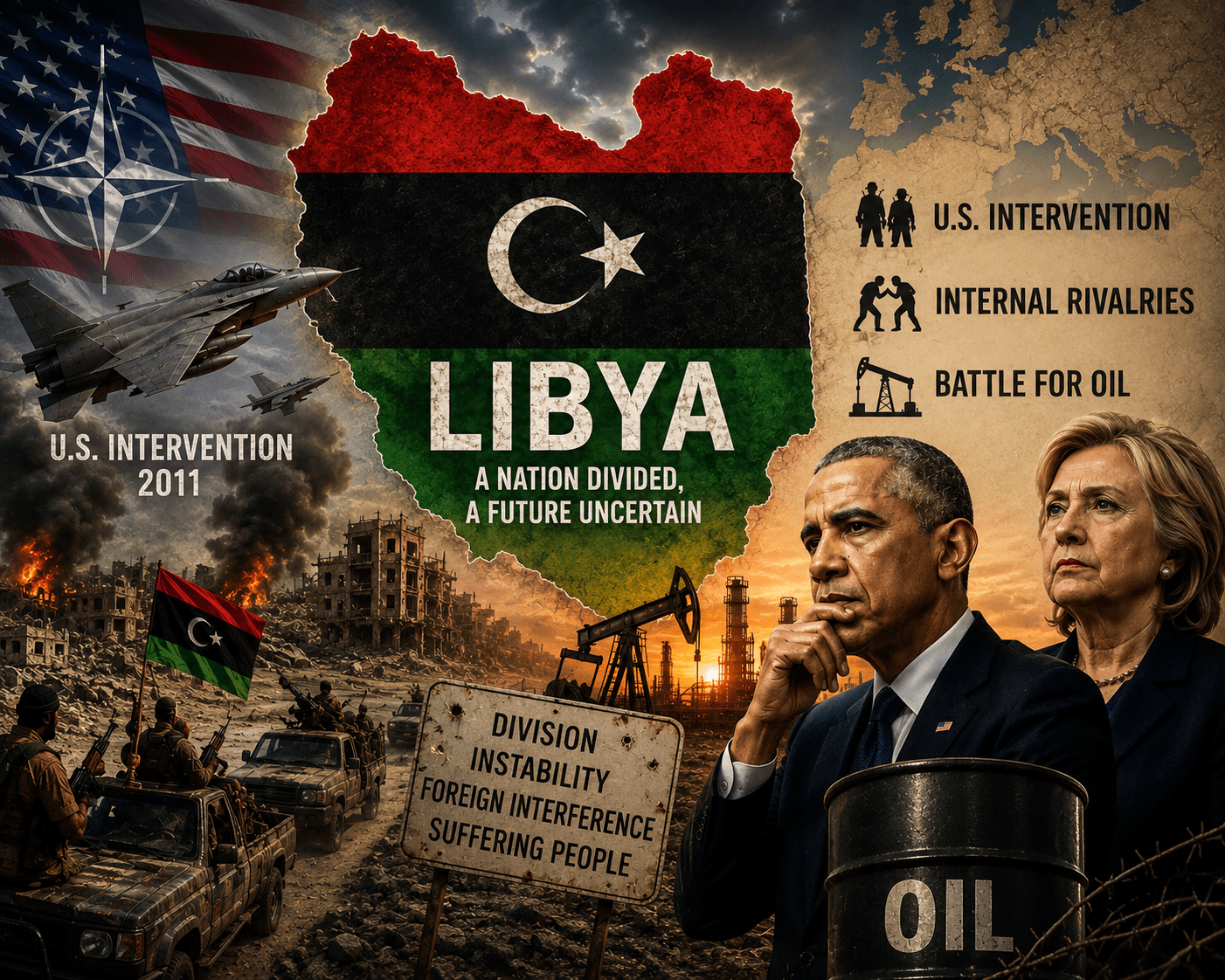
Libya’s conflict and instability today is caused by the U.S.-NATO attack in 2011 for regime change. U.S. President Obama and Secretary of State Hillary Clinton destroyed Libya’s political and security structures and contributed to the country’s subsequent fragmentation.
Since the killing of former Libyan leader Muammar Gaddafi, Libya has remained trapped in a cycle of internal conflict, political division and institutional fragmentation. The country has also increasingly become an arena for international and regional competition, driven by its strategic geographic position close to Europe and, above all, its enormous natural resources, particularly oil and gas.
Foreign powers have sought to cultivate relationships with competing Libyan factions in an effort to advance their own political, economic and strategic interests. As a result, Libya’s domestic divisions have become intertwined with broader regional and international rivalries, making the path toward a unified state increasingly complicated.
Turkey Sees “Positive” Signs in Unification Talks
Turkish Foreign Minister Hakan Fidan said he had developed a positive impression of negotiations aimed at unifying eastern and western Libya, stressing that Ankara would continue to play what he described as a constructive role as a mediator.
Speaking to journalists on August 12 in Tripoli and Benghazi, Fidan said, “Unfortunately, we have witnessed a very troubled period in Libya since the beginning of the revolution, over the past 15 years.”
Fidan also pointed to the growing construction activity in both Tripoli and Benghazi, highlighting the role of Turkish construction companies in major projects and describing the development as evidence of strengthening bilateral cooperation between Turkey and Libya.
Yet beneath these diplomatic and economic developments, Libya remains deeply divided politically, militarily and institutionally.
The Killing of Major General Fawzi Al-Mansouri
The killing of Major General Fawzi Al-Mansouri on August 10, was far more than the assassination of a senior military official in eastern Libya.
Al-Mansouri had commanded the Sabha region for years before becoming head of military intelligence. He was killed in Benghazi at a time when increasing questions were being raised about networks transporting weapons and fuel across the Sahara toward Sudan and Chad.
Did Al-Mansouri possess information about these networks, or was his assassination connected to another struggle over influence, intelligence and control?
Authorities in eastern Libya have remained largely silent regarding the motive for the killing and those responsible. Observers and analysts, however, believe the assassination could be linked to internal power struggles, political and security rivalries, regional intersections, or weapons-smuggling networks and logistical supply routes allegedly supporting Sudan’s Rapid Support Forces.
The Libyan National Army said it would “not stop fighting terrorism” and would continue its efforts to achieve stability, security and the unification of Libya’s institutions.
Drone Attacks Threaten Libya’s Oil Industry
The National Oil Corporation announced on Tuesday that a drone had targeted the Zawiya oil refinery complex, the country’s largest operating refinery, marking the fifth attack.
The latest attack followed an earlier incident in which a drone fell near a primary oil tank and a network of pipelines at the Zawiya oil blending and packaging facility.
The corporation warned that if the attacks continued, it could be forced to declare force majeure and completely suspend operations at the refinery.
Libya possesses Africa’s largest proven oil reserves, making its energy infrastructure not only a vital source of national revenue but also a major strategic asset in the broader regional struggle for influence.
The situation escalated further on August 10 when a fuel tank with a capacity of approximately 4.5 million liters was reportedly directly targeted in the western Libyan city of Zawiya, west of Tripoli.
The National Oil Corporation said that a tank designated to store automotive gasoline was directly struck, triggering an intense fire before the tank eventually collapsed.
The repeated attacks have raised serious concerns over the vulnerability of Libya’s critical infrastructure and the possibility that economic and energy facilities are becoming targets in broader political and security struggles.
Libya’s Prime Minister Abdul Hamid Dbeibah had previously held an extensive military and security meeting in Tripoli, calling for a firm response to any challenges or actions threatening vital facilities.
Can Foreign Pressure Produce a Genuine Political Settlement?
Washington, Ankara and other regional actors have intensified their contacts with different Libyan political and military forces in an attempt to promote a political settlement.
Journalist Steven Sahiounie interviewed Political writer and international affairs researcher Ahmed Arabi argues that Libya continues to suffer from extensive regional interference, with different foreign actors seeking to advance their own interests by supporting competing Libyan forces.
According to Arabi, this external struggle for influence is contributing to internal polarization and obstructing efforts to establish and preserve an independent Libyan state.
He believes that external pressure alone is unlikely to produce a genuine political settlement and that the prospects for the success of international initiatives aimed at resolving Libya’s political crisis remain weak.
Arabi points to two parallel mediation efforts: the roadmap proposed by the United Nations Support Mission in Libya in August of last year, and an initiative presented by U.S. presidential adviser for Arab affairs Massad Boulos in April of this year.
Despite the international momentum behind these initiatives, Arabi warns that if Libyans do not see tangible progress toward elections, accountability and state-building while political elites continue to benefit from international mediation efforts, public support for those initiatives will decline.
In such circumstances, international mediation could ultimately become a factor contributing to the continuation of the crisis rather than its genuine resolution.
Rising Prices, Electricity Cuts and Growing Public Anger
Libya has witnessed popular protests in Tripoli and several cities in the western part of the country, with demonstrators demanding improved basic services.
Long electricity outages during the summer have become a major source of public anger. Protesters have also demanded the removal of the Government of National Unity, accusing the authorities of failing to end political dysfunction and institutional paralysis.
The electricity crisis has once again fueled demonstrations in western Libya. Protesters recently blocked the coastal road at the entrance to Sabratha amid tensions with neighboring Sorman.
Protesters have demanded an end to prolonged electricity cuts, fairer distribution of electricity among different areas and improvements in public services.
Residents have also threatened to escalate their actions, including civil disobedience and the closure of entrances and exits to their city if their demands are not addressed.
They have called for investigations into the causes of the deteriorating services and accountability for those responsible.
Arabi believes these developments could place the Government of National Unity under simultaneous political and social pressure, particularly as service-related demands increasingly intersect with security tensions and political divisions.
Who Is Behind the Drone Attacks?
The latest security escalation raises perhaps the most difficult question: Who is behind the drone attacks targeting oil and energy infrastructure, and what political or security objective are the perpetrators seeking to achieve?
Arabi notes that only hours after Prime Minister Abdul Hamid Dbeibah warned that those involved in drone attacks against oil facilities would be held accountable, another drone attack targeted an electricity facility south of Zawiya.
The new attack came as the Tripoli-based government faced mounting pressure to contain security tensions in Zawiya, particularly given its previous relationships and understandings with several influential armed formations in western Libya.
Arabi argues that Libya’s political authorities face a complicated security environment in which armed groups, political factions, economic interests and foreign actors overlap.
He further argues that some Libyans increasingly view developments in the country, as well as the U.S.-backed political framework associated with them, as supporting a political system that distributes influence through international recognition, commercial agreements and international relationships rather than through effective governance and genuine state-building.
Libya’s Future Remains Uncertain
The continued division between eastern and western authorities, competing military structures, American intervention, economic grievances, weak public services and attacks against critical infrastructure all demonstrate that the underlying causes of Libya’s crisis remain unresolved.
Whoever possesses political or military influence over Libya’s energy infrastructure has considerable leverage over the country’s economy and its international relationships, while Libya’s strategic location makes it impossible to separate its domestic crisis from the wider geopolitical competition involving the Mediterranean, North Africa, Europe and the Middle East.
Turkey is presenting itself as a constructive mediator and economic partner, while Washington is pursuing its own diplomatic initiatives. Meanwhile, Libyan factions continue to compete for political legitimacy, security control and access to resources.
The question is whether Libyans themselves will eventually be able to establish a unified political and security framework capable of controlling the country’s territory, protecting its resources, rebuilding its institutions and holding political and military actors accountable.
If the attacks on Libya’s vital infrastructure continue, while economic hardship and political frustration deepen, the country could once again find itself dangerously close to a new cycle of instability—one that would threaten not only Libya, but the wider North African and Mediterranean region.
Steven Sahiounie is a two-time award-winning journalist.

